How Many Sea Turtles Are Left? A 2026 Look by Species
Overview
Sea turtles have been swimming the oceans for over 100 million years, but the last century has been rough on them. So how many sea turtles are actually left today? It is a fair and important question, and the answer is more complicated, and in some ways more hopeful, than you might expect. There is no single tidy number for the world’s sea turtles, but scientists track their populations closely, and the 2026 picture is a genuine mix of good news and bad. Some species are bouncing back in encouraging ways, while others remain dangerously close to the edge. This guide walks through how sea turtles are counted, where each of the seven species stands, and what it all means for Hawaii’s beloved honu.
The Short Answer: No Exact Count, But a Clear Picture
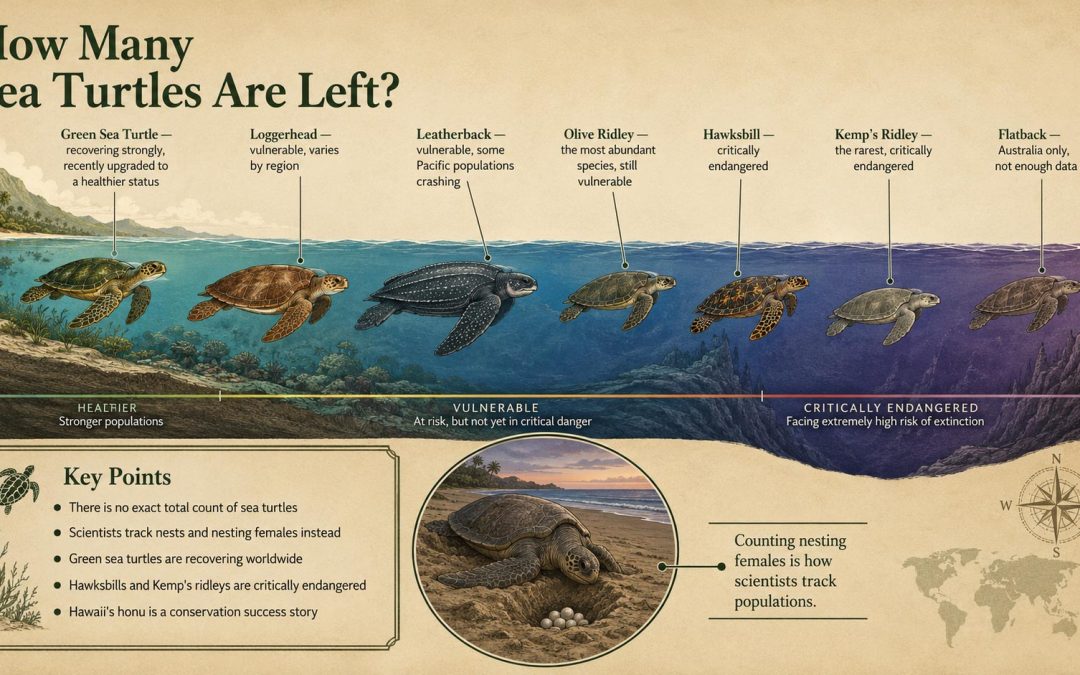
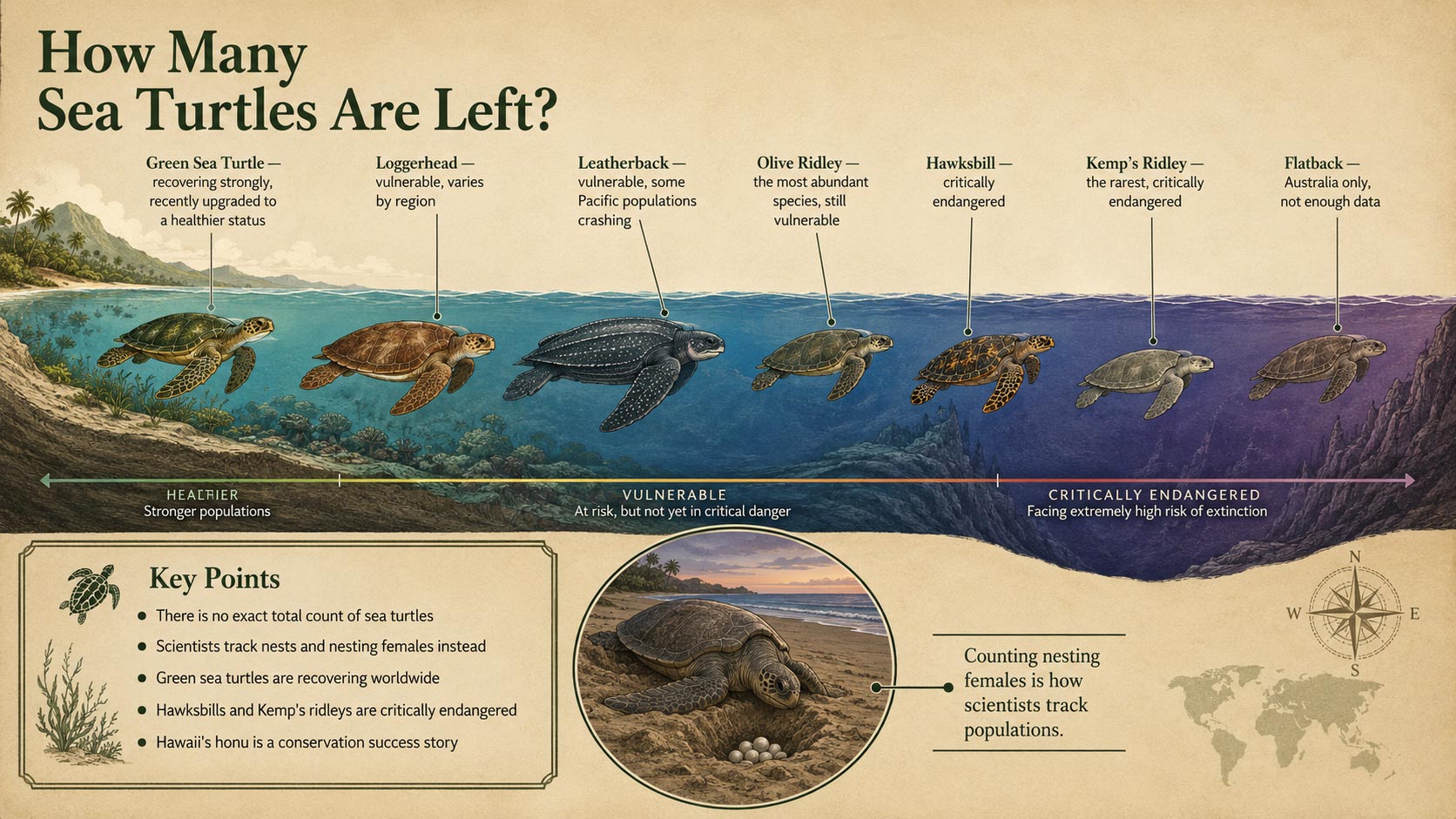
Let us be honest right away. Nobody can give you a precise total number of sea turtles alive in the world. These animals spend most of their lives spread across vast oceans, underwater and far from shore, which makes counting them directly nearly impossible. What scientists can do is track trends, and the overall message for 2026 is cautiously encouraging. Thanks to decades of conservation work, several sea turtle populations are rebounding, with more nests being counted at many beaches around the world. At the same time, a couple of species are still in serious trouble. So sea turtles as a whole are doing better than they were a few decades ago, but the recovery is uneven and far from finished.
How Do Scientists Count Sea Turtles?
Since you cannot line up every sea turtle in the ocean and count heads, researchers use a clever workaround. They count nesting females on beaches. Because female turtles return to shore to lay their eggs, and often come back to the same regions year after year, counting nests and nesting mothers gives scientists a reliable way to measure whether a population is growing or shrinking over time. This is why you often hear sea turtle numbers described as nesting females rather than a grand total. It is not the whole population, but it is the best window we have, and rising nest counts are one of the clearest signs that conservation is working.
The Seven Species and Where They Stand
There are seven species of sea turtle in the world, and each one has its own story and its own level of risk. Their conservation status is tracked on the global Red List, which sorts species into categories from healthy to on the brink. Here is a quick rundown of the seven:
- Green sea turtle, the honu of Hawaii, recovering strongly and recently upgraded to a much healthier global status
- Loggerhead sea turtle, listed as vulnerable, with populations that vary a lot by region
- Leatherback sea turtle, the giant of the group, vulnerable overall with some Pacific populations in serious decline
- Olive ridley sea turtle, the most abundant sea turtle, still listed as vulnerable despite its numbers
- Hawksbill sea turtle, critically endangered and one of the most at-risk of all
- Kemp’s ridley sea turtle, the rarest species, also critically endangered
- Flatback sea turtle, found only around Australia, with too little data for a firm status
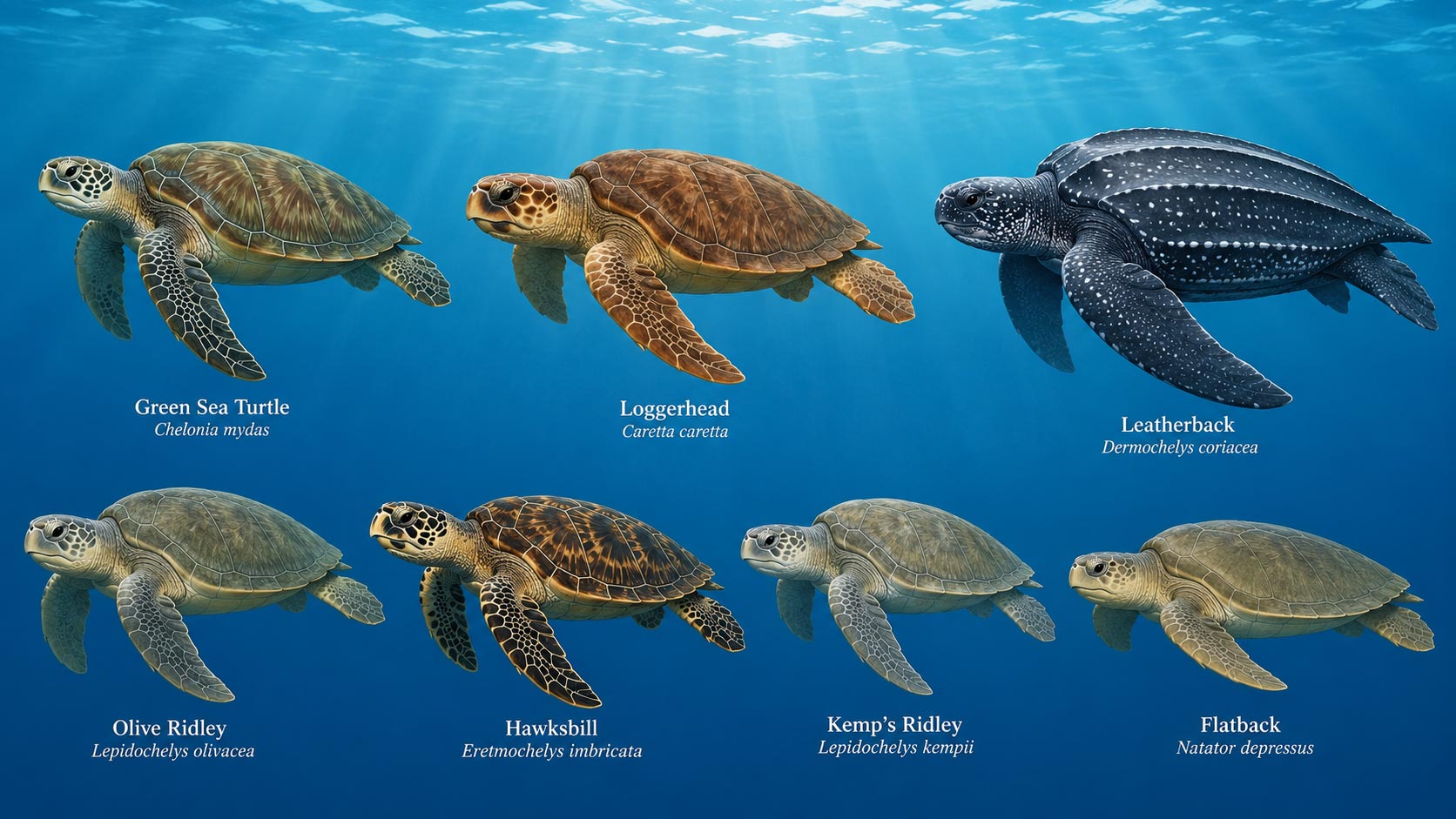
As you can see, it is not one story but seven, ranging from genuine success to genuine crisis.
Good News: The Green Sea Turtle Comeback
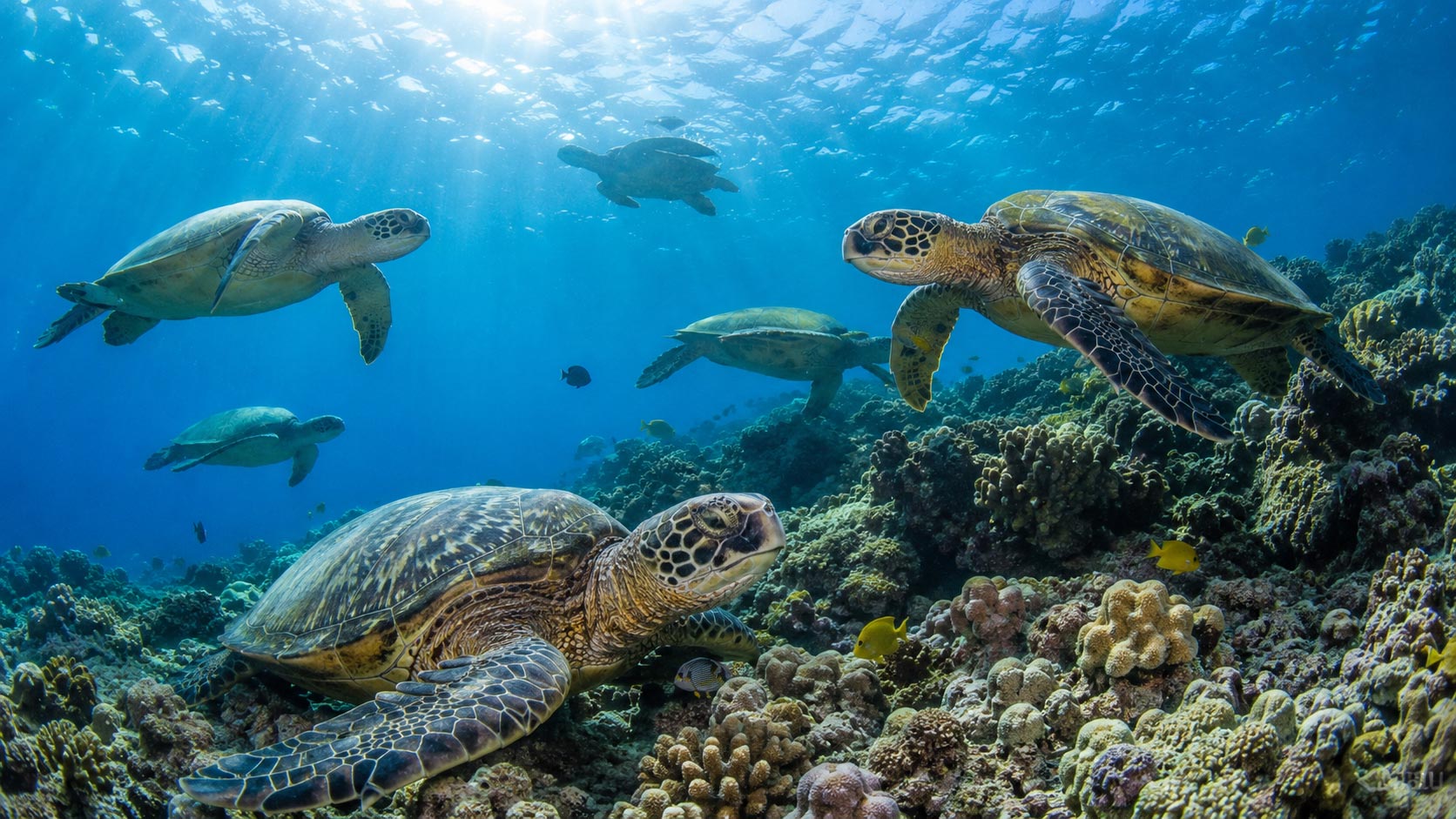
Here is the headline that surprises a lot of people. The green sea turtle, the same species you snorkel with in Hawaii, has made a remarkable recovery. After decades of protection, its global numbers have climbed significantly, and in a major milestone the green sea turtle was recently reassessed to a far healthier global conservation status than it held for years. Nest counts at many green turtle beaches around the world have been rising, a direct result of protecting nesting sites, reducing hunting, and cutting down on accidental capture in fishing gear. It is one of the clearest proofs that when people commit to protecting sea turtles, the turtles respond. That said, the recovery is not uniform, and some regional green turtle populations still face real threats, so it is progress to celebrate carefully, not a finished job.
Still in Trouble: Hawksbills and Kemp’s Ridleys
Not every species shares in the good news. The hawksbill sea turtle remains critically endangered, the most severe risk category before extinction in the wild. Hawksbills were hunted for generations for their beautiful shells, and they still face habitat loss and reef decline, leaving their numbers a fraction of what they once were. The Kemp’s ridley, the smallest and rarest sea turtle in the world, is also critically endangered. Once nearly wiped out, it has clawed back slightly thanks to intense protection, but it remains perilously close to the edge. The giant leatherback is another worry, especially in the Pacific, where some populations have crashed dramatically. These species are powerful reminders that the fight is far from over.
The Hawaiian Honu: A Conservation Success Story
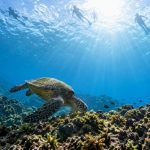
Hawaii offers one of the best examples of a sea turtle recovery anywhere. The Hawaiian green sea turtle, or honu, was in real trouble decades ago, but strong legal protection since the 1970s changed everything. Today the honu is a familiar and beloved sight, basking on beaches and gliding over reefs across the islands. Seeing green sea turtles regularly at places like Turtle Canyon off Waikiki is only possible because of that recovery. It is a living, local example of how protection pays off, and a big reason Hawaii takes honu conservation so seriously. If you want the details, our article on the honu comeback digs into just how far these turtles have come.
Why the Numbers Are Still Fragile
Even with the good news, sea turtles are not out of the woods, and their recovery can be undone. These animals still face a long list of threats, and because they take decades to mature, populations rebuild slowly and can be knocked back quickly. The biggest dangers today include:
- Accidental capture in fishing gear, one of the leading causes of sea turtle deaths
- Plastic pollution, which turtles mistake for food or become tangled in
- Loss of nesting beaches to development, erosion, and bright artificial lights
- Warming oceans and changing temperatures that affect nesting and even the sex of hatchlings
Because only a tiny fraction of hatchlings ever survive to adulthood, every threat to eggs, hatchlings, and breeding adults matters enormously. Progress is real, but it is fragile.
What This Means and How You Can Help
The takeaway for 2026 is a hopeful but honest one. Sea turtles overall are doing better than they were a generation ago, with green turtles leading a genuine comeback, yet species like the hawksbill and Kemp’s ridley still need urgent help. The good news is that everyday choices make a difference. You can help by using reef-safe sunscreen, cutting down on single-use plastic, never disturbing turtles or their nests, and supporting groups that protect nesting beaches. When you snorkel with honu in Hawaii, keeping a respectful distance is part of that same effort. Every small action adds up, and the green sea turtle’s rebound proves that our choices really can bring these ancient animals back.
Watch: Hawaii’s Green Sea Turtles
A Hopeful, Unfinished Story
So how many sea turtles are left? There is no perfect number, but the trends tell a powerful story. Around the world, sea turtles are slowly recovering, led by the remarkable comeback of the green sea turtle, while the critically endangered hawksbill and Kemp’s ridley remind us how much work remains. Hawaii’s honu stands as proof that protection works, an animal brought back from real danger to become a treasured part of the islands. The next time you watch a green sea turtle glide peacefully over a Hawaiian reef, you are seeing a conservation success in motion, and a reminder that the story of sea turtles is still being written, one protected nest and one respectful encounter at a time.