The Flatback Sea Turtle: Australia’s Best-Kept Ocean Secret
Of all seven sea turtle species swimming in Earth’s oceans today, the flatback is the one most people have never heard of. It does not roam the open Pacific. It does not nest in Hawaii or the Caribbean. It has never been spotted crossing ocean basins the way the leatherback or the loggerhead routinely do. Instead, the flatback sea turtle spends its entire life within a compact stretch of coastline, hugging the warm, shallow waters around Australia and Papua New Guinea, never venturing far from shore. That coastal loyalty makes it one of the most unusual and least understood sea turtles on the planet.
The flatback is the final species in a family of seven, and understanding it completes a picture that spans every ocean on Earth. You will not encounter one while snorkeling off the coast of Waikiki. But knowing this turtle exists, and knowing what makes it different from every other species, adds something real to the story of sea turtle life in the world’s oceans.
A Turtle Built for the Shallows
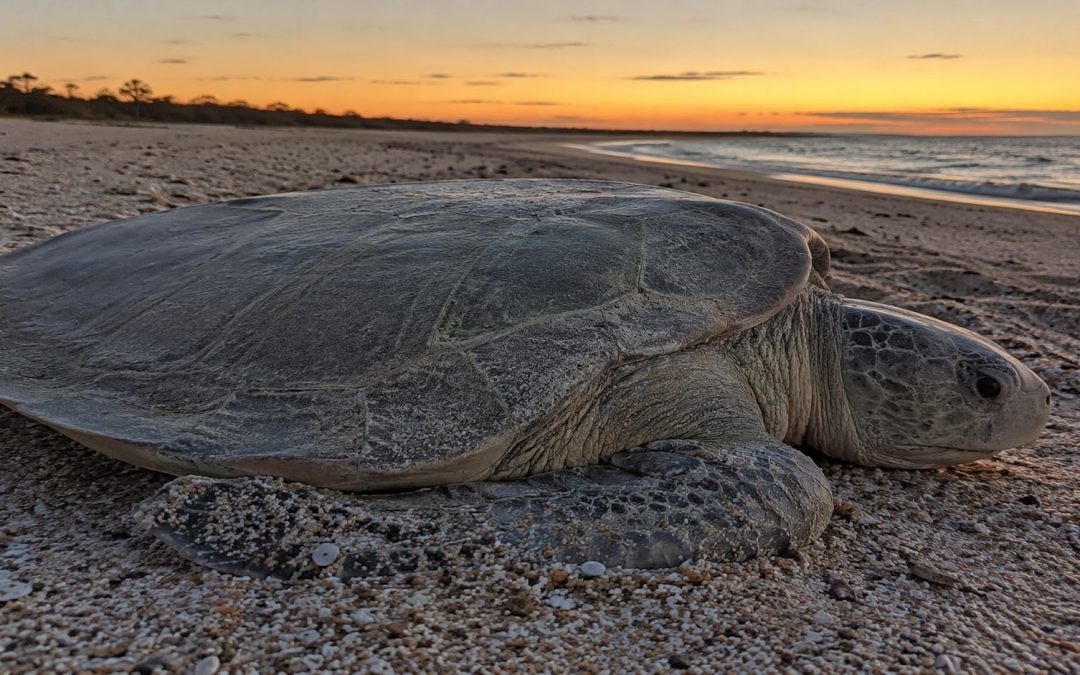
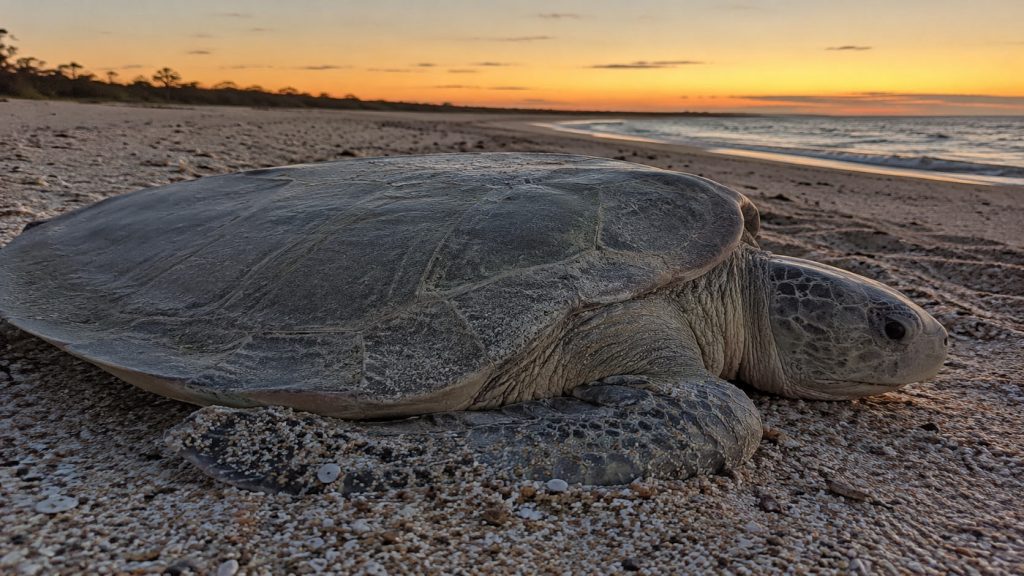
The flatback sea turtle carries the scientific name Natator depressus, and the species name says it all. Depressus is Latin for flattened, and the flatback’s carapace sits noticeably lower, rounder, and flatter than any other sea turtle species. Where other sea turtles have a high, domed shell suited for pushing through deep ocean currents, the flatback’s shell is built for a slower, shallower world.
Adult flatbacks typically measure between 2.5 and 3.5 feet in shell length and weigh between 154 and 220 pounds, though some individuals grow considerably larger, with documented weights reaching up to 770 pounds in rare cases. Their coloring leans olive-grey on top with pale cream edges and a creamy white underside. The shell surface is smooth and ridge-free, and the scales along the shell margin do not overlap the way they do on some other species. Each front flipper has a single claw, one more small detail that sets this turtle apart from its relatives.
The Only Sea Turtle That Never Leaves One Country
Every sea turtle species has a range, but the flatback’s range is singular in the reptile world. It is the only sea turtle that is both born and lives out its entire life within the waters of a single country. Its territory covers the continental shelf surrounding Australia, from Queensland in the northeast, through the Torres Strait at the top of the continent, and down through the Kimberley coast of Western Australia. It also ranges into the shallow waters off southern Papua New Guinea and southern Indonesia, but it stays entirely on the continental shelf and never moves into the open ocean.
This is a fundamental biological difference from every other sea turtle species. The leatherback, the loggerhead, and even the green sea turtle routinely travel thousands of miles across open ocean as part of their normal life cycles. The flatback skips all of that. It was born close to shore, it feeds close to shore, and it will nest close to shore for its entire adult life. Researchers believe this preference for inshore waters evolved because the continental shelf around northern Australia provides an abundance of the shallow coastal environments and soft seafloor habitats this species depends on. It is the smallest natural range of any sea turtle on Earth.
What Flatbacks Eat
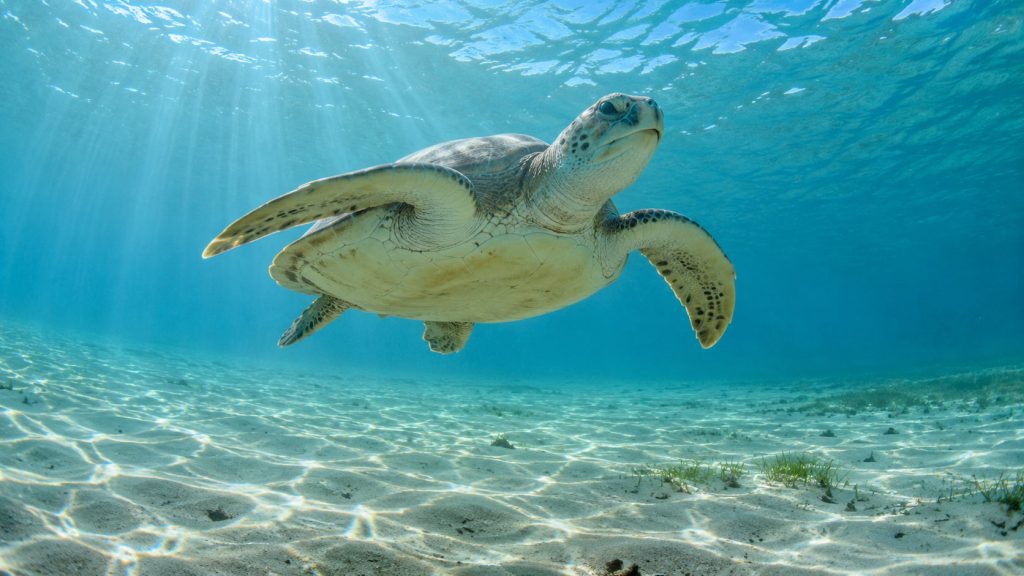
The flatback’s diet reflects the world it lives in. Because it forages in shallow, turbid coastal waters, bays, lagoons, and estuaries rather than on open-ocean seagrass meadows, its menu looks quite different from a green sea turtle’s. Flatbacks favor soft-bodied invertebrates found on or near the seafloor, including sea cucumbers, jellyfish, prawns, and mollusks. They also consume bryozoans, a group of tiny colonial marine animals that form coral-like crusts on hard surfaces, along with soft corals and seaweed when those are available. This varied, invertebrate-heavy diet is well suited to the murky, food-rich shallow waters the flatback calls home. Common items in a flatback’s diet include:
- Sea cucumbers and soft-bodied marine invertebrates
- Jellyfish and prawns
- Mollusks and marine worms
- Bryozoans and soft coral
- Seaweed and algae when available
Nesting on Australia’s Remotest Shores
Flatback sea turtles nest along the remote northern coast of Australia, with major nesting sites found at Curtis Island, Great Keppel Island, and Wild Duck Island in Queensland, the Torres Strait island groups, the Gulf of Carpentaria, and stretches of coastline along the Kimberley region of Western Australia. These beaches are typically isolated, difficult to access, and well away from heavy human activity, which has given flatback nesting grounds a degree of natural protection that other sea turtle species lack.
Female flatbacks return to nest every two to three years, laying up to four clutches during a single nesting season. Here is where the flatback breaks away from nearly every other sea turtle species in a meaningful way: it lays far fewer eggs per nest. While a loggerhead might deposit 100 eggs and a green sea turtle regularly lays 120 or more per clutch, a flatback female averages just 50 eggs per nest. Each egg is proportionally much larger than those of other species, and incubation takes approximately 55 days.
Bigger Hatchlings, Better Odds
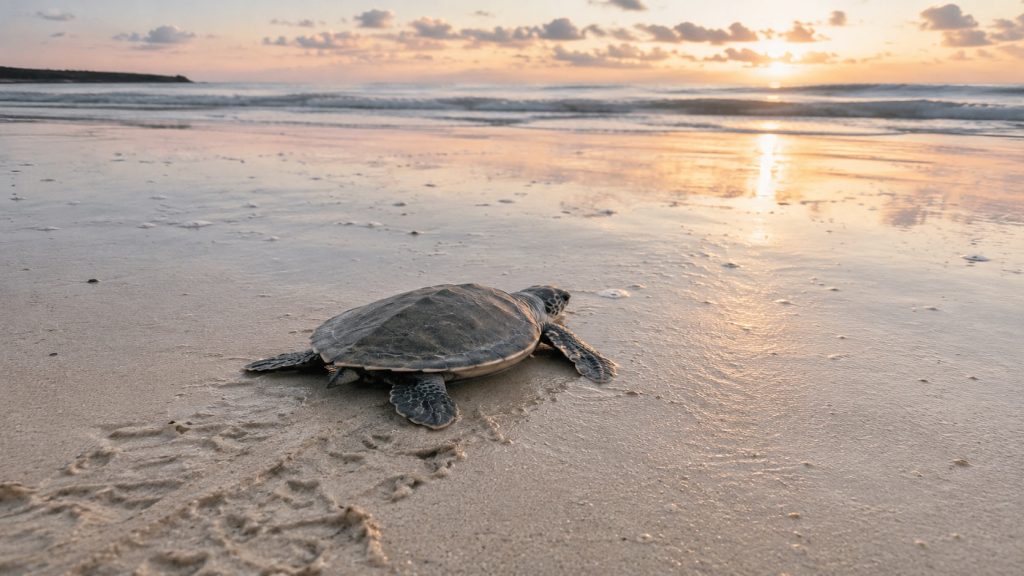
The trade-off between fewer eggs and larger ones turns out to be a genuine advantage for the hatchlings that survive incubation. Flatback hatchlings emerge noticeably bigger than hatchlings from any other sea turtle species, measuring around 60 millimeters in shell length at birth. That extra size means they are more physically capable from their first moments on the sand. They can swim harder, respond faster to threats, and have a slightly better chance of surviving those first dangerous minutes in the surf.
The nesting environment creates specific challenges that this larger size helps address. Flatback nesting beaches often have significant populations of predators including foxes, monitor lizards, and ghost crabs, all of which prey on hatchlings during the scramble from nest to ocean. Australian conservation programs focus on protecting hatchling emergence corridors and controlling artificial lighting near nesting grounds. Like all sea turtle hatchlings, flatbacks navigate toward the natural light of the open horizon to find the water. Coastal development lights can misdirect them fatally inland, making beach lighting control one of the most important tools in flatback conservation.
Conservation Status and What We Still Don’t Know
Australia lists the flatback sea turtle as Vulnerable within its borders. Internationally, the IUCN classifies it as Data Deficient, a classification that often confuses people. Data Deficient does not mean the species is doing well. It means researchers do not have enough consistent, long-term population data to make a confident global assessment of whether numbers are increasing or declining. Because the flatback nests in remote locations and has never been part of the large-scale international monitoring networks that track other sea turtle species, global population trends remain genuinely difficult to measure.
What researchers do know is that the current population of nesting females is estimated at roughly 20,000 to 21,000. A national recovery plan established in Australia in 2003 created a framework for protecting nesting beaches, monitoring key populations at sites like Kakadu National Park and Avoid Island in Queensland, and working to reduce bycatch from commercial fishing operations. Trawling nets, gillnets, and crab pots all pose ongoing risks to flatbacks in their inshore feeding habitats. The primary threats to the flatback sea turtle today include:
- Fishing bycatch from trawling, gillnets, and crab pot entanglement
- Coastal development destroying or fragmenting nesting beaches
- Predation on nests by foxes and other invasive species
- Pollution and ghost nets in coastal waterways
- Sea level rise and tropical storms affecting low-lying nesting beaches
A Species Hidden in Plain Sight
Part of why the flatback remains so little known outside Australia is that its entire world fits within one country’s coastline. All seven sea turtle species share the world’s oceans, but the flatback has never appeared on a beach in Hawaii, never been tracked crossing the Pacific, and never drawn the same level of international research attention as the green turtle or the leatherback. The conservation attention it does receive comes largely from Australian researchers, government agencies, and Indigenous communities who hold traditional connections to the flatback’s nesting beaches. Indigenous Australians carry non-commercial harvesting rights to this species under Australian law, a recognition of a relationship with the flatback that stretches back far longer than Western marine biology.
Seven Species, One Complete Picture
The flatback is the seventh and final piece of the sea turtle family. Alongside the green, hawksbill, leatherback, loggerhead, olive ridley, and Kemp’s ridley, it fills the last chapter in the story of these ancient ocean reptiles. Each species evolved to occupy a different niche in the world’s oceans, and the flatback’s niche is the warm, shallow coastal world of northern Australia.
When you snorkel with Hawaiian green sea turtles at Turtle Canyon off the coast of Waikiki on one of our tours departing from Kewalo Basin Harbor in Honolulu, you are swimming alongside one species in a family of seven. The honu gliding through the reefs at Turtle Canyon are among the best-studied and most actively protected sea turtles on Earth, a product of decades of conservation work under federal law. The flatback’s story is quieter, playing out on remote Australian beaches far from Waikiki, but it is driven by the same recognition that shapes every conversation about the honu: every sea turtle species matters, and none of them can afford to be overlooked.
One Continent, One Turtle, One Story Worth Telling
For a family of animals famous for epic ocean crossings, the flatback made a different choice. No trans-Pacific migrations. No open-ocean journeys. Just the warm, turbid shallows of northern Australia, a flat shell shaped for coastal life, and nesting beaches that most people on Earth have never heard of. It laid fewer eggs than any other species, but made them bigger. It kept the smallest range of any sea turtle in the world, but worked every corner of it. The flatback may be the least-traveled sea turtle alive, but that does not make it any less remarkable. It is the one that stayed home, and it has built an entire life around the coastline it never needed to leave.