Hawksbill Sea Turtles in Hawaii: The Rarest Honu in the Islands
Everyone who snorkels in Hawaii wants to see a green sea turtle. The honu drifts along the reef at Turtle Canyon, rests on the sand in the shallows, and moves through the water with that calm, unhurried ease that makes people stop swimming just to watch. But there is a second sea turtle living in Hawaii’s ocean, one that almost no one ever encounters. The hawksbill sea turtle, known in Hawaiian as honu’ea, is critically endangered, rare even by Hawaiian standards, and carrying one of the more quietly urgent conservation stories in the Pacific.
The Turtle With a Hawk’s Face
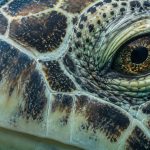
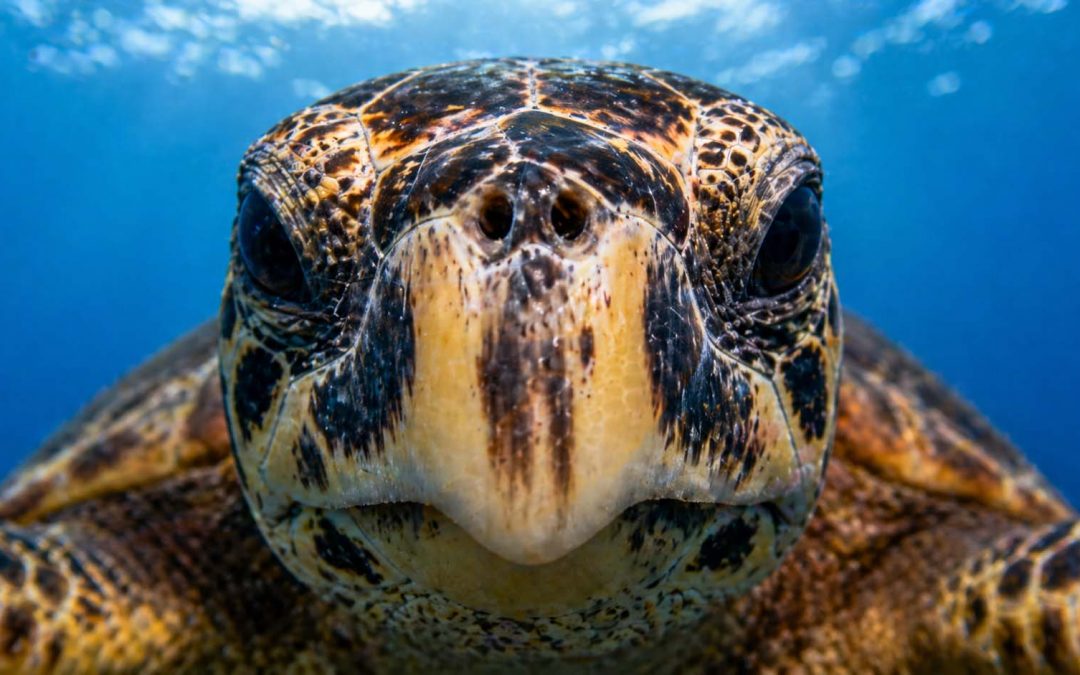
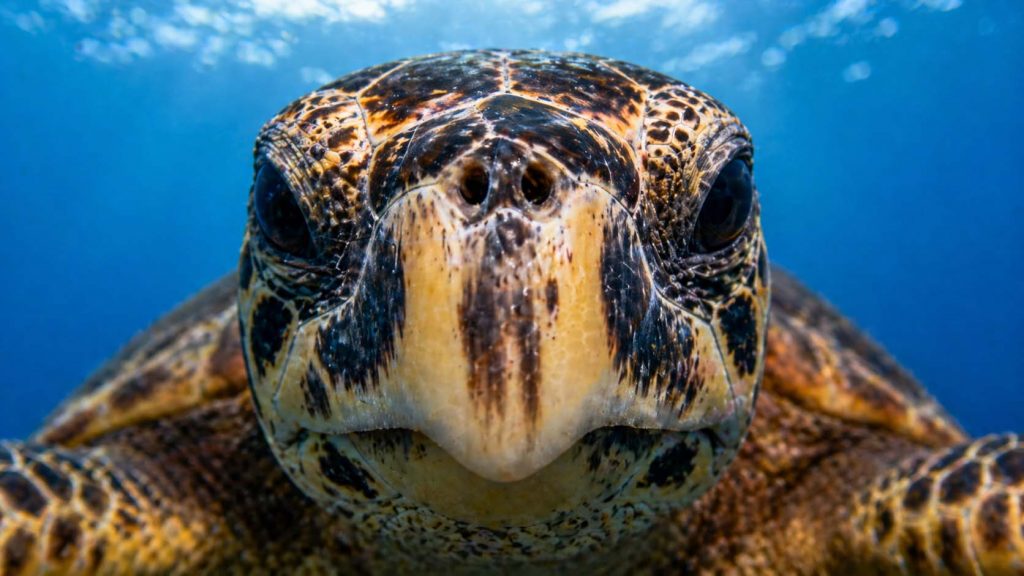
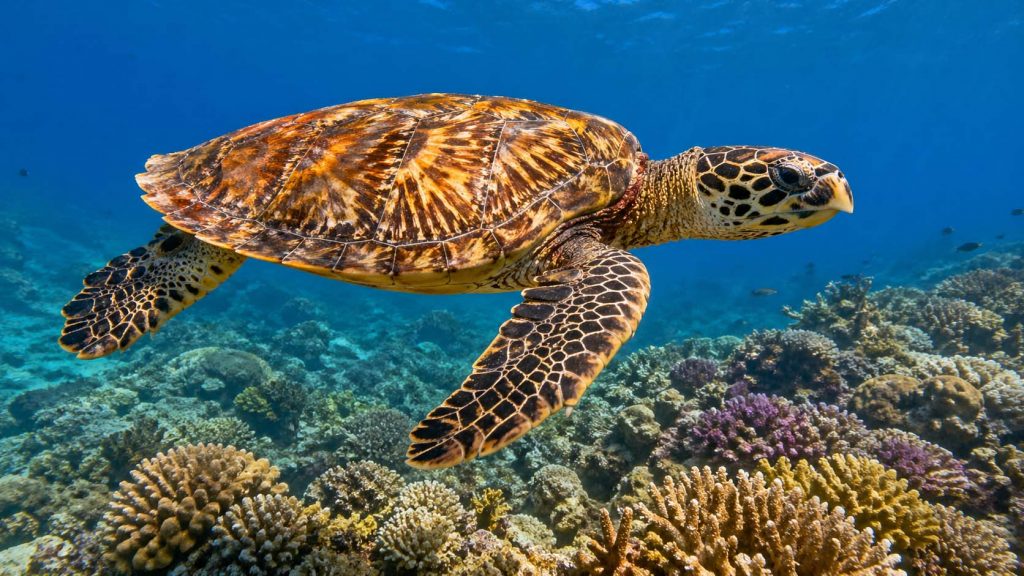
The hawksbill gets its name from the shape of its beak. Narrow and pointed, curving downward at the tip, it looks almost exactly like the beak of a hawk, which is unusual enough in a sea turtle that researchers gave the species its common name before they settled on a scientific one. The scientific name, Eretmochelys imbricata, refers to the overlapping arrangement of the shell’s scutes, which give the hawksbill a layered, almost architectural look. The colors shift from amber to gold to deep brown depending on the light, and underwater they can look almost luminous.
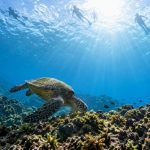
That beak is not just a visual feature. It is a precision tool. Hawksbills use their narrow, pointed bill to reach into tight reef crevices and extract sea sponges, which make up the bulk of their diet. Sponges are toxic or indigestible for almost every other animal in the reef ecosystem. Hawksbills eat them without harm and in large quantities. By doing so, they keep sponge populations from crowding out coral, which means a reef with hawksbills in it is healthier than one without them. The animal most people have never heard of turns out to be one of the reef’s most important residents.
In terms of size, hawksbills run smaller than Hawaiian green sea turtles. A typical adult weighs between 100 and 150 pounds and measures roughly two and a half to three feet. A full-grown honu often reaches 250 to 400 pounds and three to four feet in length. The hawksbill shell is also shaped differently, flatter and more elongated, with those overlapping scutes that distinguish it from the smooth, rounded shell of the green sea turtle.
How Rare Is the Hawksbill in Hawaii
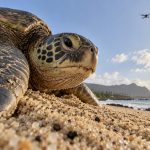
The answer is: genuinely rare. If you snorkel in Hawaiian waters, the turtles you will encounter are almost certainly green sea turtles. At Turtle Canyon off Waikiki, where our tours run, the honu is the star of the show, and that is not likely to change. Hawksbills do exist in Hawaiian waters, but any sighting is uncommon enough to count as a genuine moment of luck.
The Hawaiian hawksbill population is one of the smallest and most isolated hawksbill subpopulations in the Pacific. Researchers estimate that only about 20 to 30 hawksbill females return to nest in Hawaii in a given year. That number is heartbreakingly small when you consider that the Hawaiian green sea turtle population numbers several thousand individuals and continues to grow. Most hawksbill nesting in Hawaii happens on the Big Island, particularly along the south and east coastlines. East Maui sees some nesting as well. Researchers and wildlife organizations have monitored beaches in the Punaluu area and at Kamehame for years, documenting each nest that appears and protecting it through the season.
By comparison, the green sea turtle nesting site at French Frigate Shoals in the Northwestern Hawaiian Islands produces hundreds of nests each season and has been growing steadily for decades. The difference in scale between the two species in Hawaii tells you a lot about how close the hawksbill has come to disappearing here.
How the Tortoiseshell Trade Pushed Hawksbills to the Edge
The hawksbill was nearly driven to extinction because of its shell. For centuries, the overlapping scutes that give the hawksbill its distinctive layered appearance were harvested and sold as tortoiseshell, a luxury material used in combs, jewelry, eyeglass frames, decorative fans, and furniture inlay. The demand stretched across Asia, Europe, and the Americas and continued for so long that hawksbill populations around the world collapsed before meaningful protections were in place.
By the time the international community took the problem seriously, the damage was severe. The species was listed as critically endangered on the IUCN Red List, the highest category of concern before extinction, where it remains today. In the United States, hawksbills are listed under the Endangered Species Act, which makes it a federal crime to harm, harass, or possess one. Hawaii state law adds an additional layer of protection. None of that undoes what the trade did, but it does mean that every nest that appears on a Hawaiian beach today is protected in ways that would have seemed impossible a hundred years ago.
Habitat loss has compounded the problem. Hawksbills need healthy coral reefs to find their food, and as reefs have degraded from warming ocean temperatures, pollution, and coastal development, the availability of healthy sponge-covered habitat has shrunk. Nesting beaches face pressure from light pollution, erosion, and human activity. Hawksbills also get caught as bycatch in longline fishing gear and entangled in nets. Every threat that affects green sea turtles affects hawksbills too, with less margin for error given how small the population already is.
Honu’ea in Hawaiian Culture
In Hawaiian, the green sea turtle is honu and the hawksbill is honu’ea. Both names carry weight. Both animals appear in Hawaiian cultural tradition as sacred creatures connected to the ocean, to family, and to the concept of aumakua, the ancestral guardians that take form in nature and watch over the living. The fact that Hawaiian tradition recognized the hawksbill as a separate, named creature reflects how carefully the Hawaiian people observed the ocean around them and how precisely they understood it.
The honu’ea’s rarity only deepens that cultural significance. Generations of Hawaiian fishermen and coastal families who knew these waters would have understood that the hawksbill was something different from the honu, something harder to find and more particular in its habits. An animal that rare, living for decades in a reef system you know well, takes on a different kind of meaning. It is not background scenery. It is a relationship.
What Is Being Done to Bring the Hawksbill Back
Conservation work for the Hawaiian hawksbill is methodical and unglamorous in the best possible way. Researchers monitor nesting beaches on the Big Island each season, document every nest that appears, count eggs, and install protective exclosures to shield eggs from mongooses, rats, and other introduced predators. NOAA Fisheries tracks the population over time and works with local partners to understand where hawksbills are feeding between nesting seasons and how far individual animals travel.
Because the Hawaiian population is so small, every nest matters in a way that is almost mathematical. A good season with high hatching success and healthy hatchling emergence can move the needle for this subpopulation. A bad season, with nests lost to weather or predators, is a real setback. The people doing this work know that the margin is tight and they treat it accordingly.
- Nest exclosures protect eggs from introduced predators like mongooses and rats throughout the incubation period
- Individual females are monitored and photographed across nesting seasons to track returning animals
- NOAA satellite tagging programs help researchers understand hawksbill feeding and migration routes between nesting seasons
- Partnerships between wildlife organizations, local communities, and state agencies coordinate beach monitoring and public education
For visitors to Hawaii, the most useful thing is awareness. Most people leave the islands without knowing that a second sea turtle exists here. Knowing that honu’ea are out there, understanding what they face, and supporting ocean conservation in any form, whether through the tours you choose, the reef-safe sunscreen you use, or the plastic you do not bring to the beach, adds up over time in ways that are real even if they are hard to measure.
What This Means When You Snorkel at Turtle Canyon
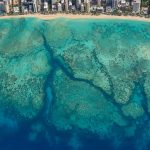
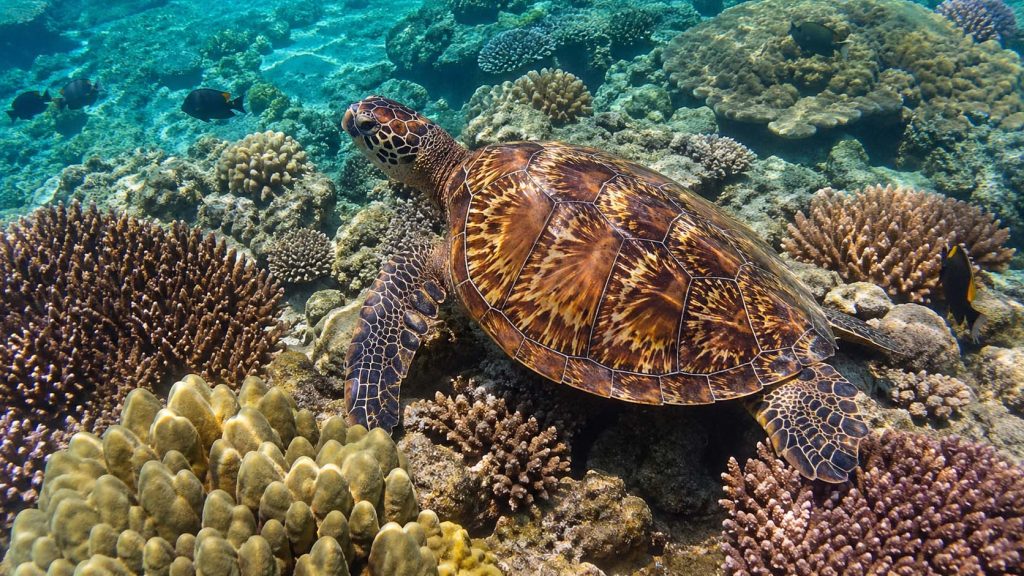
At Turtle Canyon off Waikiki, green sea turtles are your most likely encounter. That is almost guaranteed. The honu that live and feed on this reef have spent years learning every corner of it, and they are comfortable enough around snorkelers that you often end up swimming alongside one without any effort on your part. Hawksbill sightings at Turtle Canyon are not something we can promise because they simply are not common in shallow coastal reef environments like this one. Hawksbills tend to be found in areas with rich, deep sponge growth, which is not the defining feature of Turtle Canyon’s reef ecosystem.
But knowing that honu’ea exist in Hawaiian waters makes every turtle sighting a little richer. You are swimming alongside animals that belong to a lineage stretching back more than 100 million years. The green sea turtle at Turtle Canyon and the hawksbill somewhere out in deeper Hawaiian waters are part of the same ancient story, one that Hawaii is still actively trying to keep going.
The Turtles and You tour departs from Kewalo Basin Harbor, just a short complimentary trolley ride from Waikiki hotels, and includes all snorkel gear, life vests, a snack, and a Hawaiian cultural performance onboard. You will swim with real wild turtles in the open ocean. No tanks, no feeding stations, just the reef and the animals that have always lived on it.
Two Turtles, One Ocean, One Chance
Hawaii has two sea turtles. Most people only ever hear about one. The green sea turtle’s recovery is a genuine conservation success story, and it is worth celebrating every time you see one drifting along the reef. But the hawksbill’s story is still unresolved, still being written season by season on a handful of quiet beaches on the Big Island and Maui. Whether that story has a good ending depends on how seriously people take the problem now, while there is still time to make a difference. The honu’ea is out there. It just needs the ocean to keep being a place where it can live.