What Makes the Loggerhead Sea Turtle One of the Ocean’s Most Remarkable Animals
Of all seven sea turtle species, the loggerhead may be the most underrated. It does not flash the hawksbill’s jewel-like shell pattern, and it does not hold the leatherback’s record-breaking size. What it has instead is a jaw built to crush conch shells, a navigation system tied to Earth’s magnetic field, and a travel range that spans entire ocean basins. The loggerhead sea turtle has been on this planet for more than 100 million years, and every detail of its body tells the story of how it survived.
A Head Built for Power
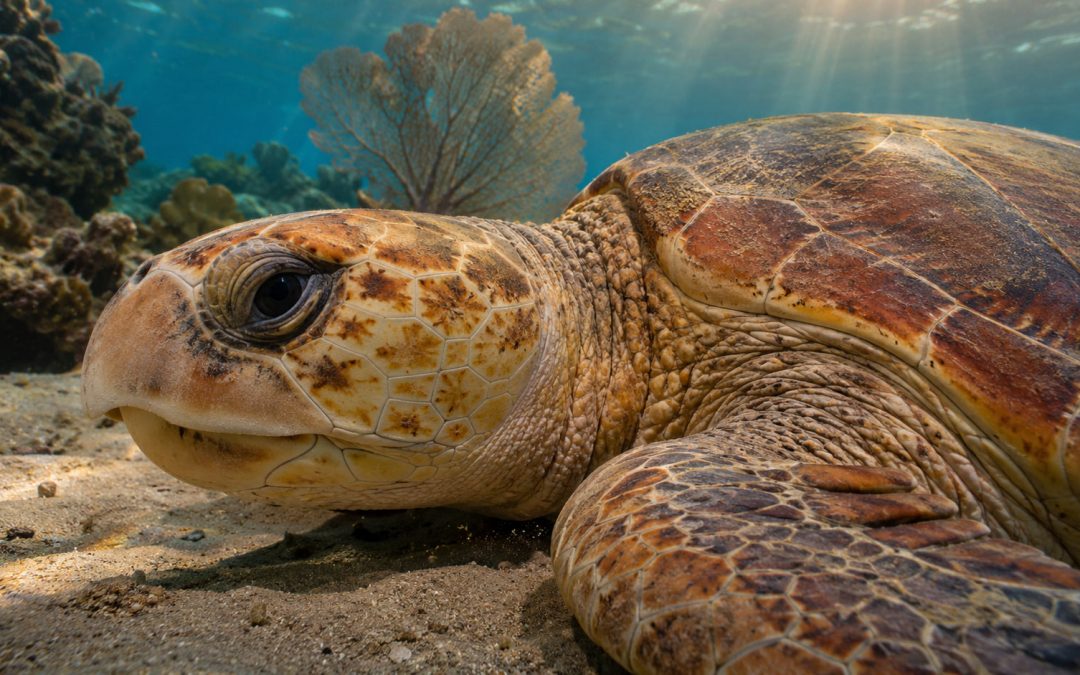
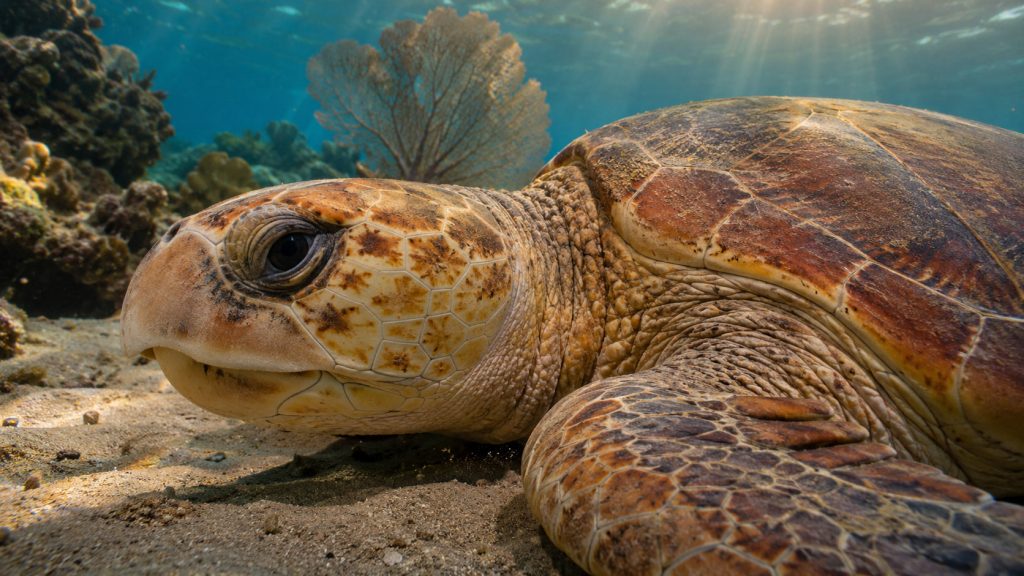
The loggerhead sea turtle gets its name from something most people notice immediately: the head. Compared to other sea turtles, the loggerhead carries a wider, blockier skull that makes up a noticeably larger proportion of its body. That oversized head is not a coincidence. It houses jaw muscles powerful enough to crack through horseshoe crab shells, conch, clams, and other hard-bodied prey that most animals simply cannot access. The scientific name is Caretta caretta, a doubling of the same word that follows a naming tradition in biology used to designate defining representatives of their group. The loggerhead fits that role as a widely studied, widely distributed species.
The shell, or carapace, of a loggerhead runs a rich reddish-brown across the top with a lighter cream-colored underside. The surface is made up of bony plates covered in a hard material called scutes, giving the shell its segmented, organized appearance. This reddish tone is one of the easiest ways to tell a loggerhead apart from the Hawaiian green sea turtle, which tends toward a darker, more uniformly olive-brown tone.
Size and Strength
Adult loggerheads typically measure between two and a half and three and a half feet in length, with weights ranging from about 200 to 400 pounds. Some individuals have exceeded 1,000 pounds, though that is rare. Among the seven sea turtle species, the loggerhead ranks as one of the largest hard-shell turtles in the world. Only the leatherback outweighs it, and the leatherback carries a flexible, rubbery shell instead of a hard one.
Male loggerheads develop a longer, thicker tail that extends visibly past the rear edge of the shell. Females have shorter, less prominent tails. Unlike the females, which must come ashore to nest, male loggerheads almost never return to land after the day they hatched. They live their entire adult lives at sea.
A Hunter, Not a Grazer
The Hawaiian green sea turtle is a grazer. It nibbles on seagrass and algae, moving slowly along the reef like an ocean lawn crew. The loggerhead works the seafloor differently. Its diet centers on hard-shelled invertebrates: horseshoe crabs, whelks, clams, mussels, conch, barnacles, and sea urchins. The jaw bites down, the shell cracks, and the animal inside becomes a meal. Loggerheads also eat jellyfish, fish, and other softer prey when the opportunity comes up.
This feeding behavior matters beyond just keeping one turtle alive. By cracking open shells and disturbing sediment as it feeds, the loggerhead helps cycle nutrients through the seafloor and creates feeding opportunities for other animals. It plays a real role in the health of the ocean floor environment in areas where it feeds regularly.
The loggerhead’s taste for jellyfish also creates a significant vulnerability. From below the surface, floating plastic bags look strikingly similar to jellyfish. Researchers have found evidence of plastic ingestion in loggerheads across multiple ocean regions, and the debris they swallow can cause fatal blockages.
Where Loggerheads Roam
Loggerheads are found in temperate and subtropical waters across the Atlantic, Pacific, and Indian Oceans. They cover more ocean territory than almost any other sea turtle species, and some individuals have been tracked migrating more than 7,500 miles on a single journey.
In the Atlantic, the largest concentration of loggerhead nesting happens along the southeastern coast of Florida. Beaches in Brevard and Indian River counties see tens of thousands of nesting females each summer, making this stretch of coast one of the most critical loggerhead nesting areas on Earth. Mediterranean beaches, particularly in Greece, also host significant loggerhead populations.
The Pacific loggerhead population follows one of the longest known migration routes in the animal kingdom. These turtles nest almost entirely on the beaches of Yakushima Island and other southern Japanese islands, then travel all the way across the Pacific to feeding grounds off Baja California, Mexico. Juvenile loggerheads make this crossing by riding the North Pacific gyre, a vast ocean current system that loops across the entire Pacific. Researchers tracking these animals were surprised by how consistently they used the current to navigate, treating it almost like a natural highway.
Loggerheads and Hawaii
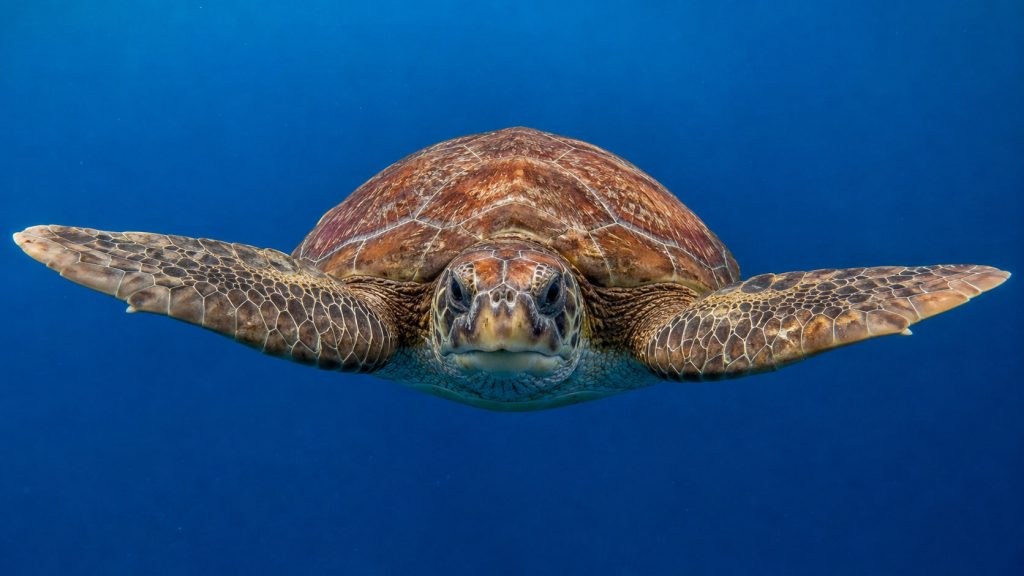
The sea turtle you are most likely to meet while snorkeling off Waikiki is the Hawaiian green sea turtle, or honu. Green sea turtles are year-round residents of Hawaiian waters. They feed on the reefs and seagrass beds around the islands, rest on the seafloor, and occasionally bask on shore. They are the whole reason Turtle Canyon got its name. If you join a snorkeling tour out of Waikiki, the turtles you will be swimming with are honu.
Loggerheads are not residents of Hawaii, but they do occasionally pass through Hawaiian waters as part of their trans-Pacific migration between Japan and Baja California. These sightings are rare and always something to remember. If you could compare the two species side by side, the differences would stand out clearly. The loggerhead’s broader, heavier head, its reddish-brown coloring, and its larger overall build are all distinct from the more streamlined profile of a Hawaiian green sea turtle gliding across the reef.
The Long Road from Egg to Ocean
Female loggerheads return to nest on the same beach where they were born, sometimes after an absence of 20 or more years. They come ashore at night, dig a body pit in the sand, then excavate an egg chamber about 20 inches deep. Each clutch holds between 100 and 120 eggs. Over a single nesting season, a female may return to the same beach three to five times, with about two weeks between visits. Then she heads back to the ocean and will not return to nest for another two to five years.
Hatchlings typically emerge at night, push up through the sand as a group, and race toward the water guided by the natural light over the ocean. Once they reach the surf, they swim hard into open water and largely disappear. Researchers call this period the lost years: a stretch of early life that can last anywhere from five to fifteen years during which young loggerheads drift through open-ocean current systems far from shore. They grow slowly, eat what they find, and remain almost entirely invisible to scientists. Satellite technology and long-term tracking programs have pieced together parts of this story, but significant gaps remain.
Threatened but Still Fighting
The loggerhead sea turtle is listed as Threatened under the Endangered Species Act and is classified as Vulnerable on the IUCN Red List. Some Pacific subpopulations carry an even higher designation of Endangered. These classifications reflect decades of pressure from human activity touching every part of the loggerhead’s life cycle, from egg to open-ocean crossing.
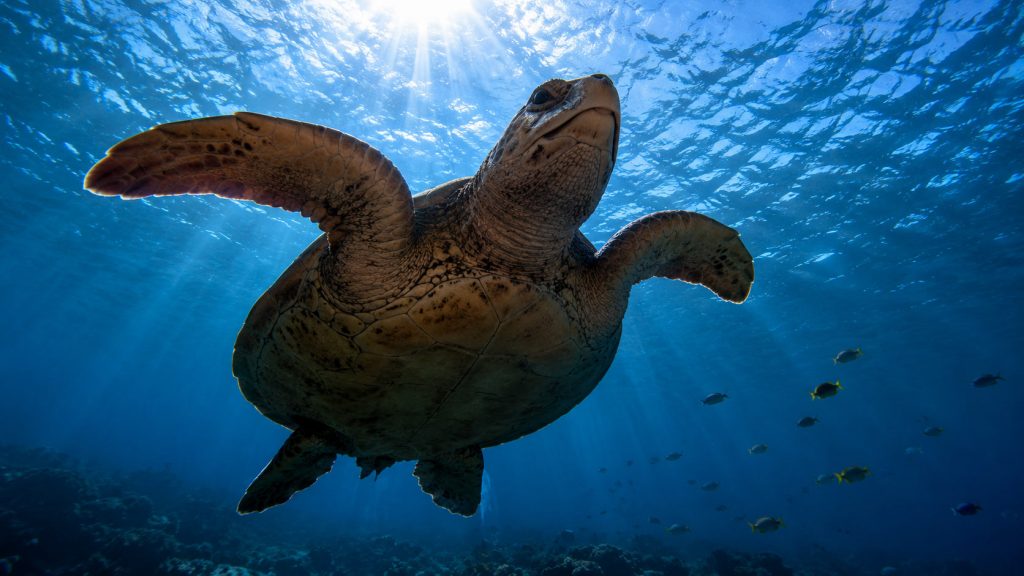
The main threats are consistent and well-documented. Bycatch in commercial longline fisheries and shrimp trawl nets kills tens of thousands of sea turtles every year, with loggerheads among the most affected. Coastal development reduces and fragments nesting beach habitat. Artificial lighting on beachfront buildings disorients hatchlings and pulls them away from the ocean. Boat strikes injure and kill turtles in shallow coastal feeding areas. And plastic pollution presents a constant ingestion hazard throughout every ocean the loggerhead calls home.
- Bycatch in longline and trawl fisheries
- Coastal development on nesting beaches
- Artificial lighting that disorients hatchlings
- Boat strikes in feeding areas
- Plastic pollution and jellyfish-lookalike debris
Conservation efforts have made a measurable difference, and that part of the story deserves equal attention. Turtle excluder devices, known as TEDs, are required gear in U.S. shrimp trawl fisheries and have significantly reduced loggerhead bycatch since the 1980s. Beach lighting ordinances in nesting areas have improved hatchling survival rates in places where they have been consistently enforced. Satellite tracking and long-term monitoring give researchers better data every year on migration routes and population trends. Some Atlantic loggerhead populations show signs of stabilizing or slowly growing, which is a meaningful development for a species that takes more than 20 years to reach reproductive age.
- Turtle excluder devices (TEDs) required in U.S. trawl fisheries
- Beach lighting ordinances near nesting areas
- Satellite tracking and long-term population monitoring
- Marine protected areas covering critical feeding and migratory zones
Every piece of plastic kept out of the ocean, every beach left undisturbed, and every sustainable seafood choice adds to a larger total that matters for species like this one.
Ancient Wanderer, Open Ocean: The Loggerhead Deserves Its Moment
The loggerhead sea turtle does not always get the headlines it deserves. It is not the biggest sea turtle and it is not the rarest, but it is one of the most capable. It crosses oceans. It cracks shells. It finds its way home across thousands of miles of open water using nothing but magnetic information built into its nervous system. It has been doing this since before the continents looked the way they do today.
When you snorkel at Turtle Canyon off Waikiki, the turtles you meet are Hawaiian green sea turtles, residents of these reefs in every sense of the word. But knowing the broader world of sea turtles, including long-distance travelers like the loggerhead, makes every in-water encounter richer. These animals are not background scenery. They are ancient, highly adapted, and irreplaceable parts of the ocean. They deserve the same sense of awe on a 7,500-mile Pacific crossing that they inspire on a coral reef just offshore.