Do Sea Turtles See in Color? Inside the Honu’s Underwater Vision
Overview
If you have ever watched a green sea turtle glide over a bright coral reef, you might wonder how much of that colorful scene the turtle actually sees. Is the reef as vivid to a honu as it is to us, or does it live in a world of grays and blurs? It turns out sea turtles have surprisingly good color vision. Not only can they see color, they can see some colors we cannot, including ultraviolet light. Their eyes are beautifully tuned to the underwater world they live in. This guide explains whether sea turtles see in color, which colors they see best, and how their vision helps them feed, travel, and survive from the very moment they hatch.
The Short Answer: Yes, and Better Than You Might Think
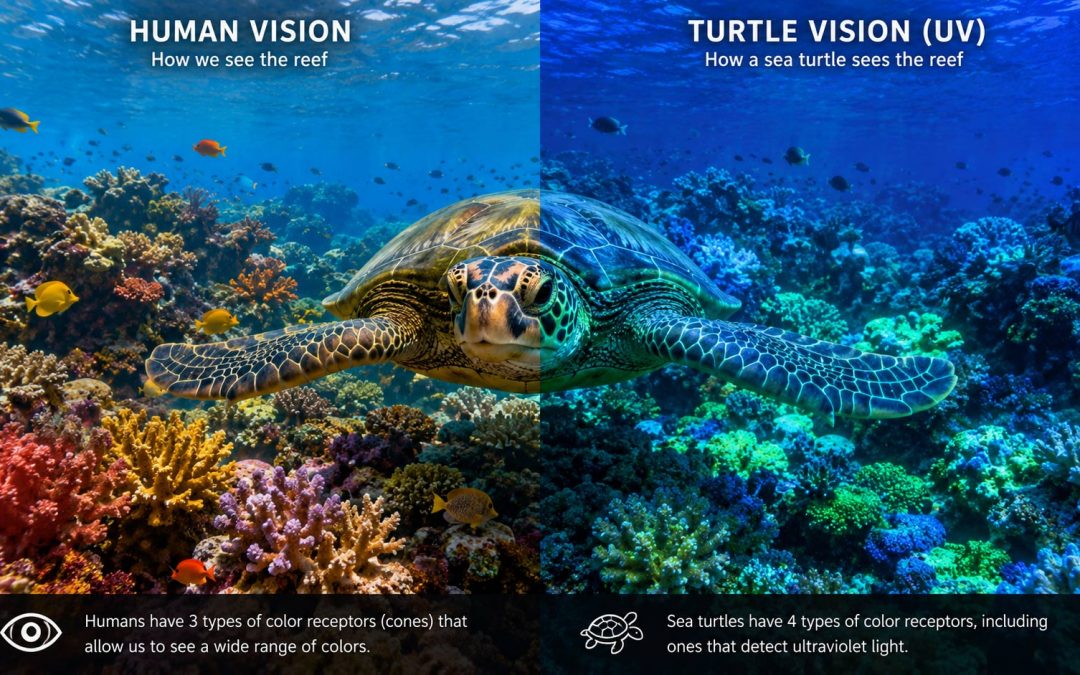
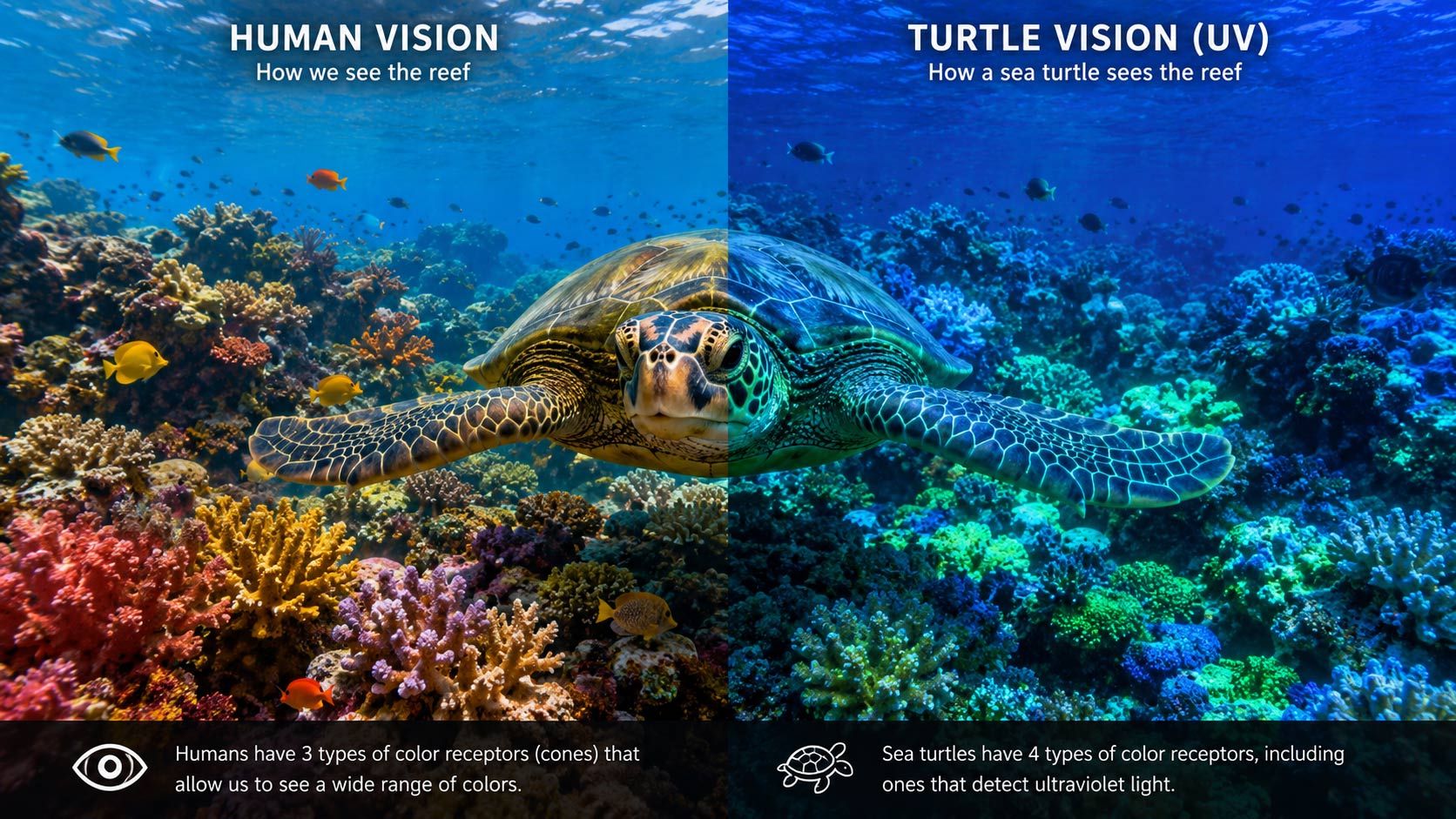
Sea turtles see in color, and their color vision is quite good. They are not colorblind. Their eyes contain the special cells needed to detect different colors, and research on green sea turtles and other species shows they can tell apart blues, greens, and yellows. Even more remarkable, they can sense ultraviolet light that is completely invisible to people. So the reef a honu sees is a colorful place, just tuned a little differently than the one we see. Far from drifting through a gray blur, a sea turtle takes in a rich, vivid underwater world.
How a Sea Turtle’s Eyes Work
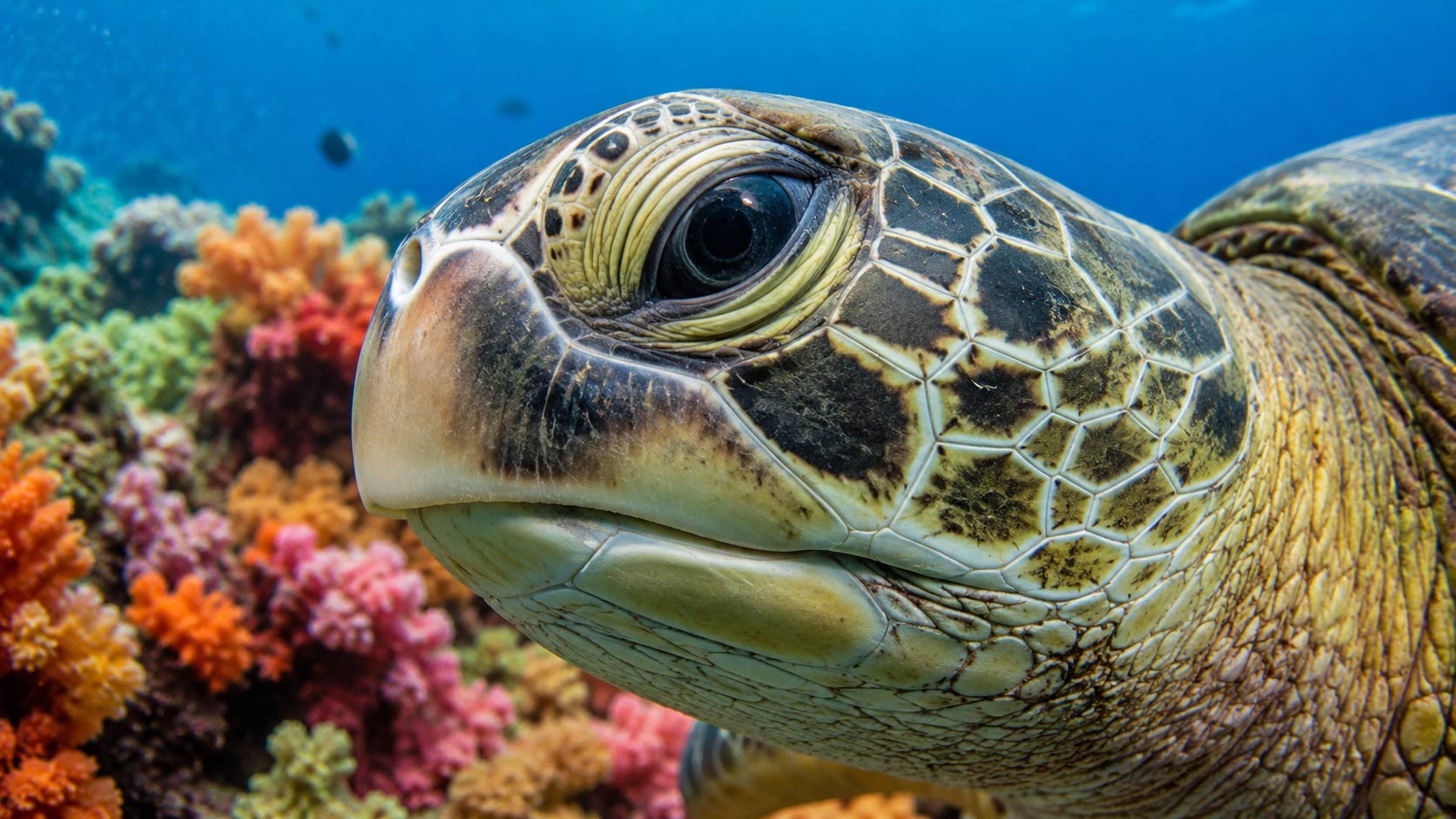
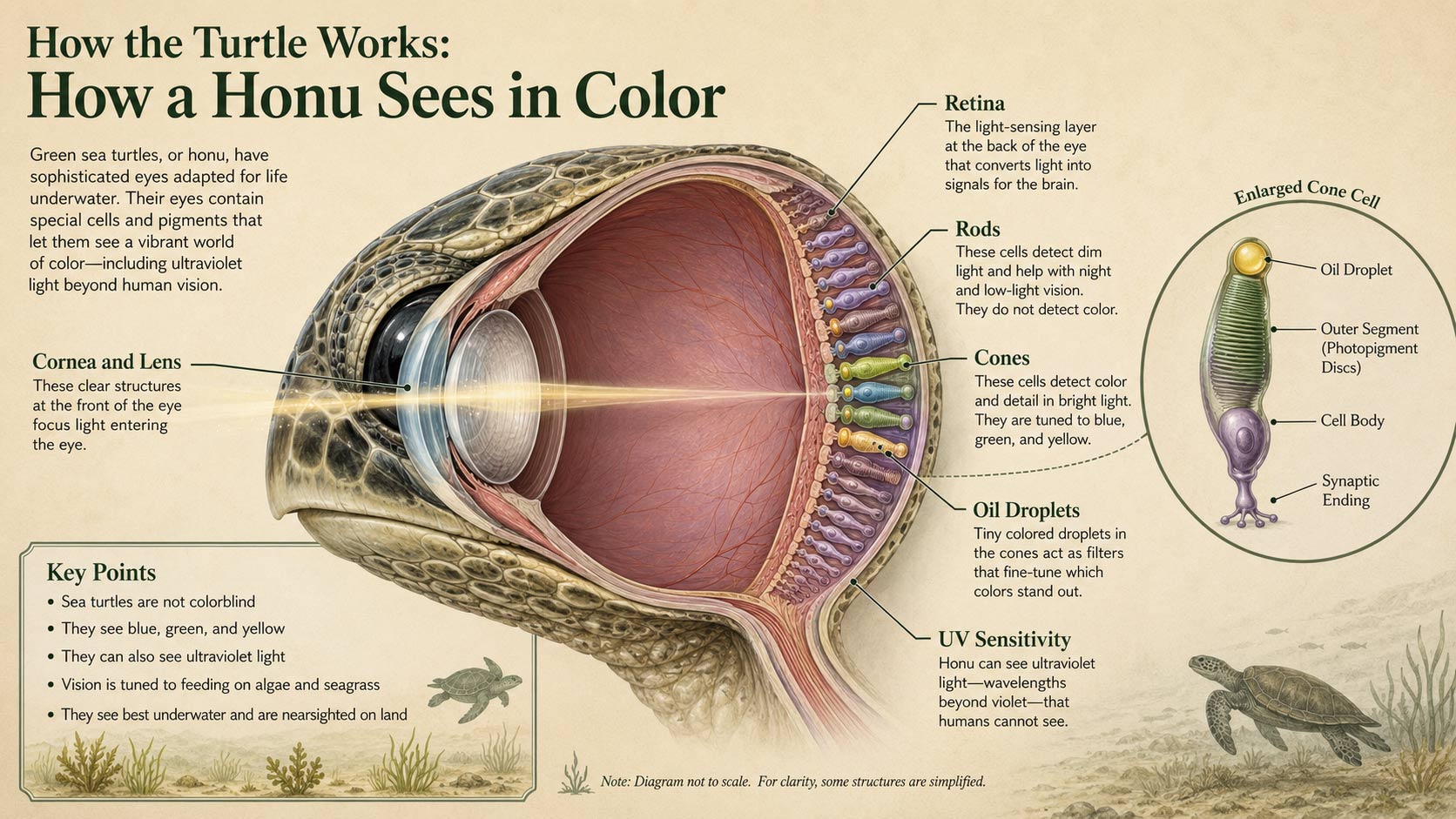
To understand turtle color vision, it helps to know a little about how any eye sees color. Eyes use two kinds of light sensing cells. Rods handle dim light and help an animal see when it is dark, but they do not detect color. Cones are the color detectors, and the more types of cones an animal has, the richer its color vision. Sea turtles have both rods and cones, which means they can see across a range of lighting and can clearly perceive color. Green sea turtles take it a step further with tiny colored oil droplets tucked inside their cones. These droplets act like built in filters that fine tune which colors the turtle sees best, nudging its vision toward the wavelengths that matter most in the ocean.
The Colors a Honu Can See
Research suggests green sea turtles are sensitive across a wide band of colors, from ultraviolet through blue and green and into yellow. The ability to see ultraviolet light is the real showstopper, since humans cannot see UV at all. Where we see nothing, a turtle may pick up light and patterns we have no idea are there. At the same time, a turtle’s eyes seem especially tuned to blues and greens, which makes perfect sense once you think about where it lives. In the ocean, red light fades away quickly as you go deeper, while blue and green light reach much farther. A sea turtle’s eyes are matched to the light that is actually around it, so it sees its world clearly instead of wasting effort on colors that vanish underwater.
Why Honu Love Yellow and Green
One of the most interesting findings is that green sea turtles show a real preference for yellow and other longer wavelength colors. Scientists think this ties directly to what they eat. Adult green sea turtles are grazers, spending their days feeding on the algae and seagrass that carpet the reef. Being especially tuned to greens and yellows would help a turtle pick out its next meal against the busy background of the seafloor. So a honu’s color vision is not random at all. It is shaped by its diet and its habitat, quietly helping the turtle find food in the exact world it lives in. A few ways this tuning helps a honu:
- Spotting algae and seagrass to graze on across the reef
- Seeing clearly in the blue green light that fills ocean water
- Picking up ultraviolet cues that people cannot detect at all
Underwater Champs, Blurry on Land
Sea turtles are built to see well underwater, which is exactly where they spend nearly their entire lives. Their eyes work beautifully beneath the surface, letting them navigate the reef and spot both food and danger. On land, though, it is a different story. Out of the water a sea turtle becomes quite nearsighted, and the world looks blurry to it. This is part of why a nesting female or a basking turtle can seem clumsy or unbothered on the beach, since its eyes simply are not made for sharp vision in air. If you want a deeper look at how far a turtle can see and the special way its eyes are protected, we cover more in our guides on turtle eyesight and the honu’s three eyelids.
How Color Helps Hatchlings Find the Sea
Color and light are a matter of life and death for a newly hatched sea turtle. When baby turtles dig out of their sandy nest, usually under the cover of night, they find the ocean by heading toward the brightest, most open horizon, which is naturally the light reflecting off the water. Their sensitivity to certain colors and light guides that desperate scramble to the sea. Sadly, this is also why artificial lights near beaches are so dangerous, because they can lure hatchlings in the wrong direction, away from the safety of the ocean. Understanding how turtles see light is a big part of protecting the next generation of honu.
What This Means for Snorkelers
So what does all of this mean when you are in the water with a honu? It means the turtle almost certainly sees you, and it sees you in color. It notices movement, shapes, and bright colors, which is one more reason to be a calm and respectful presence in the water. Sudden movements or chasing can startle an animal that is watching you more closely than you might think. When you snorkel at a spot like Turtle Canyon off Waikiki, moving slowly and keeping a respectful distance lets the turtle stay relaxed and carry on with its day. The reef you are soaking in with your own eyes is a world the honu sees in its own rich color too.
Watch: Meet the Sea Turtle
A Reef Seen in Color
So do sea turtles see in color? Absolutely, and their vision is a wonderful match for their watery world. Honu see blues, greens, and yellows, they can detect ultraviolet light we will never glimpse, and their eyes are tuned to spot the algae and seagrass they love to eat. They see best underwater and turn nearsighted on land, and from their very first hours their sensitivity to light helps guide them to the sea. The next time you float above a green sea turtle on a bright Hawaiian reef, remember that you are not the only one enjoying the view. The honu is taking in a colorful world all its own, perfectly designed for a life beneath the waves.