What Is A Turtle Shell Made Of? Bone, Keratin, And A Living Skeleton
If you have ever watched a green sea turtle drift over a Hawaiian reef, your eye goes straight to that beautiful shell. It is smooth, patterned, and tough, and it is the feature that makes a turtle a turtle. But have you ever stopped to ask what a turtle shell is actually made of? Most people imagine a hard helmet or a mobile home the turtle hides inside, something it could slip out of if it wanted to. The real answer is far more surprising. A sea turtle shell is part of the animal’s own skeleton, made of living bone fused to its spine and ribs, then covered with hard plates of the same stuff that forms your fingernails. It is alive, it grows, and the turtle can feel through it. This guide explains in plain terms what a honu shell is built from, why it can never be removed, and how this remarkable armor helps Hawaii’s turtles thrive.
The Short Answer: Bone On The Inside, Keratin On The Outside
A turtle shell is made of two main materials working together. Underneath is a layer of bone, and on top of that bone sits a layer of hard plates made of keratin, the same protein found in your fingernails, hair, and a bird’s beak. So a shell is not one solid piece of armor. It is bone for strength and structure, capped by keratin plates for protection against scrapes and wear. Together these two layers create something that is both incredibly strong and surprisingly light, exactly what an animal needs to carry its own armor everywhere it goes. Once you understand those two simple ingredients, bone and keratin, the rest of the shell story falls neatly into place.
Two Parts: The Carapace And The Plastron
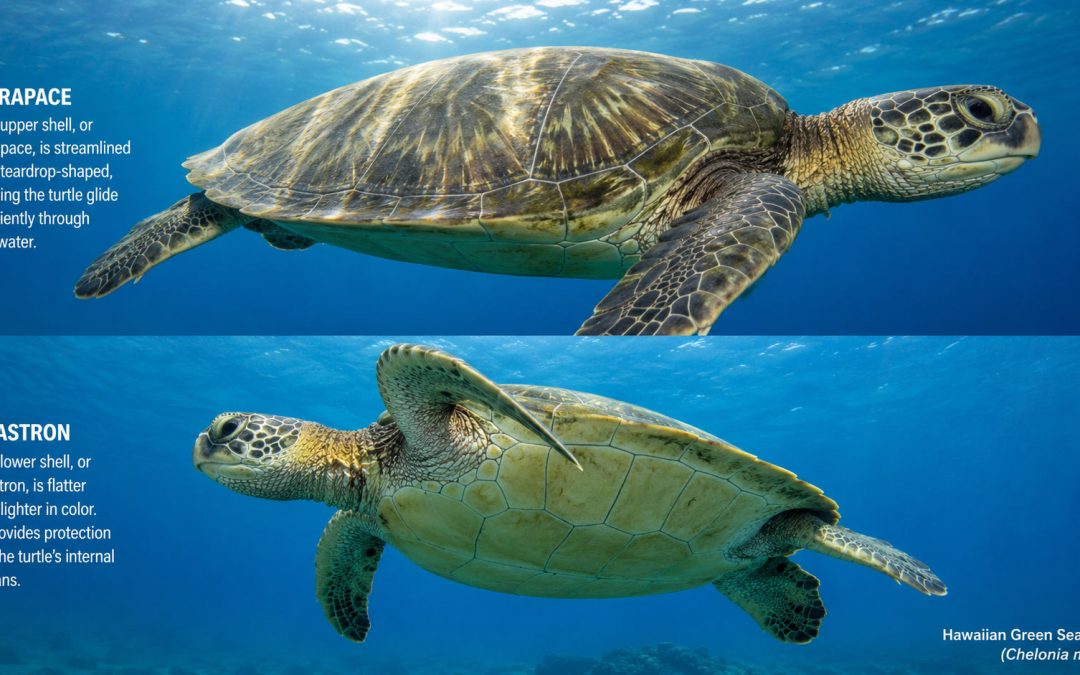
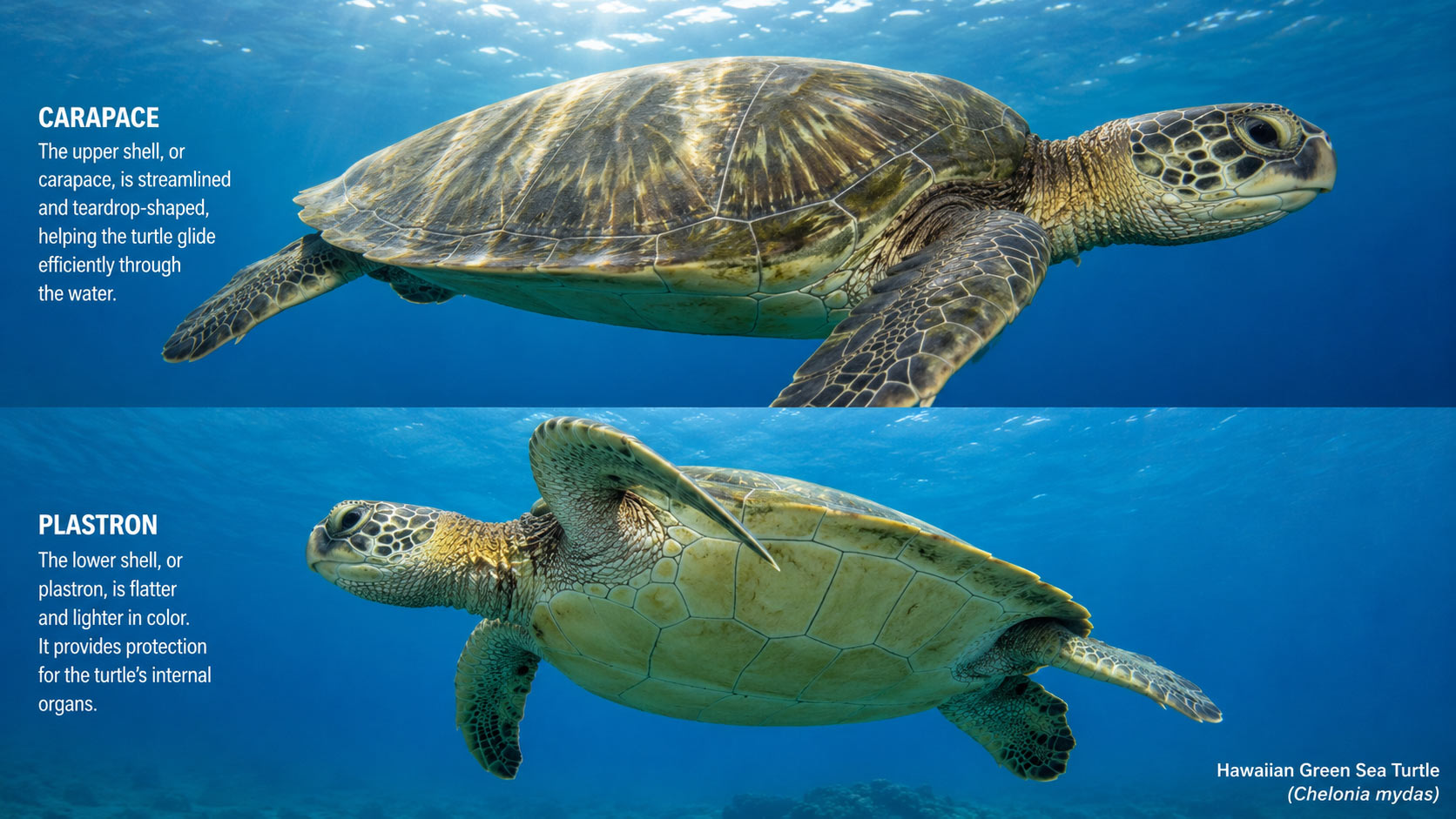
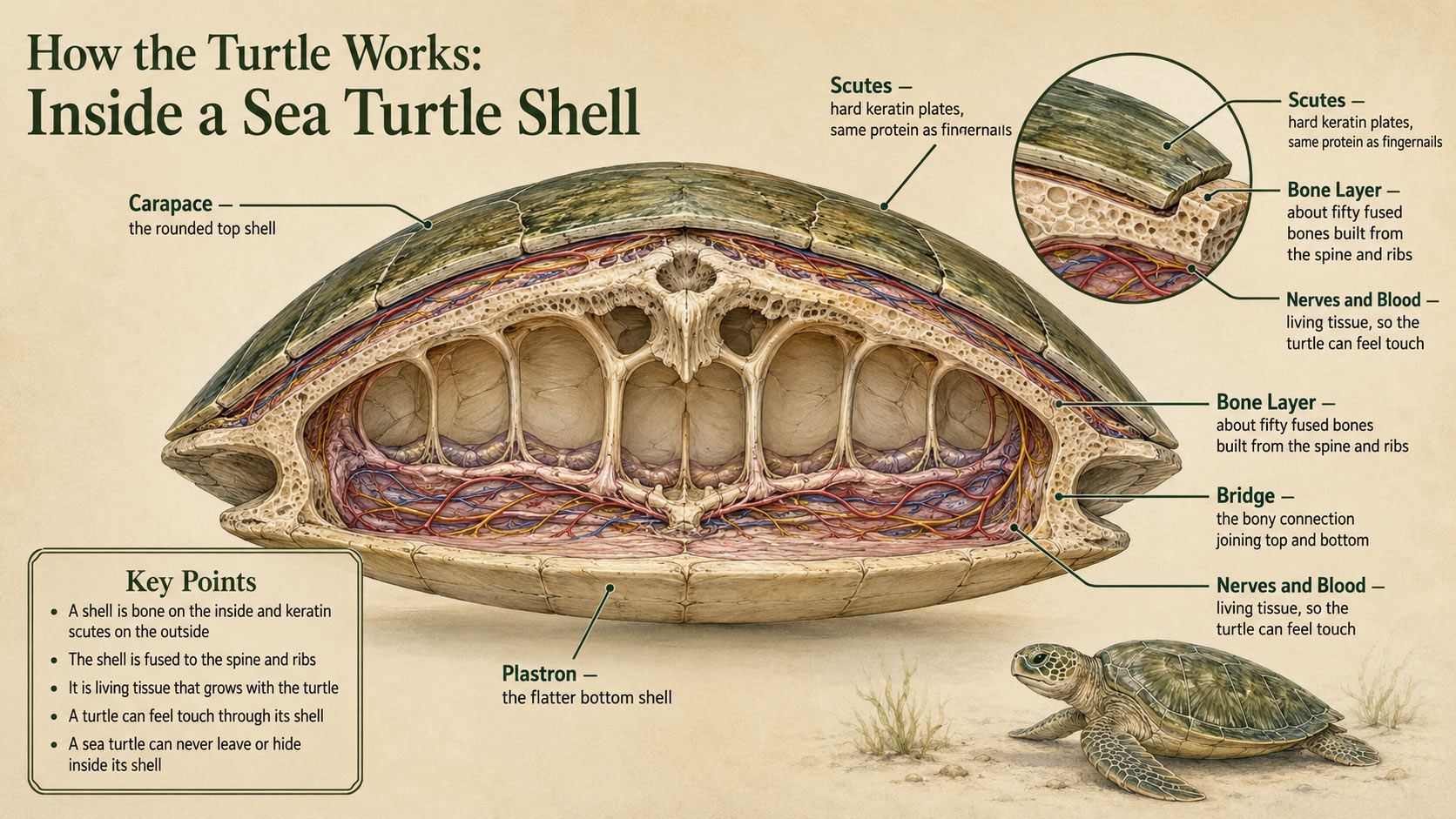
A turtle shell is not a single dome. It comes in two connected parts. The top half, the rounded part you see when a turtle swims past, is called the carapace. The bottom half, the flatter underside that covers the turtle’s belly, is called the plastron. These two pieces are joined along each side by a bony structure called the bridge, which links the top and bottom into one solid case around the turtle’s body. You can think of the carapace as the roof and the plastron as the floor, with the bridge acting like the walls that hold them together. This two part design wraps the turtle’s vital organs in a protective box while still leaving openings at the front and back for the head, flippers, and tail.
- Carapace, the rounded top shell you see when a turtle swims
- Plastron, the flatter bottom shell that protects the belly
- Bridge, the bony connection that joins the top and bottom into one case
A Skeleton Turned Inside Out
Here is the fact that surprises almost everyone. A turtle shell is not something the animal wears over its body. It is part of the body, built directly from the skeleton. Over millions of years, a turtle’s ribs and backbone grew outward and flattened, then fused together to form the bony dome of the carapace. In other words, the turtle’s spine and ribs are literally part of the shell. This is completely different from any other animal. Your ribs sit inside your body wrapped in muscle and skin, but a turtle’s ribs are spread wide and locked into the shell on its back. That is why people sometimes say a turtle is an animal with its skeleton turned inside out. The carapace of a sea turtle is made of around fifty bones all knitted together, including those repurposed ribs and vertebrae. It is one of the most unusual body plans in the entire animal kingdom.
What Are Scutes Made Of?
The hard, polished plates you see on the outside of a turtle’s shell have a name. They are called scutes, and they are made of keratin, the very same protein in your fingernails and hair. These scutes lie over the bone like a layer of shingles on a roof, protecting the bone underneath from scratches, bumps, and the constant wear of ocean life. On a green sea turtle, the carapace is covered by a neat arrangement of scutes, and the large central plates famously number thirteen, a pattern that has long held meaning in Hawaiian culture. The scutes are also where a turtle’s coloring and beautiful markings live, giving each shell its own look. Because keratin is tough but not living tissue on the surface, scutes can take a beating and slowly wear or shed over time while the bone beneath stays protected.
The Shell Is Alive
One of the biggest myths about turtle shells is that they are dead, like a snail’s empty shell or a suit of armor hanging on a wall. They are not. A turtle shell is living tissue, full of bone, blood vessels, and nerve endings. Because it is made from the skeleton and wired with nerves, a turtle can actually feel touch and pressure through its shell. A gentle tap, a scrape against the reef, or the bite of a barnacle is something the turtle senses, which is one big reason you should never touch or knock on a turtle’s shell. The shell can also be injured and can bleed, and like other bone it can slowly heal. On top of all that, the shell is alive in another way. It grows. As the turtle gets bigger over the years, its shell grows right along with it, since the two are one and the same. A honu can never outgrow its shell because the shell is simply part of who it is.
Why A Sea Turtle Can Never Leave Its Shell
Cartoons love to show a turtle climbing out of its shell like slipping off a backpack, but in real life this is impossible. Because the shell is fused to the spine and ribs, it is permanently attached to the turtle’s body for life. There is no seam to unzip and no way to crawl out. A turtle is born with its shell already part of its skeleton, and it stays that way until the end of its life. This also explains another important fact about sea turtles. Unlike a land tortoise, a sea turtle cannot pull its head and flippers inside its shell to hide. Its body and limbs are built for swimming, not for tucking away. So the shell is not a hiding place a turtle ducks into. It is a permanent piece of the animal, always on, always part of the turtle itself.
How A Sea Turtle Shell Differs From A Tortoise Shell
All shells are built from the same basic recipe of bone and keratin, but the shape changes depending on where the animal lives. A land tortoise carries a tall, heavy, dome shaped shell that offers serious protection and lets the animal pull its head and legs inside. A sea turtle has a flatter, smoother, more streamlined shell shaped a bit like a teardrop. That low, sleek design slips through the water with very little drag, helping the turtle glide for miles without wasting energy. A tall domed shell would act like an anchor in the sea, and a flat streamlined shell would offer too little protection on land, so each animal ended up with the shape that suits its home. Same materials, very different jobs. The honu’s shell is essentially a swimming machine, built for speed and grace rather than for hiding.
The Leatherback: The Turtle With No Hard Shell
There is one remarkable exception to the bone and keratin rule, and it belongs to the largest sea turtle on earth. The leatherback does not have the hard, plated shell that other sea turtles do. Instead of big keratin scutes over solid bone, its back is covered in tough, rubbery, leathery skin, which is exactly how it got its name. Underneath that skin sits a mosaic of thousands of tiny bones embedded in the body rather than a single fused bony dome. This flexible, oil rich shell helps the leatherback dive incredibly deep and survive in colder water than any other sea turtle. It is a great reminder that nature loves to experiment. While Hawaii’s green sea turtle and the reef loving hawksbill wear the classic hard shell, their giant cousin shows that even the turtle’s signature feature can be reinvented.
What The Shell Does For A Honu
The shell is not just for looks, of course. It does several vital jobs at once. First and most obviously, it is armor, a hard protective case that shields the turtle’s organs from predators and from the bumps and scrapes of reef life. Second, it is structure. Because the ribs and spine are part of the shell, it gives the turtle’s whole body its shape and support, almost like a built in frame. Third, that streamlined dome is key to swimming, cutting cleanly through the water so the turtle can travel long distances with ease. The shell even plays a small role in buoyancy and in storing minerals the body needs. All of this comes from one elegant structure that the turtle never has to take off, repair on its own, or leave behind. It is protection, skeleton, and swimsuit rolled into one.
- Protection, a hard case guarding the turtle’s organs from predators and scrapes
- Structure, a built in skeleton that supports and shapes the whole body
- Swimming, a streamlined dome that glides smoothly through the water
What This Means For Snorkelers At Turtle Canyon
Knowing what a shell is really made of changes the way you see a turtle in the water. When you float above a green sea turtle at a spot like Turtle Canyon off Waikiki, you are not looking at an animal wearing a hard hat. You are watching a creature whose own skeleton is on the outside, a living dome of bone and keratin that grows with it, feels touch, and powers it gracefully through the reef. That understanding is also a reminder to be gentle. Because a turtle can feel through its shell, touching or knocking on it is uncomfortable and stressful for the animal, and in Hawaii it is against the law to disturb a honu. The kindest and most rewarding thing you can do is simply watch from a respectful distance and admire that incredible shell doing exactly what millions of years of evolution designed it to do.
Watch: How The Turtle Got Its Shell
A Living Suit Of Armor
So what is a turtle shell made of? At its heart it is two materials, a layer of bone built straight from the turtle’s spine and ribs, capped with hard plates of keratin called scutes, the same protein as your fingernails. The shell comes in two parts, the rounded carapace on top and the flatter plastron below, joined by a bony bridge into one solid case. Far from a dead shield or a removable shelter, it is living tissue that grows with the turtle, carries blood and nerves, and can never be taken off because it is part of the skeleton itself. From the sleek dome of Hawaii’s green sea turtle to the leathery back of the giant leatherback, the turtle shell is one of nature’s most clever designs. The next time you watch a honu glide past in the clear blue water off Oahu, you will see that beautiful shell for what it truly is, a living suit of armor the turtle was born wearing and will carry, with quiet grace, for its entire life.