How Hawaiian Sea Turtle Flippers Actually Work
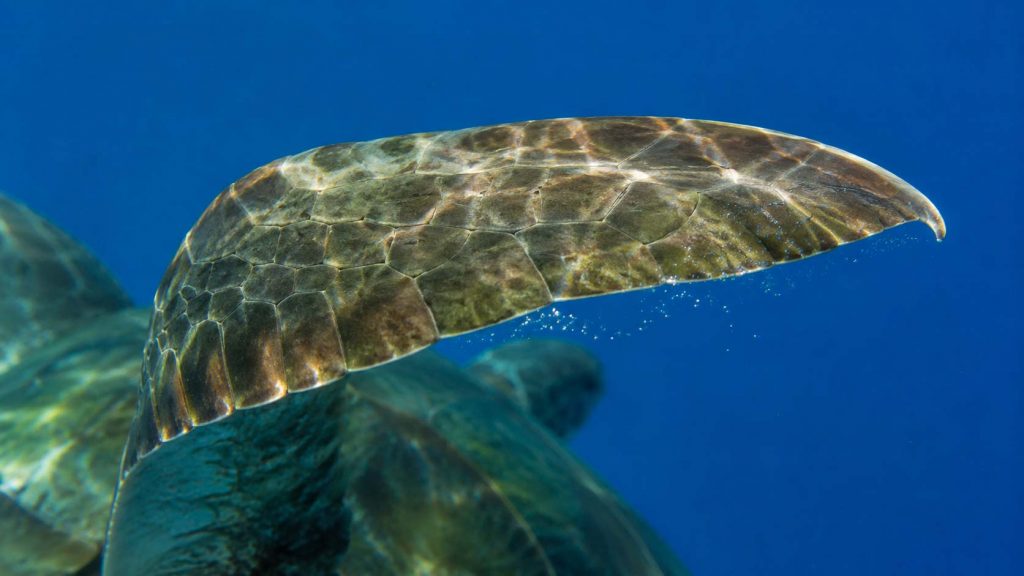
On almost every Oahu turtle snorkel tour, a guest will say the same thing within the first minute of seeing a honu underwater: “It looks like it is flying.” That is not a coincidence. A Hawaiian green sea turtle does not paddle the way a dog or a sea otter does. It flies, in a very real sense, using long winglike front flippers that move through the water the way a bird’s wings move through the air. Meanwhile, the rear flippers stay tucked behind, gently adjusting course like the tail rudder of a small plane. Once you understand how these two flipper sets work together, every turtle you watch suddenly makes more sense, from the way they bank around coral heads to the way females haul themselves up a beach to nest. This is the full story behind the flippers of a Hawaiian sea turtle.
What A Sea Turtle Flipper Is Actually Made Of
A flipper looks simple from the outside, but the bones inside tell a more interesting story. A sea turtle flipper has the same basic skeleton as the limb of any other reptile, including the long finger bones, or phalanges, that you can find in your own hand. Over millions of years, those finger bones stretched, flattened, and fused inside a tough sheath of skin and connective tissue.
The result is a long, flat, slightly curved paddle with very little flexibility in the middle and most of the power coming from the shoulder or hip. There are no separate fingers or toes you can see from the outside, but the bones are still there, hidden under the skin. In a quiet way, every sea turtle flipper is a reminder that these animals once had ancestors that walked on land.
Front Flippers: The Power Stroke
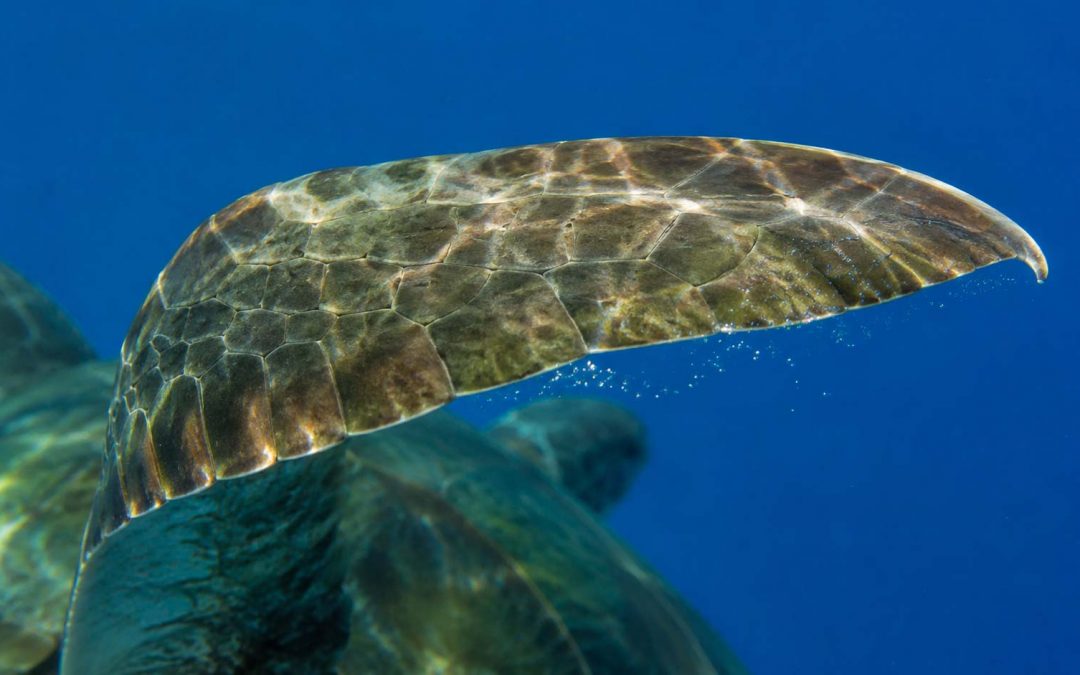
The front flippers do almost all of the work of moving a sea turtle forward. They are long, narrow, and shaped like an airplane wing, with a slightly thicker leading edge and a thin, smooth trailing edge. When a honu cruises through the reef, those front flippers sweep up and down in a flowing figure-eight motion, very similar to the way a sea bird flaps its wings.
On the down stroke, water is pushed back and downward, and the turtle lifts and slides forward. On the up stroke, the flipper twists slightly so it slices back through the water with less drag, then catches the water again on the next sweep. This is why a sea turtle in motion looks like it is flying. The animal is not pushing water like an oar. It is generating lift like a wing.
Rear Flippers: Built For Steering
While the front flippers move a sea turtle forward, the rear flippers handle the fine work of steering. They are shorter, broader, and rounder than the front pair, more like small fans than wings. Most of the time they trail quietly behind the body, tucked close to the shell.
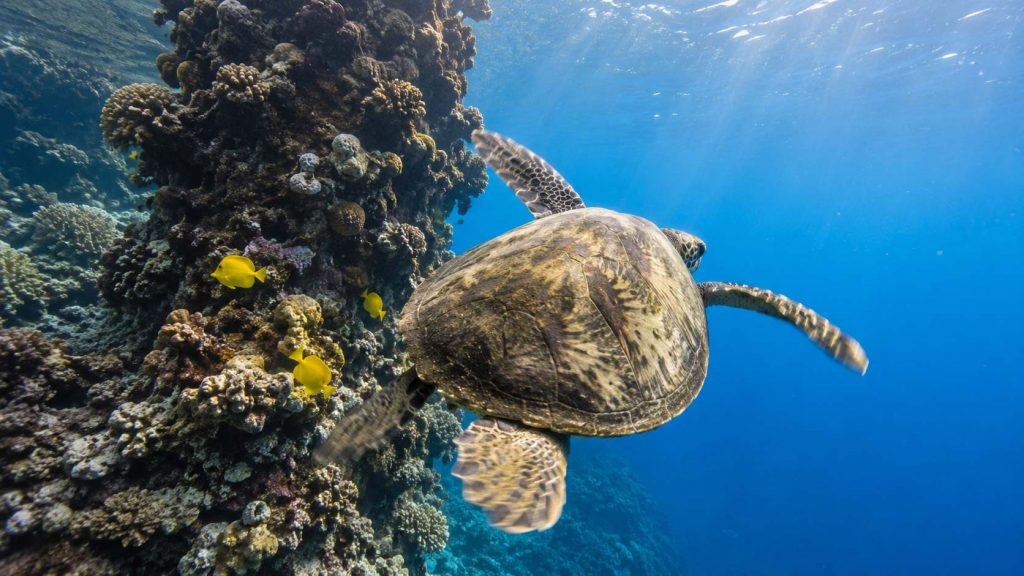
When a honu wants to turn, slow down, or hold position, the rear flippers fan out, twist, and angle into the water. A small tilt to one side is enough to swing the whole animal in a smooth arc. A push backward acts like a brake. When a turtle hovers above the reef, watching divers from a comfortable distance, the rear flippers are usually the part doing the constant micro-adjustments. They are doing the same job that a rudder does on a boat, only with a lot more finesse.
The Single Claw On Every Flipper
If you look very closely at a sea turtle flipper as it passes by, you may spot something surprising. Each flipper has a single, small, curved claw set into the leading edge, near the elbow or knee joint. It is a leftover from the turtle’s ancient terrestrial relatives, and it still has a job to do.
Males use the claws on their front flippers to grip onto the shell of a female during mating. Females use the claws on their rear flippers to help excavate the nest chamber on the beach. The rest of the time, the claws are barely noticeable, but they are a great reminder that even highly specialized swimmers still carry tools from their walking past.
Why Sea Turtles Cannot Walk Like Land Turtles
The same flipper design that makes sea turtles such elegant swimmers also means they cannot walk the way a box turtle or a tortoise walks. Tortoises have short, columnlike legs designed to support their weight on dry land. A sea turtle’s flippers are long, flat, and built for slicing through water.
On a beach, a nesting honu has to drag her entire body forward with a slow, side-to-side heave, pushing with the front flippers and inching the rear of her shell along behind. It is exhausting work for an animal that weighs hundreds of pounds. This is one of the main reasons sea turtles return to land only to nest or, in the case of Hawaiian honu, to bask in the sun on remote beaches. Their flippers are simply the wrong shape for life on solid ground.
Female Honu And The Nesting Flipper Job
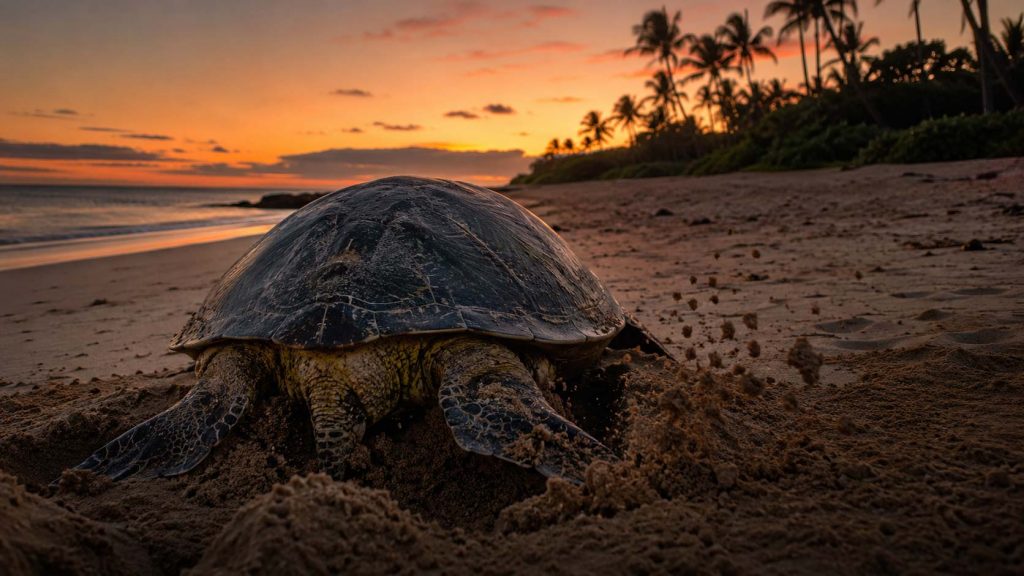
For female green sea turtles, the rear flippers take on one more critical job. Once she has hauled herself above the high tide line, a nesting female uses her rear flippers like a pair of careful hands, scooping out a deep, vase-shaped nest chamber in the sand. She works one flipper at a time, lifting a single load of damp sand, flicking it to the side, and then alternating to the other flipper.
Watching Flippers On A Turtle Canyon Snorkel
She cannot see what she is doing, but the rear flippers seem to know exactly when the nest is the right depth and shape. After laying around a hundred eggs, she uses those same rear flippers to gently cover the chamber, then drags her body forward to fill in a wider area of disturbed sand. It is one of the most precise uses of a body part anywhere in the reptile world.
Turtle Canyon is one of the easiest places in the world to watch sea turtle flippers in action. The water is clear, the turtles are calm, and they often cruise within easy sight of snorkelers floating on the surface. With a little patience, guests can see all of the major flipper behaviors in just a few minutes:
- A slow, sweeping figure-eight motion of the front flippers as a honu glides between coral heads.
- A sharp fan-out of the rear flippers as the turtle banks into a turn around a piece of reef.
- A relaxed, almost motionless drift, with the rear flippers trailing and the front flippers held still mid-stroke.
- A sudden, single hard pump of the front flippers when a turtle decides to surface for a breath.
Once you know what to look for, the difference between the front and rear flippers becomes obvious. The front pair pull the turtle through the water. The rear pair handle the fine art of where it is going.
Why Flipper Health Matters For Hawaiian Honu
Healthy flippers are everything for a sea turtle. A honu that loses a flipper to a shark bite, a boat strike, or entanglement in fishing line is not just injured. It is suddenly working with the wrong tools. A turtle missing a front flipper has to work much harder to swim a straight line and is more likely to spiral or list to one side. A turtle missing a rear flipper struggles to steer cleanly and, if it is a female, may have trouble digging a proper nest.
This is why marine rehabilitation centers, including those working with Hawaiian green sea turtles, put so much effort into wound care and, in some extraordinary cases, into building custom prosthetic flippers. The famous case of a sea turtle named Allison, who lost three flippers and was given a carbon-fiber rudder so she could swim straight again, is a powerful reminder of just how important these limbs are. A complete set of flippers is the difference between a turtle that thrives and one that simply survives.
How A Leatherback Flipper Is A Little Different
Most sea turtles, including the green, the hawksbill, the loggerhead, the olive ridley, the Kemp’s ridley, and the flatback, share the same general flipper design. The leatherback is the outlier. Its front flippers are massive in proportion to its body, sometimes stretching nearly nine feet from tip to tip on the largest adults.
That long wingspan helps power the deepest dives and the longest open-ocean journeys of any reptile on Earth. Hawaiian green sea turtles are not record-setting flippers in the same way, but they are perfectly tuned for life around coral reefs, where short bursts of speed, tight turns, and patient hovering matter more than open-ocean endurance.
What This Means For Your Tour
A honu drifting past at Turtle Canyon is doing something quietly remarkable every second it is in front of you. The long front flippers are slicing through the water in figure-eight wing strokes, providing nearly all of the forward push. The rear flippers are making small, constant adjustments, steering the turtle through a maze of coral and reef fish without a single wasted motion.
The claws on each flipper are tucked out of the way, ready for a future role on the nesting beach. The bones inside, hidden under the skin, are still the same bones a land reptile would have, only stretched and reshaped over millions of years of evolution. Once you know how it all fits together, you stop seeing a turtle “swimming” and start seeing one of the ocean’s best-engineered animals doing exactly what it was built to do.
Wings, Rudders, And A Quiet Masterpiece Of Design
Sea turtle flippers look effortless because they are some of the most refined limbs in the ocean. The front pair work like wings, lifting the body forward with smooth figure-eight strokes. The rear pair work like rudders, fine-tuning every turn and adjustment, then doubling as nesting tools for female honu on a sandy beach. Together, they explain why a Hawaiian green sea turtle can move like it is flying while a tortoise on the same beach can barely cross a sidewalk. The next time a honu glides past on a Turtle Canyon snorkel tour, take a moment to watch the flippers. Once you see how they work, the whole graceful picture of a sea turtle in motion finally makes sense.