Sea Turtle Camouflage: How Honu Hide In Plain Sight
At first glance, a big green sea turtle gliding over a bright Hawaiian reef does not seem like it is hiding from anything. It moves slowly, it rests in the open, and it lets snorkelers admire it up close. But nature is sneakier than that. Sea turtles are actually wearing a disguise, one so old and so effective that most people never even notice it. The trick is in their coloring. A honu is dark on top and light on the bottom, and that simple arrangement helps it disappear into the ocean when a predator looks its way. It is a form of camouflage called countershading, and it is used by countless ocean animals to survive. This guide explains how sea turtle camouflage works, why the dark back and light belly are so important, who a turtle is hiding from, and how this quiet magic trick helps Hawaii’s honu stay safe in the sea.
The Short Answer: A Trick Called Countershading
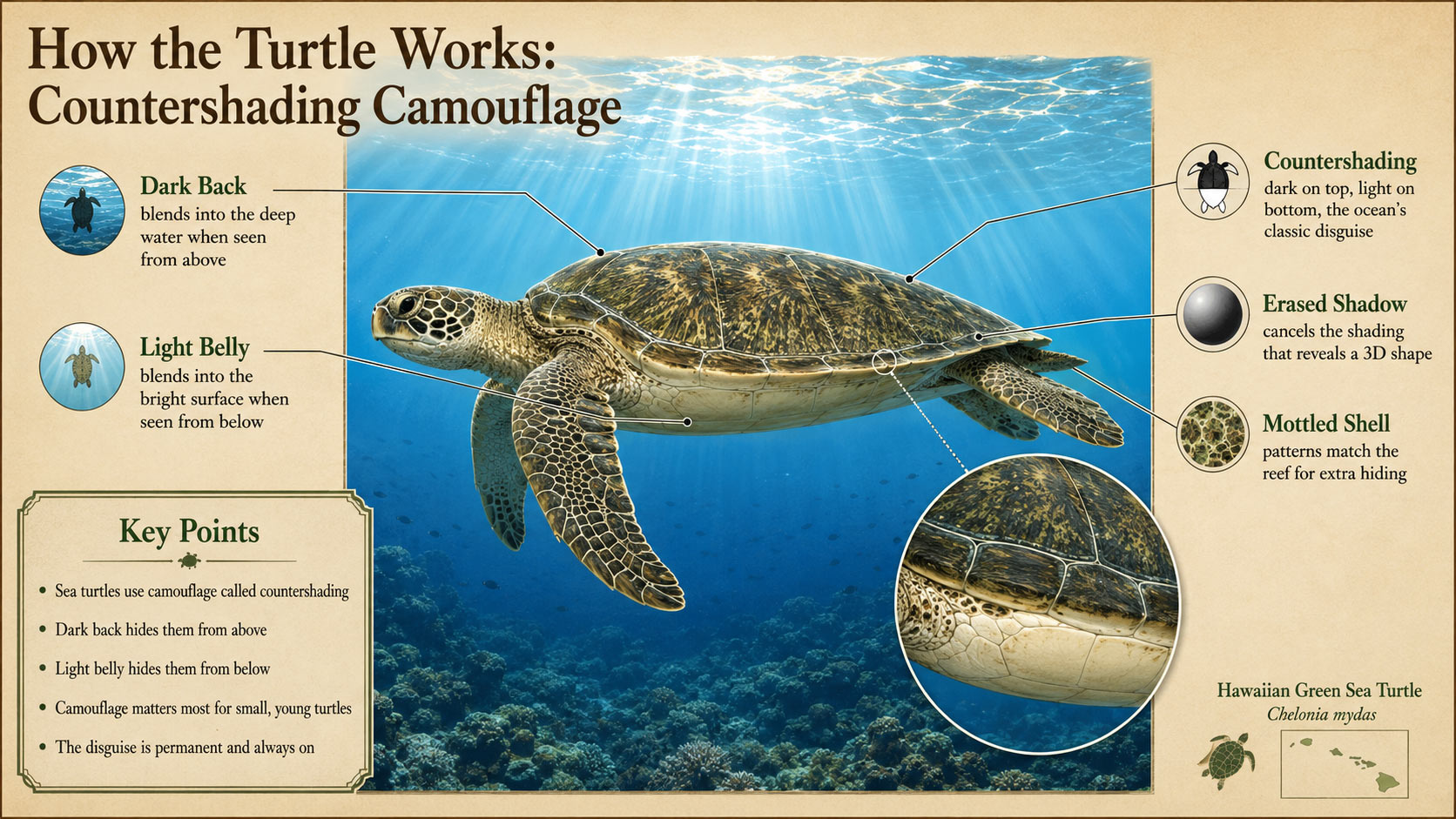
The main way sea turtles camouflage themselves is through a pattern known as countershading. In plain terms, a sea turtle is dark colored on its upper shell and much lighter colored on its underside. This is not just for decoration. It is a survival strategy that helps break up the turtle’s outline and blend it into the water no matter which direction a predator is looking from. When something looks down at the turtle from above, the dark back hides it against the deep, shadowy water below. When something looks up at it from beneath, the pale belly hides it against the bright, sunlit surface above. One simple color scheme, two directions of protection. It is one of the most elegant and common camouflage tricks in the entire ocean, and the sea turtle wears it beautifully.
What Is Countershading?
Countershading is a type of natural camouflage where an animal is darker on the side that faces the light and lighter on the side that faces away from it. In the ocean, light always comes from above, streaming down from the sky through the surface. So a sea turtle is dark on its back, the side that catches the sunlight, and light on its belly, the side that sits in shadow. If you have ever noticed that many ocean animals share this look, from sharks to penguins to countless fish, you have been spotting countershading without knowing its name. It is one of nature’s favorite designs because it solves a tricky problem. In open water, there is nowhere to hide, no bush or rock to duck behind. So instead of hiding behind something, these animals hide by blending into the water itself, and countershading is how they pull it off.
Hidden From Above: The Dark Back
Picture a predator swimming high above a sea turtle and looking down. Below the turtle is deep water, which grows darker and darker until it fades to black. If the turtle had a light colored back, it would stand out against that darkness like a bright spot, easy to see and easy to target. But a honu’s back is dark, a mix of greens, browns, and near black tones, so when a predator peers down, the turtle’s shell blends right into the gloom of the deep water beneath it. The dark carapace essentially melts into the shadowy background, making the turtle very hard to pick out from above. This matters because some ocean predators, and even seabirds near the surface, do their hunting by looking down into the water for a meal. The dark back is the turtle’s way of vanishing against the deep.
Hidden From Below: The Light Belly
Now flip the view. Picture a predator swimming below the turtle and looking up toward the surface. Up there, the water is bright, glowing with sunlight filtering down from above. A dark belly would show up against that brightness as a clear, obvious silhouette, a dark shape framed against the light like a target. But a sea turtle’s belly is pale, a light cream or yellowish white, so when a predator looks up, the turtle’s underside blends into the bright, sunlit water above it. The turtle nearly disappears against the glow of the surface. This is important because many ocean hunters, especially large predators like sharks, often attack from below, rising up out of the deep toward prey outlined against the light. The pale belly is the honu’s defense against exactly that kind of ambush, helping it fade into the brightness overhead.
Erasing The Shadow
There is one more clever thing countershading does, and it has to do with shadows. In normal light, any solid object looks three dimensional because it is brighter on top, where the light hits, and darker underneath, where it falls into shadow. That shading is a big part of how our eyes recognize a shape as a rounded, solid body. Countershading flips this on its head. By being dark exactly where sunlight would naturally brighten it, and light exactly where shadow would naturally darken it, the sea turtle cancels out its own shading. The result is that the turtle looks flatter and less solid, which makes its rounded body harder for a predator’s eyes to pick out as a three dimensional animal. In effect, the turtle erases the very shadows that would give away its shape. It is a subtle trick, but it adds another layer to the disguise on top of the blending it already does.
Blending With The Reef
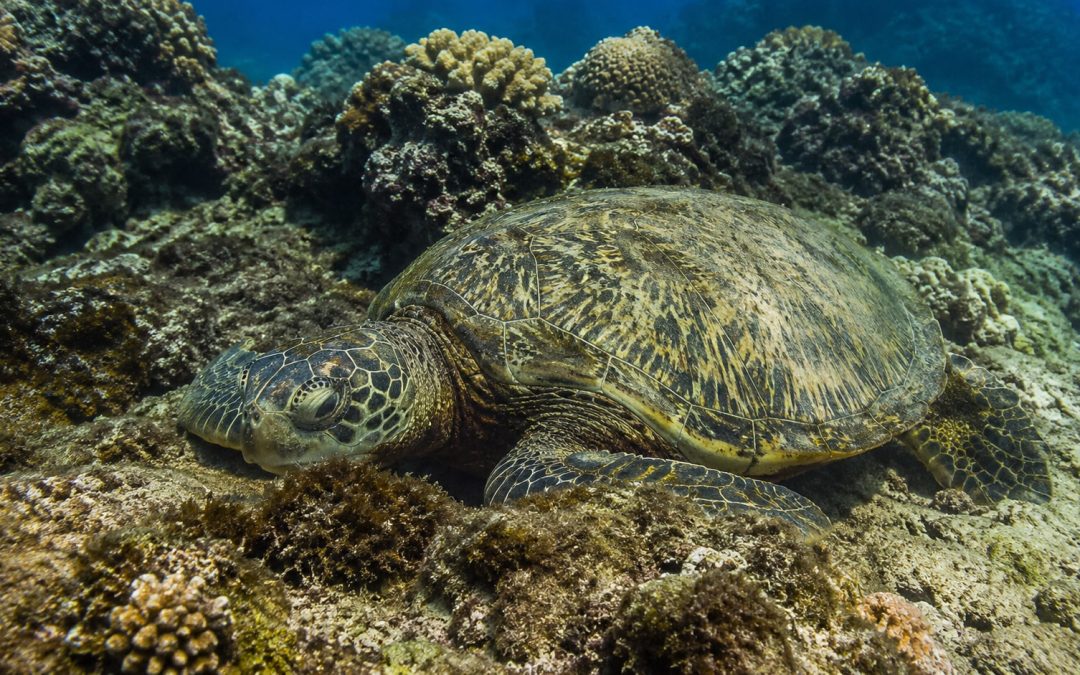
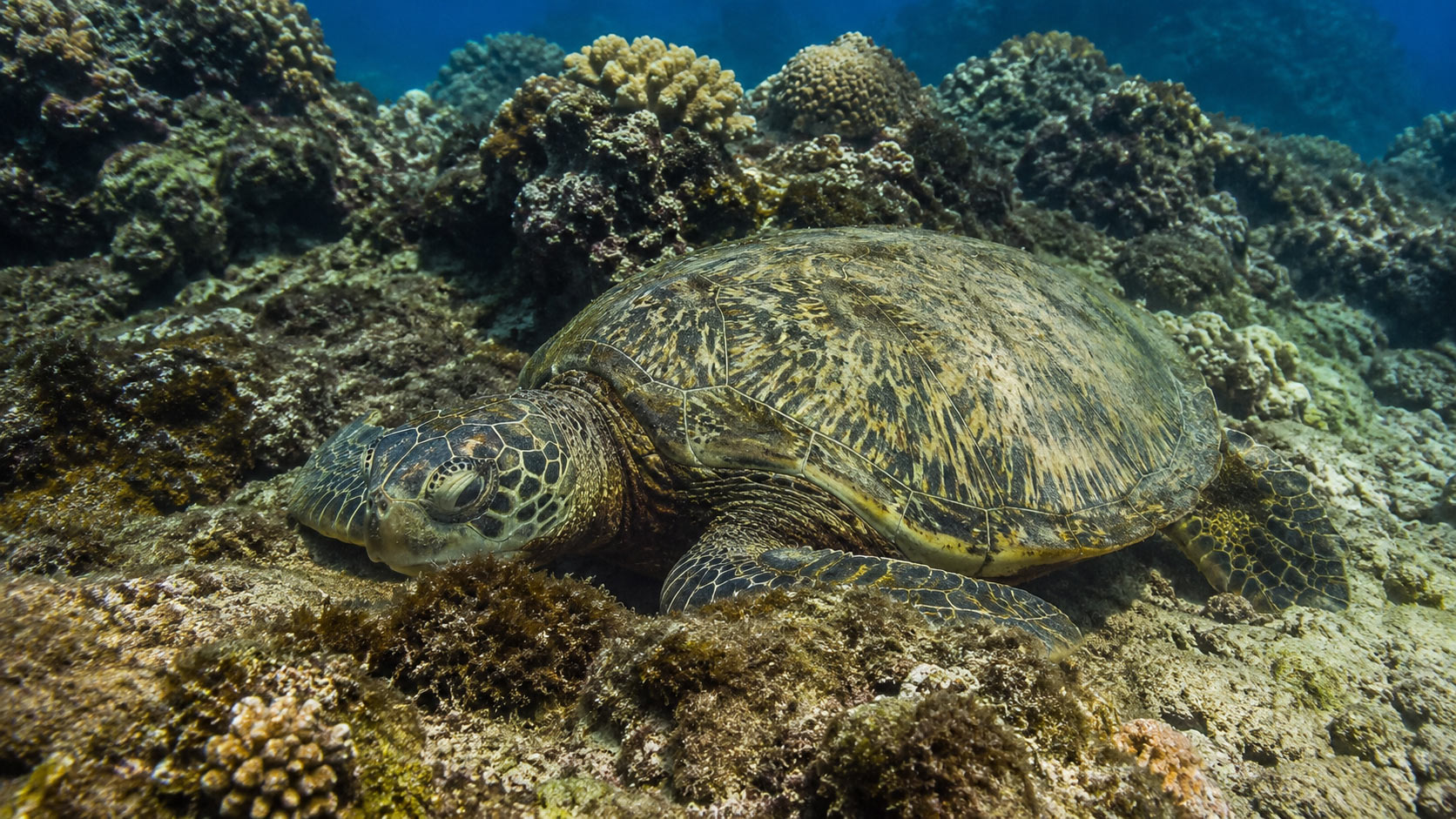
Countershading is the main event, but it is not the only camouflage a sea turtle has. The coloring and pattern of a green sea turtle’s shell also help it blend into its surroundings, especially over a reef. A honu’s carapace is not a single flat color. It is a mottled mix of dark and lighter patches, streaks, and swirls that echo the dappled light and shifting shapes of the reef below. When a turtle rests among rocks, coral, and patches of algae, that patterned shell breaks up its outline and helps it fade into the busy background of the seafloor. The colors of a green sea turtle even connect to what it eats, since a diet rich in algae and seagrass is part of what gives the species its greenish tones. So between the countershading and the mottled reef matching pattern, a resting honu can be surprisingly tricky to spot, blending into the very reef it calls home.
Who Is The Turtle Hiding From?
If a big adult sea turtle has so few enemies, you might wonder why it needs camouflage at all. The answer is that a turtle is not always big, and the ocean is full of hungry mouths. A full grown honu is large and armored enough that only the biggest predators, like large sharks, pose much of a threat. But camouflage is a lifelong tool, and it matters most when a turtle is young, small, and vulnerable. Baby and juvenile turtles face a long list of predators, from fish and seabirds to crabs and larger ocean hunters. For a small turtle drifting in the open sea, blending into the water can be the difference between living another day and being eaten. So while an adult honu wears its countershading like a comfortable old coat, that same disguise was doing life saving work back when the turtle was a tiny, defenseless youngster.
The Riskiest Years: Hatchlings And The Lost Years
Camouflage is never more important than in a sea turtle’s earliest days. It is often said that only about one in a thousand hatchlings survives to adulthood, and the journey is brutal from the very first moment. When baby turtles scramble from their sandy nest to the sea, they are bite sized snacks for crabs, birds, and fish, and countless little ones never make it. Those that reach the water then vanish into the open ocean for a mysterious stretch of early life that scientists call the lost years, drifting far from shore among floating seaweed. Out there, camouflage is a young turtle’s constant companion. Its dark back and light belly help it stay hidden from the many predators that would happily eat such a small, soft creature. Every honu you see gliding calmly over a Hawaiian reef survived those terrifying early years, and its camouflage was part of how it beat the staggering odds.
Camouflage They Cannot Change
It is worth clearing up one common mix up. A sea turtle’s camouflage is not like an octopus or a chameleon that can change color on command. A honu cannot shift its shades to match a new background or flash a pattern to hide. Its countershading and shell coloring are fixed, built into the animal from birth, a permanent disguise rather than a costume it can swap out. This is called passive camouflage, meaning it works simply by existing, without the turtle doing anything at all. In a way, that makes it even more remarkable. The turtle does not have to think about hiding or actively blend in. It simply wears a body that evolution shaped over millions of years to melt into the ocean automatically, day and night, whether the turtle is swimming, resting, or asleep. The disguise is always on, doing its quiet work every second of the turtle’s life.
A Trick Shared Across The Ocean
One of the neatest things about sea turtle camouflage is realizing how many other animals use the very same trick. Countershading is everywhere in the ocean. Sharks have it, with darker backs and paler bellies. So do dolphins, penguins, and a huge range of fish, from tiny sardines to massive tuna. Even some animals on land and in the sky share the pattern. This tells us that countershading is one of nature’s most successful and time tested solutions to the problem of staying hidden in open space. When so many different creatures, hunted and hunters alike, independently landed on the same dark on top, light on bottom design, you know it works. The sea turtle is simply one member of a very large club of animals that learned to disappear by matching the light of their world, and it has been perfecting the look for a very long time.
What This Means For Snorkelers At Turtle Canyon
Here is a fun takeaway you can use in the water. Because sea turtles are so well camouflaged, they can be trickier to spot than you might expect, especially a turtle resting quietly on the reef. That dark, mottled shell that blends into the coral and rocks means a still honu can sit right in front of you and be easy to miss until it moves. When you snorkel at a place like Turtle Canyon off Waikiki, it pays to slow down, scan carefully, and look for the shape of a shell tucked among the reef rather than expecting a turtle to stand out in bright color. Once you train your eye to notice that rounded outline and gentle movement, you will start spotting turtles you would have swum right past. Knowing about their camouflage does not just make you a better turtle spotter. It gives you a deeper appreciation for how perfectly these animals fit into the ocean they call home.
Watch: Sea Turtles 101
The Master Of Hiding In Plain Sight
So the peaceful honu drifting over the reef is quietly wearing one of the ocean’s oldest and cleverest disguises. Through countershading, its dark back hides it against the deep water below and its pale belly hides it against the bright surface above, while erasing the shadows that would give away its rounded shape. Add in a mottled shell that blends into the reef, and you have an animal remarkably good at hiding in plain sight. This camouflage is a permanent, built in gift, most vital during the dangerous early years when a tiny turtle must survive a sea full of predators. It is the same trick used by sharks, dolphins, penguins, and countless fish, a design so successful that nature has reached for it again and again. The next time you float above a green sea turtle in the clear waters off Oahu, take a moment to appreciate the disguise. You are looking at a true master of hiding in plain sight, perfectly matched to the beautiful ocean it was born to blend into.