How Do Sea Turtles Mate? The Surprising Science Behind Honu Reproduction
Ancient Love Story: The Remarkable Way Hawaii’s Sea Turtles Find a Mate
When most people think about Hawaii’s sea turtles, they picture a peaceful honu gliding through clear water, resting on the ocean floor, or floating near the surface for a breath of air. What very few people ever see is the other side of these ancient animals: the dramatic courtship battles, the long ocean migrations, and the precise biological timing that makes every turtle you encounter in the wild a genuine survivor against extraordinary odds. Reproduction in the green sea turtle is one of nature’s most layered stories, and once you understand it, every glimpse of a honu takes on a completely different meaning.
It Takes Decades to Be Ready
One of the most stunning facts about sea turtle reproduction is how long it takes before any of it even begins. Hawaii’s green sea turtles do not mature sexually until they are somewhere between 25 and 35 years old. Some individuals have been documented waiting until they were 40 before mating for the first time. That is longer than most humans wait to start a family, and it is one of the reasons why these animals are still considered a protected species. The pipeline from hatchling to breeding adult is extraordinarily long, and every adult turtle lost to a boat strike, fishing gear entanglement, or pollution represents decades of growth that cannot be replaced.
You can actually tell adult males apart from females just by looking at their tails. Once a male green sea turtle reaches sexual maturity, his tail grows long and thick, sometimes extending well beyond the rear edge of his shell. Female tails remain short. It is one of the most visible physical differences between the sexes, and when you spot it underwater, you are looking at an animal that has already survived 25 or more years in the wild.
Courtship Happens in the Open Ocean
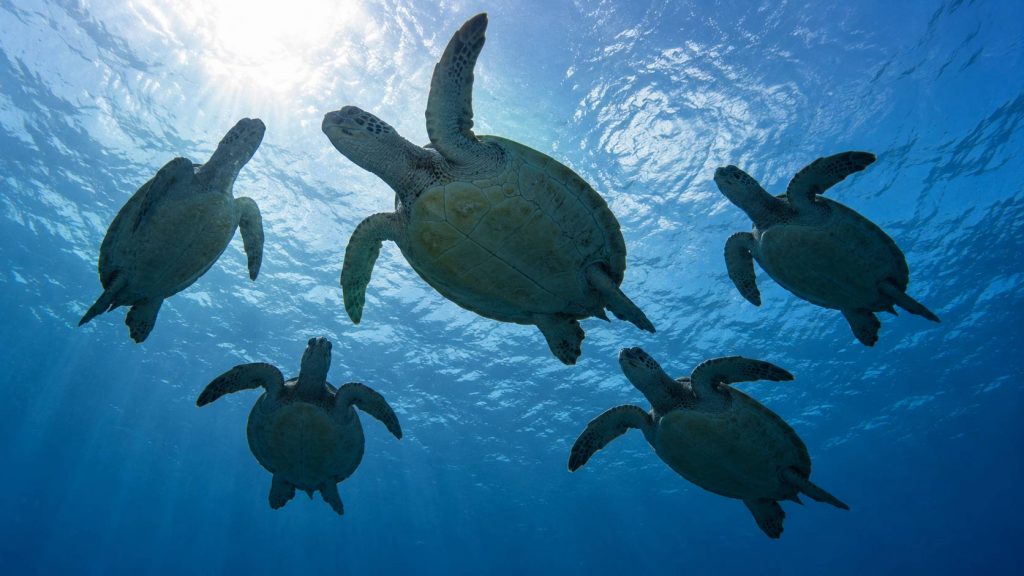
Sea turtles do not mate on land. Everything that leads to the next generation begins in the water, and it is considerably less graceful than the turtles’ peaceful reputation might suggest. During mating season, multiple males will pursue a single female, competing aggressively for the chance to mate with her. The competition can be intense, with males biting at each other and at the female, leaving visible marks on shells and flippers. Off Hawaii’s coast, this behavior typically takes place near feeding areas, along migration routes, and just offshore from nesting beaches in the spring months.
When a male successfully mates with a female, the process can last several hours. Mating takes place at the water’s surface or just below it, with the female supporting the male on the back of her shell while simultaneously surfacing to breathe for both of them. It is a demanding physical event for the female, who must keep both animals afloat through the entire process.
One Female, Multiple Fathers
Something many people do not realize is that a single clutch of sea turtle eggs can have more than one father. Females are capable of storing sperm from multiple males and using that stored sperm to fertilize successive clutches across an entire nesting season. This biological ability, called multiple paternity, means that the eggs a female lays over the course of a few months may carry the genetics of several different males who mated with her weeks or even months earlier.
Researchers believe this genetic diversity serves the species well. A nest with varied genetics produces hatchlings that are better equipped to handle a range of environmental conditions. What looks like chaotic competition among males in the water is actually a finely tuned biological system that helps the species adapt and survive across generations.
The 600-Mile Journey to Nest
After mating, Hawaii’s female green sea turtles begin one of the most remarkable migrations in the animal world. More than 90 percent of them leave the main Hawaiian Islands and swim northwest for roughly 600 miles to a remote stretch of atolls and reefs known as French Frigate Shoals, part of the Papahanaumokuakea Marine National Monument. This is the primary nesting ground for Hawaiian green sea turtles, and females return to it season after season throughout their lives.
The males stay behind. In fact, once a male green sea turtle crawls out of the nest as a hatchling and enters the ocean for the first time, he never returns to land for the rest of his life. Only females come ashore, and they do it solely to lay eggs. Every male sea turtle you see at Turtle Canyon or anywhere in Hawaii’s coastal waters is living out his entire existence in the ocean, from the moment he was born.
Digging In and Laying Eggs
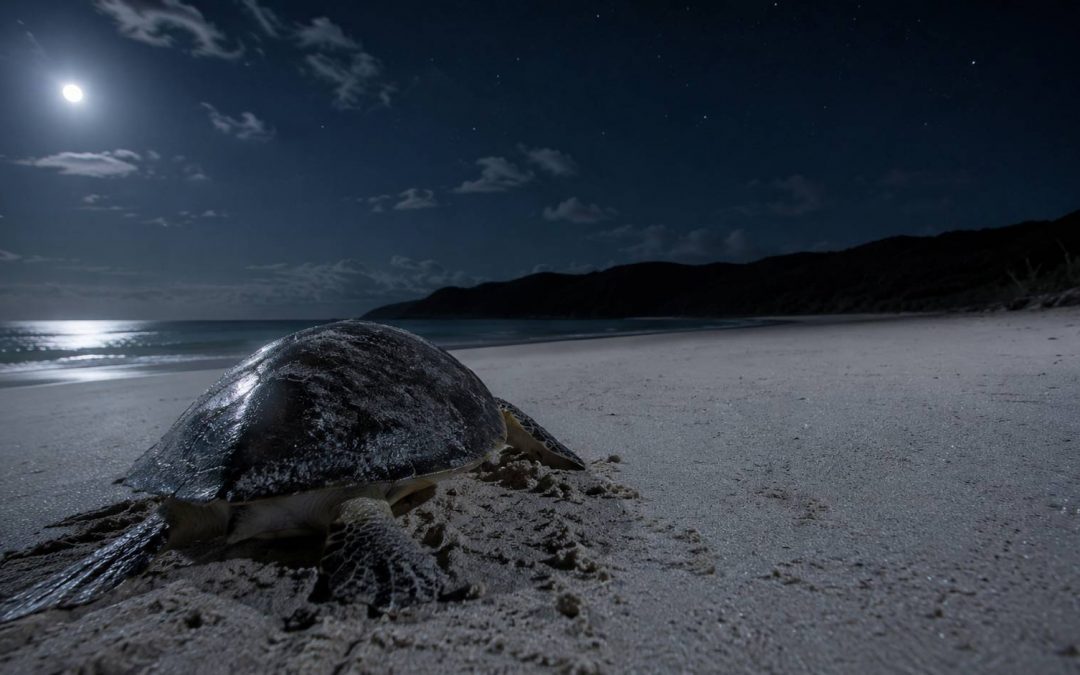
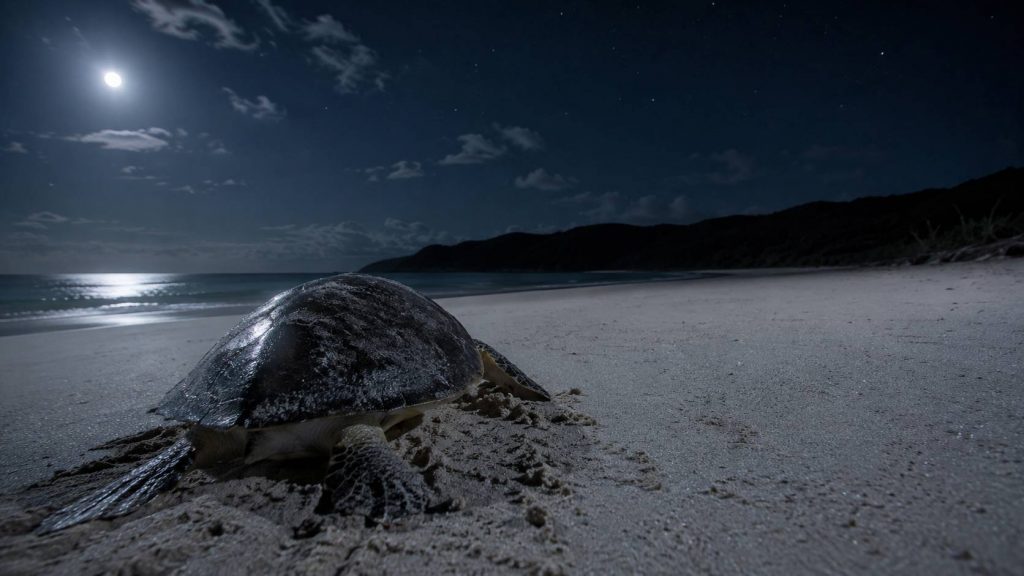
Female green sea turtles arrive at the nesting beach at night. Using her rear flippers, the female digs a flask-shaped hole in the sand called a nest chamber. She works methodically, sometimes for an hour or more, until the hole is deep enough to protect the eggs from predators and the heat of the midday sun. Then she lays her clutch before covering the nest, disguising the surface, and returning to the sea. The whole process happens in darkness, and the female does not eat, rest, or linger.

One female does not stop at a single nest. Over the course of a nesting season, she may come ashore and lay eggs up to six times, spacing her visits roughly two to four weeks apart. This is an enormous physical investment, and it happens only once every two to four years. Female green sea turtles do not breed every year because they need time to recover and rebuild their energy reserves before the next season.
- Average clutch size: 75 to 100 eggs
- Average nests per season: 4 to 6
- Time between nests: 2 to 4 weeks
- How often females breed: every 2 to 4 years
The Temperature That Decides Everything
Once the eggs are buried, the female’s role is complete. The nest incubates on its own, warmed by sunlight filtering through the sand above. What determines whether each hatchling will be male or female is not genetics — it is temperature. Warmer sand produces more females. Cooler sand produces more males. This process is known as temperature-dependent sex determination, and it makes sea turtles especially sensitive to shifts in global climate.
As global temperatures continue to rise, researchers have noted a significant skew in the ratio of male to female hatchlings across many sea turtle populations worldwide. More heat in the sand means more females hatching, which may eventually reduce the number of males available to breed. In some populations the ratio has already shifted dramatically. Hawaiian green sea turtles face the same pressure, and scientists track hatchling sex ratios carefully as part of long-term population health monitoring.
Two Months Underground, Then the Race Begins
The eggs incubate for approximately 60 days. When the time comes, hatchlings use a temporary sharp egg tooth to break free of their shells. The entire nest tends to hatch around the same time, and the young turtles work together from inside the sand column, stimulating each other to push upward toward the surface. They typically emerge at night, when temperatures are cooler and fewer predators are active on the beach.
Once on the surface, hatchlings follow the brightest horizon. In an undeveloped coastal setting, that means the ocean, which reflects the sky with more light than the dark vegetated land behind the beach. They sprint across the sand toward the water, a run that can be interrupted by birds, crabs, and other predators waiting in the dark. Estimates suggest that only about one in one thousand hatchlings will survive to adulthood. The odds are severe, which is exactly why females lay so many eggs, return so many seasons, and why protecting nesting habitat matters so much to the survival of the species.
What You Are Really Seeing at Turtle Canyon
When you snorkel at Turtle Canyon off Waikiki with Turtles and You, every adult green sea turtle you encounter has already beaten every set of odds described in this post. It has survived the sprint across the beach, the years drifting through open ocean as a juvenile, the decades of growth in Hawaiian waters, and possibly a mating season of its own. The honu drifting calmly alongside your snorkel fins has a life story that spans longer than most people’s careers.
That context is part of what makes these encounters worth protecting. Hawaii’s Endangered Species Act protections and the conservation work done in and around Papahanaumokuakea have given Hawaiian honu a genuine fighting chance at recovery. Seeing a healthy adult green sea turtle in Hawaii’s warm blue water is not just a beautiful moment on a vacation. It is evidence that decades of protection and careful conservation are actually working.
Every Turtle in the Water Has Already Won
Behind every peaceful honu drifting through the waters off Waikiki is a survival story that stretches back decades. From the long wait before maturity, to the fierce competition at sea, to the 600-mile migration and the nighttime sprint across the sand as a hatchling, sea turtle reproduction is one of the most demanding biological processes in the ocean. The turtles you see at Turtle Canyon are the rare ones who made it through every stage. If that does not make you want to snorkel out and say hello, nothing will.