How a Waikii Turtle Tour Boat Avoids Hitting an Oahu Sea Turtle
Overview
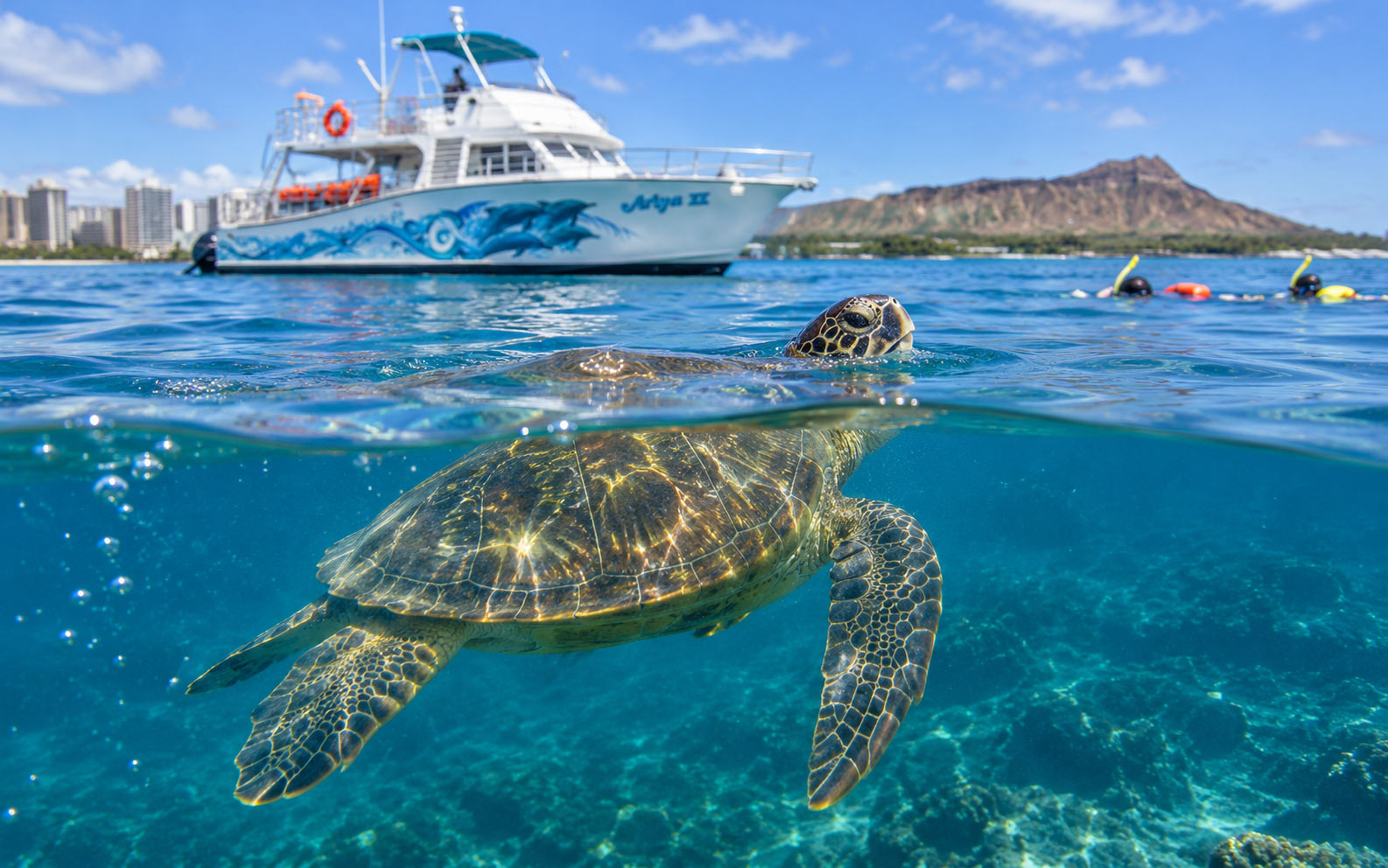
A green sea turtle breathes air. That one fact is the whole problem. However much time a honu spends grazing a ledge twenty feet down, it has to come up, and when it does it floats at the surface with maybe a few inches of wet shell breaking the water. No splash, no spout, no noise. From the deck of a moving boat that is almost nothing to look at, and it is sitting in exactly the band of water a hull and a propeller pass through. Boat strikes injure and kill Hawaiian green sea turtles every year, and almost every one of those cases traces back to speed, attention, or both. Which is also the hopeful part, because speed and attention are two things a crew gets to decide.
The Short Answer
A tour boat avoids hitting a sea turtle by going slow enough to react and by having more than one person whose actual job is watching the water. Everything else is detail built on top of those two things.
Slow water speed buys the time to see a turtle and change course. A posted lookout is what turns that time into a decision. There is no clever technology that replaces either one.
How Often This Really Happens in Hawaii
This is not a hypothetical worry dressed up as a safety talk. NOAA Fisheries takes in somewhere between roughly ten and twenty five boat struck turtles in Hawaii in a typical year, and the agency is careful to call that a conservative number, because a turtle hit offshore does not always wash up somewhere a person will find it. The real total is higher than the one anybody can count.
Some years are much worse. In 2020, state and federal wildlife officials tallied 22 reported boat strike turtles across Oahu, Kauai and Maui in the space of about nine months and went public asking boaters to slow down. One of those cases was a 150 pound green turtle whose shell was shattered and whose spinal cord was damaged. It could not be saved.
That is the pattern with these injuries. A strike is either blunt force trauma from the hull or clean cuts from the propeller, and often both. Most struck turtles do not survive, and the ones that do usually need months of care.
Why a Honu Is Easy to Miss
Four things stack against the turtle, and a crew that understands all four watches the water differently.
- A surfacing turtle shows almost nothing. A breath takes a few seconds and the profile above water is low, dark and the same color as shadow on a swell
- There is no wake or spray to catch your eye. A turtle at the surface is silent and nearly still, unlike a dolphin or a whale
- Big turtles react slowest. Wildlife officials specifically flag large subadults and adults as the ones that struggle to get out of the way of a fast boat, which is the opposite of what most people assume
- Chop hides everything. A light wind texture on the surface is enough to erase a turtle’s head from a hundred feet away
There is also the question of what a turtle hears coming. Research published in early 2026 on Kemp’s ridley turtles, a close relative of the Hawaiian green, or Chelonia mydas, found their hearing is sharpest around 200 to 300 hertz and falls off above about 400 hertz. That low band overlaps the noise an engine and propeller make, which means boat sound can blur into the general background rather than stand out as a warning. The scientists who ran the study are careful about how far that goes, and they say it shows where the overlap sits, not that turtles fail to notice boats. Either way, nobody should be counting on the animal to move first.
Where Strikes Actually Happen
Here is the detail that shapes how a tour runs its day. Most boat strikes in Hawaii happen in relatively shallow water close to shore, and very often in or right around small boat harbors and launch ramps. Not way offshore. Not out at the dive site. In the first and last few minutes of the trip.
That makes sense once you say it out loud. Harbors are narrow, busy and shallow. Turtles feed on algae growing on the rocks, walls and shallow bottom inside and around them. The channel out is the one stretch where a lot of boats and a lot of turtles are crowded into the same small piece of water. It is also the stretch where a crew is busiest with lines, gear and guests, which is exactly why the rules are strictest there.
Rule One, the Throttle
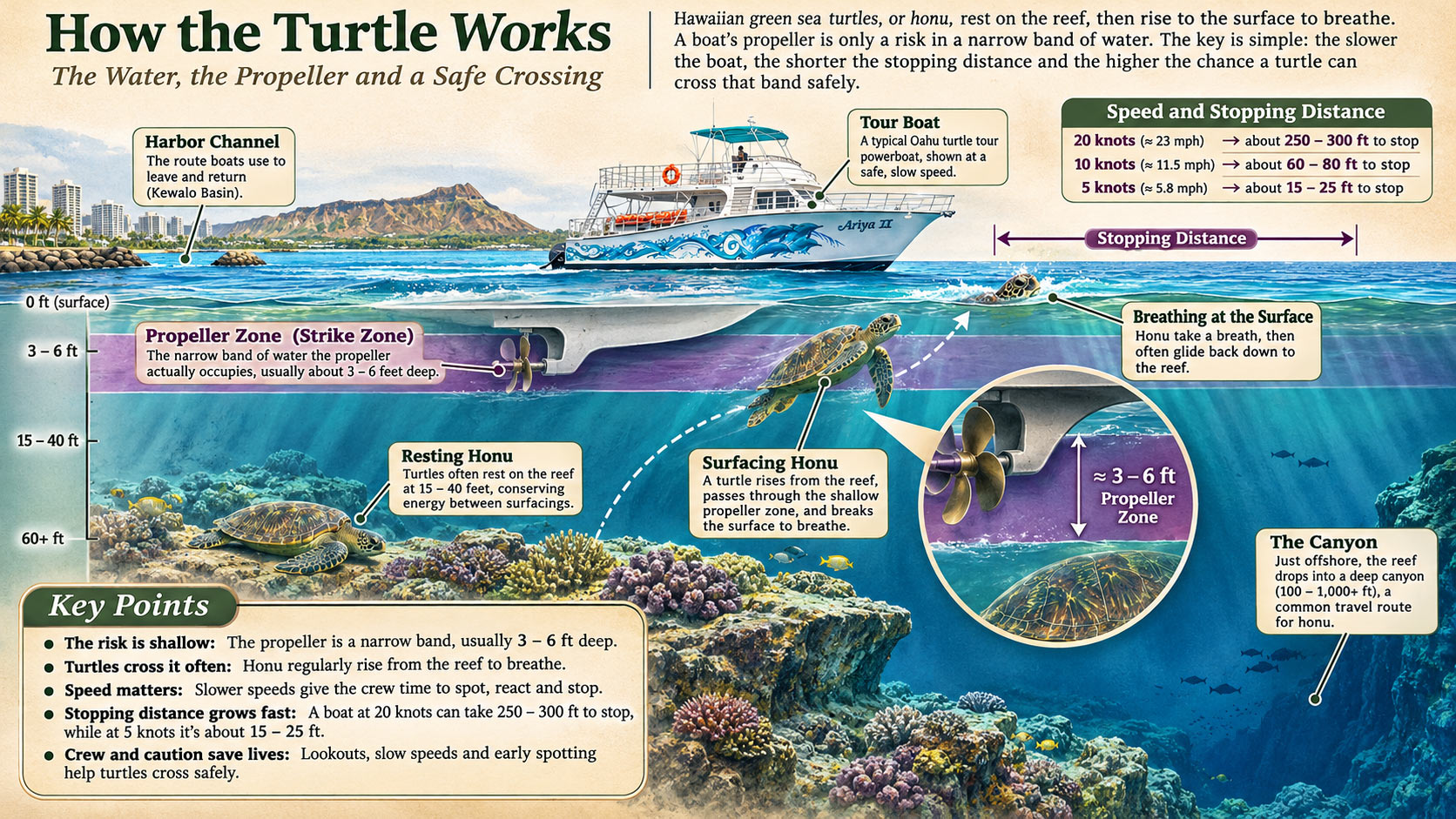
The single most effective thing a boat can do is simply not go fast in the places turtles are. Federal and state guidance for Hawaii is specific about it. Run 5 to 10 knots near and around harbors. Hold a slow or no wake speed within 200 feet of shore, and keep personal watercraft beyond 300 feet. Ease off the throttle until the boat is out in deeper water, and keep the speed moderate anywhere over shallow reef.
Those are not suggestions a captain weighs against the clock. Speed limits and no wake zones in and around harbors are always in effect, and on a turtle snorkeling Oahu trip there is no reason to push them anyway. The site is a short run from Kewalo Basin, roughly ten to fifteen minutes, so the few minutes saved by running hard through the channel would buy nothing and risk a lot.
Slower also means quieter and smoother, which is why the ride out on a well run tour feels unhurried rather than like a race.
Rule Two, Somebody Is Watching
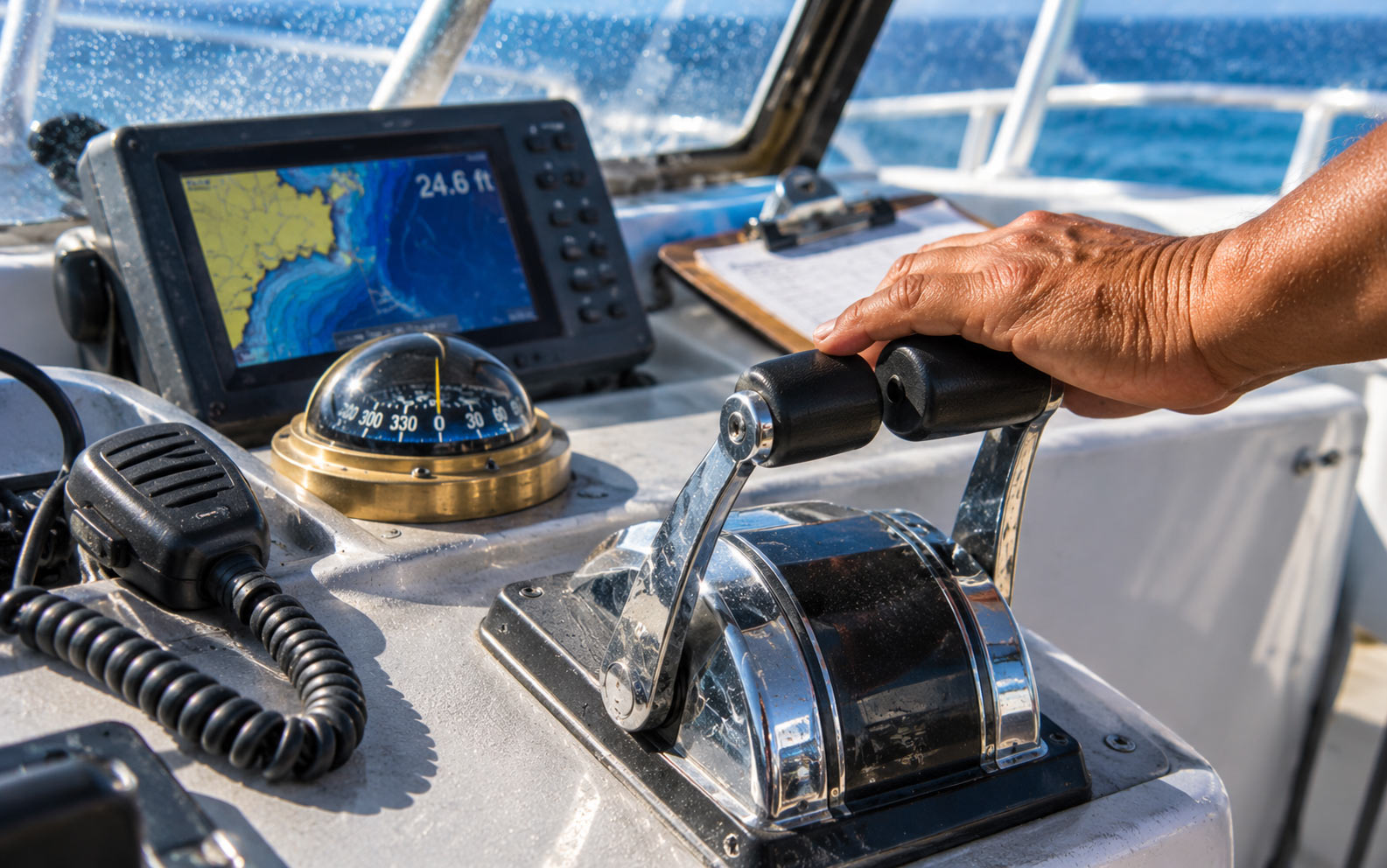
Both NOAA and the state Division of Boating and Ocean Recreation ask operators to post a lookout when running near reef, and to use extra sets of eyes on board wherever possible. On a tour boat that part is easier than it is for a private boater, because there is a crew rather than one person doing everything.
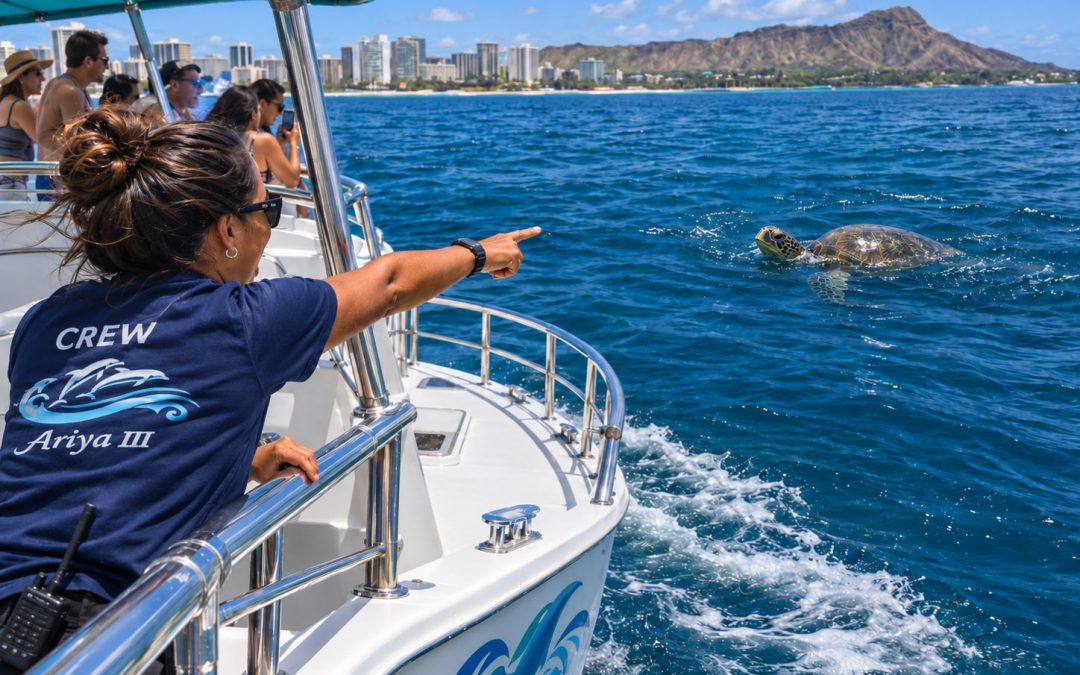
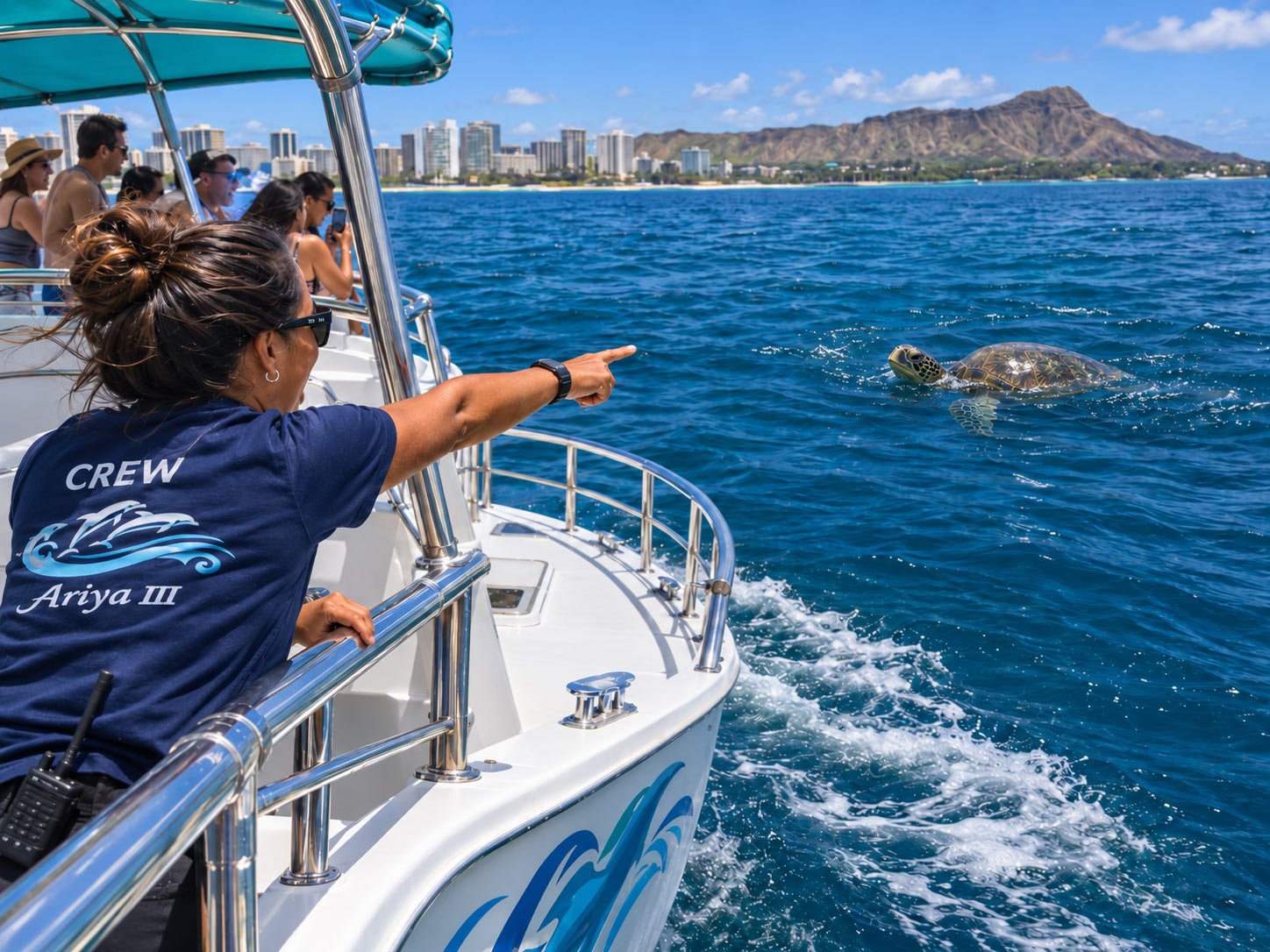
What that looks like in practice is layered. The captain is up at the helm with the highest sightline on the boat, which is one of the quiet advantages of a double-deck powerboat like the Ariya II. A crew member who is not steering is looking at the water ahead. And with a deck full of guests, there are a dozen more people facing forward with nothing else to do, which is the reason a crew tells you to sing out if you see something. That is not customer entertainment. It is the lookout system working.
A lookout is also looking for more than turtles. The same scan catches coral heads, swimmers, divers, floating debris and the other small hazards that live in nearshore water.
What Happens When a Turtle Is Spotted
The response is short and boring, which is the point. Speed comes off, the boat is put in neutral when a turtle is close, and the turtle is given the space to do whatever it was going to do. Nobody steers toward it for a better look and nobody idles over the top of it. Three habits do most of the work here.
- Come off speed first, then decide. Slowing down is never the wrong first move
- Go to neutral when an animal is near the hull, because a spinning propeller is the part that does the worst damage
- Steer around and keep going, rather than circling back. Circling puts the boat over the animal again at the moment it is surfacing
A turtle that surfaces, breathes and dives away unbothered is the whole goal. The best possible version of this story is the one where nothing happens and the turtle never changes what it was doing.
At the Site, the Engines Go Off
The safest configuration on the entire trip is the one guests spend the most time in. Once the boat is in position over Turtle Canyon Oahu and people are getting ready to get in, the engines are shut down. There is no propeller turning anywhere near the honu or the swimmers for the entire time everyone is in the water.
That is also why a turtle snorkeling Oahu tour works at all as a way to see these animals. A still, quiet boat with people floating calmly at the surface in life jackets is about as low impact as a boat full of visitors gets. The honu are moving around fifteen to twenty five feet below, going about their afternoon, and nothing above them is chasing anything.
Hawaii has a related program worth knowing about. The state maintains day-use moorings at popular sites so boats can tie to a fixed buoy instead of dropping an anchor that tears up living coral. Moorings are daytime only, with a two and a half hour limit when another boat is waiting, and anchoring is not allowed within a hundred yards of an established mooring where there is live coral. It is a reef rule rather than a turtle rule, but the two are the same thing in the end. The reef is the reason the turtles are there.
The Part Guests Play
Visitors tend to assume turtle protection is entirely the crew’s department. On a boat it mostly is, but there are a few things only guests can do.
- Say something the second you see an animal, even if you think the crew already saw it. Two people calling the same turtle costs nothing
- Wait for the all clear before entering the water, and get back on board when you are asked. The crew needs to know where every person is before an engine starts
- Stay with the group rather than swimming off on your own, so the captain can keep track of the whole party at a glance
- Keep your distance in the water. The guidance in Hawaii is to stay about ten feet off a honu and let it decide how close it wants to come
- Never feed or touch a turtle. A honu that learns to approach boats and people for food is a honu that will keep swimming up to the next one
Small group sizes help with all of this, which is part of why eco certification with the Sustainable Tourism Association of Hawaii and a proper honu etiquette briefing before anyone gets wet are worth more than they sound.
If a Turtle Does Get Hit
Accidents happen even to careful people, and the worst reaction is to leave quietly. Hawaii has a statewide Marine Wildlife Hotline at 1-888-256-9840 for reporting an injured, stranded or struck sea turtle, and reporting a collision is what gives the animal a chance at rescue and rehab.
Green sea turtles in Hawaii are protected under state law and federal law, including the Endangered Species Act, so harassing or harming one carries real consequences. That is worth saying plainly, but it is not the reason to make the call. The reason is that a turtle with a cracked shell found in the first hours has a far better outcome than one found days later.
The Best Part of the Trip Is the Part You Never Notice
Nobody books a boat trip to admire a throttle at idle. But the reason a tour can go out to the same stretch of water off Oahu year after year and still find honu resting on the same ledges is that the boats working there have mostly stopped being a threat to them. Slow speed through the channel. Somebody always watching. Engines off while people are in the water. None of it photographs well.
The turtles at the canyon have been coming back to that spot for generations, long before any of this had a schedule attached. The best thing a boat can do is show up, stop, and not matter very much. If you would like to see how the trip itself runs, the Turtle Canyon tour page lays out the day, and the crew will happily tell you why they are only doing six knots on the way out.