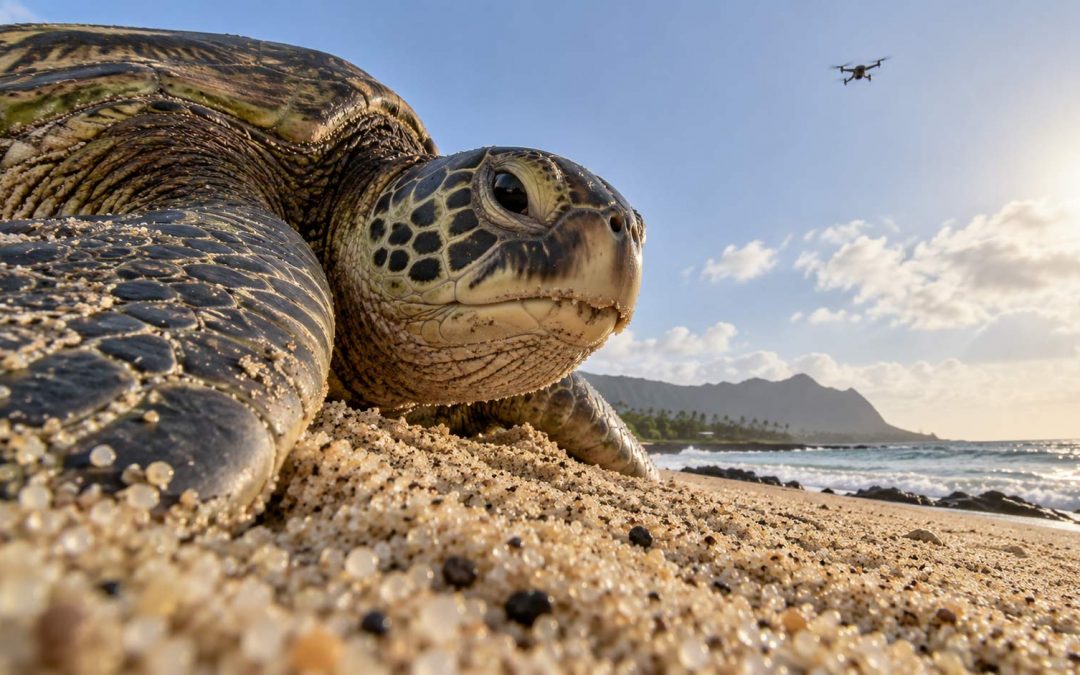
Drones and Honu: Hawaii’s Rules for Filming Sea Turtles From the Air
Overview
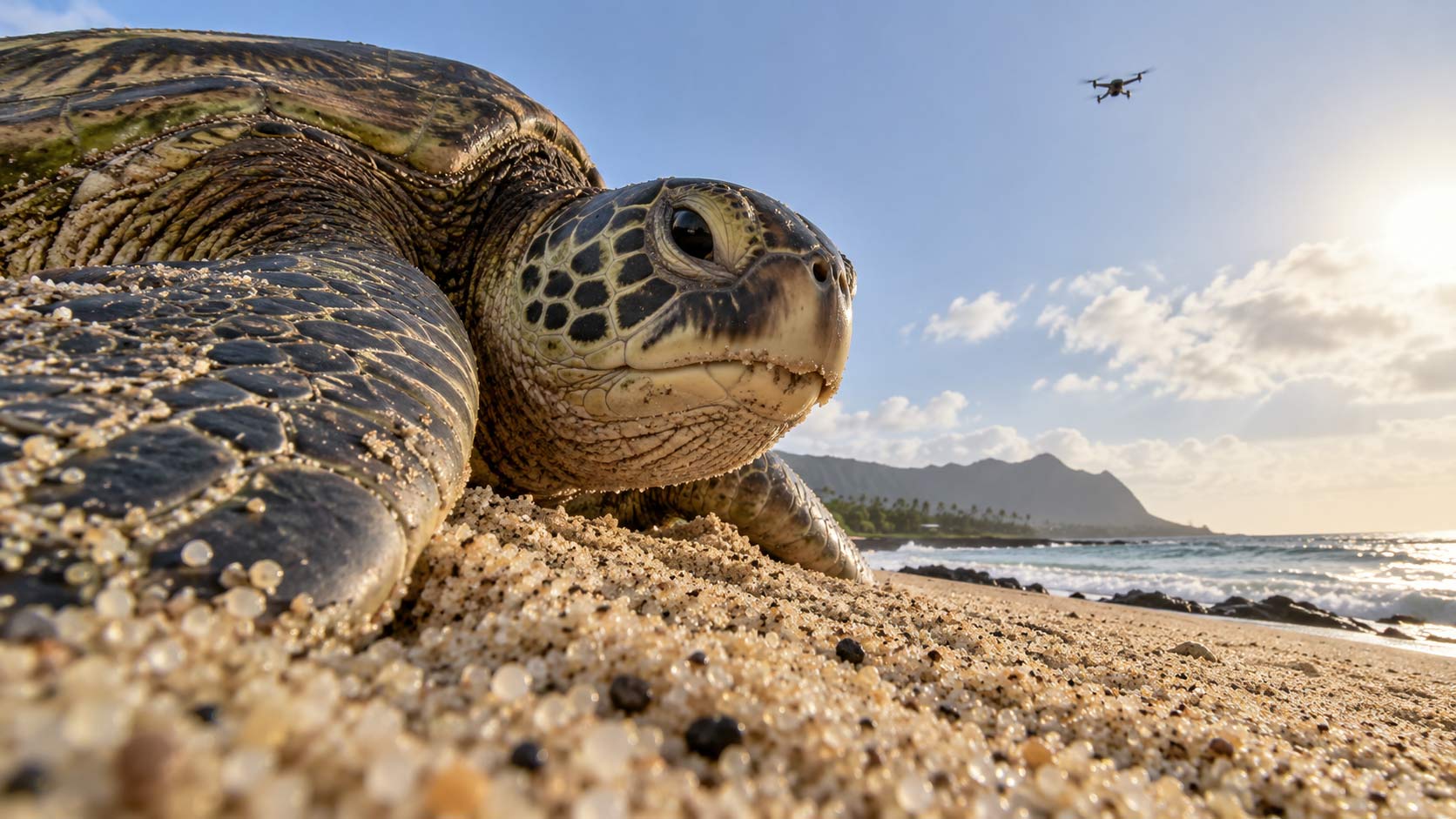
Ten years ago nobody needed a rule about this. Now a good drone fits in a jacket pocket, costs less than a nice camera lens, and a sea turtle resting on a Hawaiian beach is one of the most tempting subjects on the island. The gear got cheap and easy faster than visitors learned the etiquette, and basking honu ended up absorbing the difference. The part that trips people up is not that they are trying to break a law. It is that they are looking for a number to obey, some altitude that makes the shot fine, and no such number exists for sea turtles. What the law actually watches is the turtle.
The Short Answer
You can legally fly a drone in many places in Hawaii. What you cannot do is operate it in a way that changes a sea turtle’s behavior.
If a resting honu lifts its head, turns, starts moving, or hauls itself back into the ocean because of your drone, that is harassment under federal law, and intent does not matter. The turtle reacting is the evidence. A pilot who says they were being careful and a turtle that just fled the beach cannot both be the official version of events.
So the honest answer to “how high do I have to be” is that height is only useful insofar as it keeps the animal from noticing you.
The Legal Test Is Behavior, Not Altitude
This is the single most important thing in this post, so it is worth being precise.
Hawaiian green sea turtles are protected under federal law and under Hawaii state law. The protected activity is defined as harassment, which means an act that disrupts normal behavior patterns such as resting, feeding or nesting. There is no published number of feet that makes a drone automatically legal over a turtle, the way there are specific distance rules for some marine mammals and specific aircraft rules near whales.
People hear about those other numbers and assume one exists for turtles. It does not. That sounds like a loophole, and it is actually the opposite, because it means you cannot point at an altimeter to defend yourself. The standard is the outcome.
NOAA’s general guidance for being near a sea turtle in person is to stay at least 10 feet away, about 3 meters, on land or in the water. Treat that as the spirit of the thing rather than a flight ceiling. A drone 10 feet above a basking turtle is obviously a problem.
Why a Drone Bothers a Resting Honu
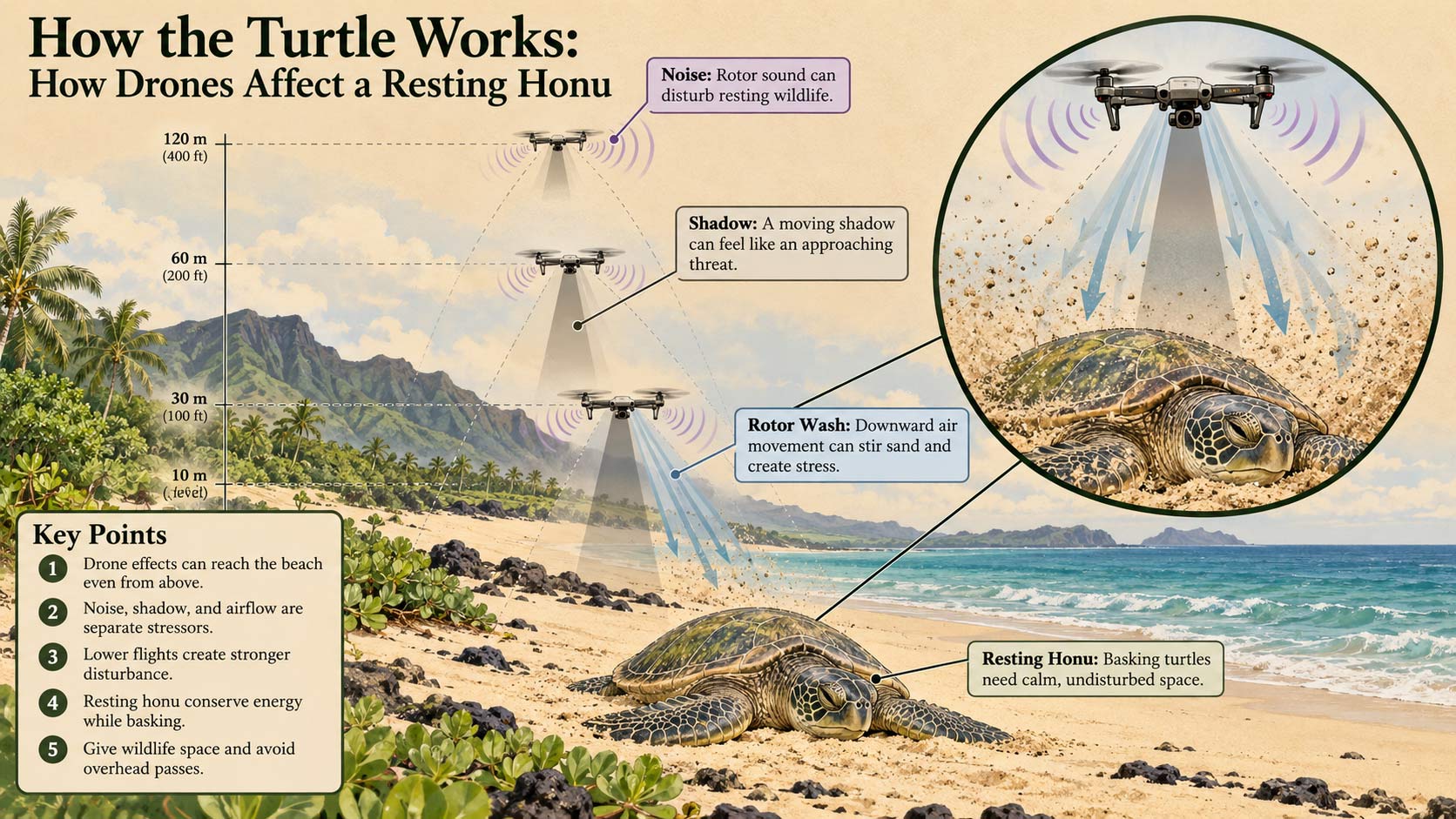
A person standing quietly 20 feet up the beach barely registers. A drone at the same distance can clear the whole animal off the sand. Three reasons, and they stack.
- The sound sits in the wrong range, a high constant whine that does not resemble surf, wind or anything else on a beach
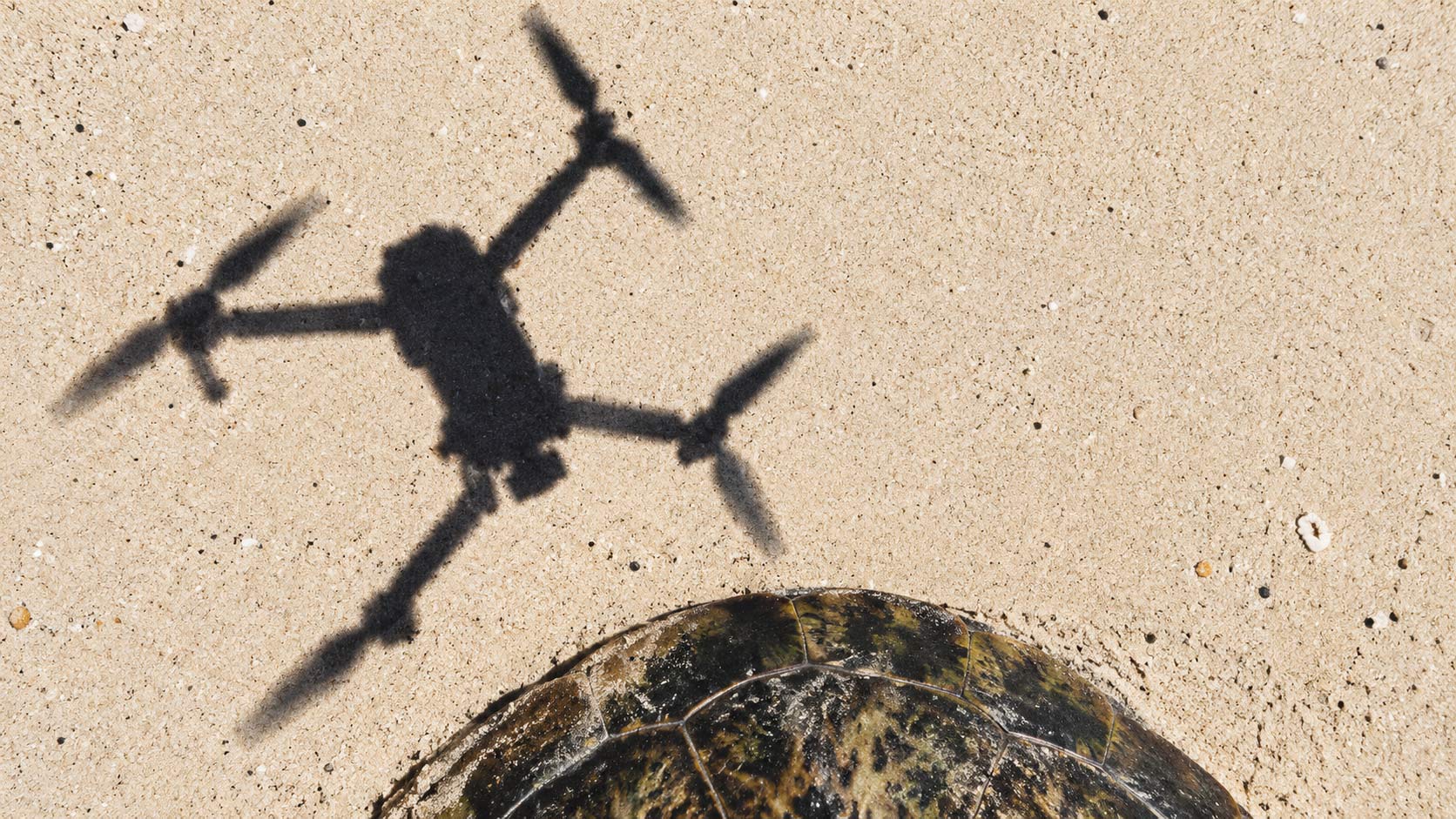
- The shadow moves overhead, and a shape passing above a vulnerable animal is the oldest predator signal there is
- Rotor wash kicks up loose sand at low altitude, which is physically unpleasant and lands on eyes and nostrils
Basking matters more than it looks like it does. A honu hauls out to warm up and rest, and Hawaii is one of very few places where green sea turtles do this at all. An animal that gets pushed off the sand repeatedly loses the actual benefit of being there. It is not one dramatic incident, it is a dozen small interruptions in a day at a popular beach.
What Gets People in Trouble in Real Life
The pattern is almost always the same, and it is rarely malicious.
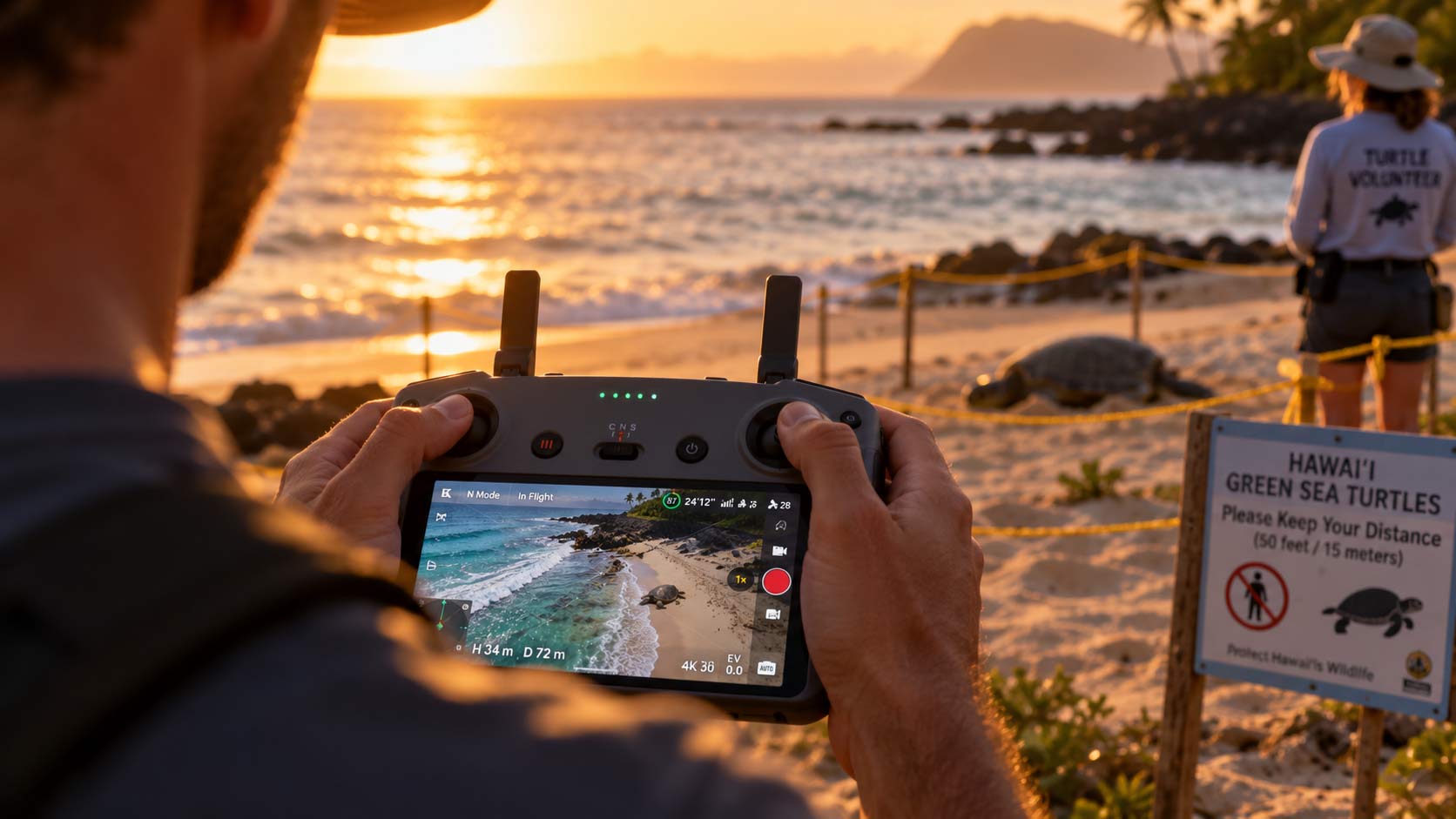
Someone launches well back from the water, which is fine. Then the shot is not quite close enough, so they descend for a better frame. Then they want the turtle centered, so they hover. Within a minute there is a machine holding position above a resting animal, and that is the part that stopped being legal.
Popular basking beaches on Oahu’s North Shore, Laniakea in particular, see this constantly. They also tend to have volunteers on the sand keeping people at a respectful distance, which means there is usually somebody present who knows the rules and will say something. Getting asked to land is the good outcome. Getting reported is the other one.
The Four Rule Sets You Are Flying Under at Once
This is where it gets genuinely confusing, because four separate systems apply at the same time and clearing one does not clear the others.
- Federal wildlife law, which protects the turtle itself and uses the harassment standard described above
- Hawaii state wildlife law, which adds its own protections for honu
- FAA rules for the aircraft, including registration for most drones over 250 grams, staying below 400 feet, keeping it in visual line of sight, not flying over people, and passing the free TRUST test for recreational flight
- Land and park rules, since Hawaii state parks require a permit for drone use, and county and private property rules vary
The important thing to understand is that the FAA does not protect sea turtles. Following every FAA rule perfectly tells you nothing about whether you just harassed a protected animal. They are different laws answering different questions, and people who have carefully done their FAA homework often assume they are covered. They are not.
Because the park and county side changes, check the current state rules before you fly rather than trusting a blog post, including this one.
Drones Done Right
None of this means drones are bad for turtles. Used properly they have become one of the best tools in sea turtle science, and it is worth seeing why.
Researchers fly high, fly briefly, and fly on a planned path rather than hovering. From altitude a drone can count animals across a huge area without a single person walking onto a beach or putting a boat over a reef. Surveys that used to mean disturbing a site for days now happen in one quiet pass. Teams have counted green sea turtle aggregations in numbers that would have been guesswork from the ground.
That is the distinction that matters. The problem was never the aircraft. It was the altitude, the hovering, and the instinct to get closer.
How to Get the Shot Without Breaking Anything
You can come home with footage you are proud of and never put a turtle under your rotors. A few habits do almost all of the work.
- Decide your altitude before you launch and do not descend for a better frame once you are up
- Never hover over an animal, fly a straight planned line and move through
- Keep it short, since a long flight over the same beach is where problems build
- Use the zoom and the crop in editing instead of closing the distance in the air
- Launch and land well away from where turtles are resting, because takeoff is the loudest moment
- Watch the animal, not the screen, and if it lifts its head or starts to move, climb away immediately
- Skip it entirely at a crowded basking beach, where the shot is not special and the risk is highest
- Film the landscape with turtles incidental in the wide frame, which usually looks better anyway
The last one is the real tip. A tight aerial of one turtle looks like every other tight aerial of one turtle. A wide shot of a Hawaiian coastline that happens to have honu on the sand tells a story.
In the Water, the Same Logic Applies
Most of this post is about the beach, because that is where basking turtles are most exposed. The underlying idea does not change offshore.
On a snorkel trip, guests are at the surface in life jackets looking down, which is about as low impact as watching wildlife gets. Put a drone above that same reef and you have added noise and a moving shadow over animals that were perfectly relaxed a moment earlier. If you bring one on a boat, ask the crew first. There is usually a good reason the answer is no.
If You See Someone Doing It Wrong
Most drone pilots over turtles are tourists who genuinely do not know. A friendly word often ends it, and that is the best possible result for everyone including the pilot.
If it is persistent, or if an animal is clearly being pushed off a beach, it is reportable to state and federal wildlife authorities, and a photo or video with a time and location is far more useful than a description. Do not escalate it into a confrontation on the sand. Document it and hand it to the people whose job it is.
The Best Aerial Is the One the Turtle Never Noticed
Here is the whole thing in a sentence. If the honu never reacted, you did it right, and no number on a screen proves that better than the animal staying put.
A sea turtle on a Hawaiian beach is doing something it can only do in a handful of places on earth, and it is doing it in the open with no way to hide. Hovering over that for a few seconds of footage is a bad trade. Fly high, fly past, keep it short, and let the thing you came to see go on doing what it was doing.
That shot still exists. It is just taken from further away.