Why Is There a Canyon Off Waikiki? How Turtle Canyon Oahu Formed
Overview
The question we get is always about depth. How deep is Turtle Canyon Oahu, can I touch the bottom, is it over my head. Those are fair questions and they have short answers. The more interesting question is the one nobody asks, which is why there is a canyon off Waikiki in the first place. The Oahu south shore could have been a flat shelf. Instead it is a reef platform with channels cut through it, sand floors between limestone walls, ledges and overhangs. None of that is accidental, and none of it was built by the ocean you see today. It was built by lava, then by coral, then carved by rain and streams during a period when that seafloor was dry land you could have walked across.
The Short Answer
Three things made Turtle Canyon, in order.
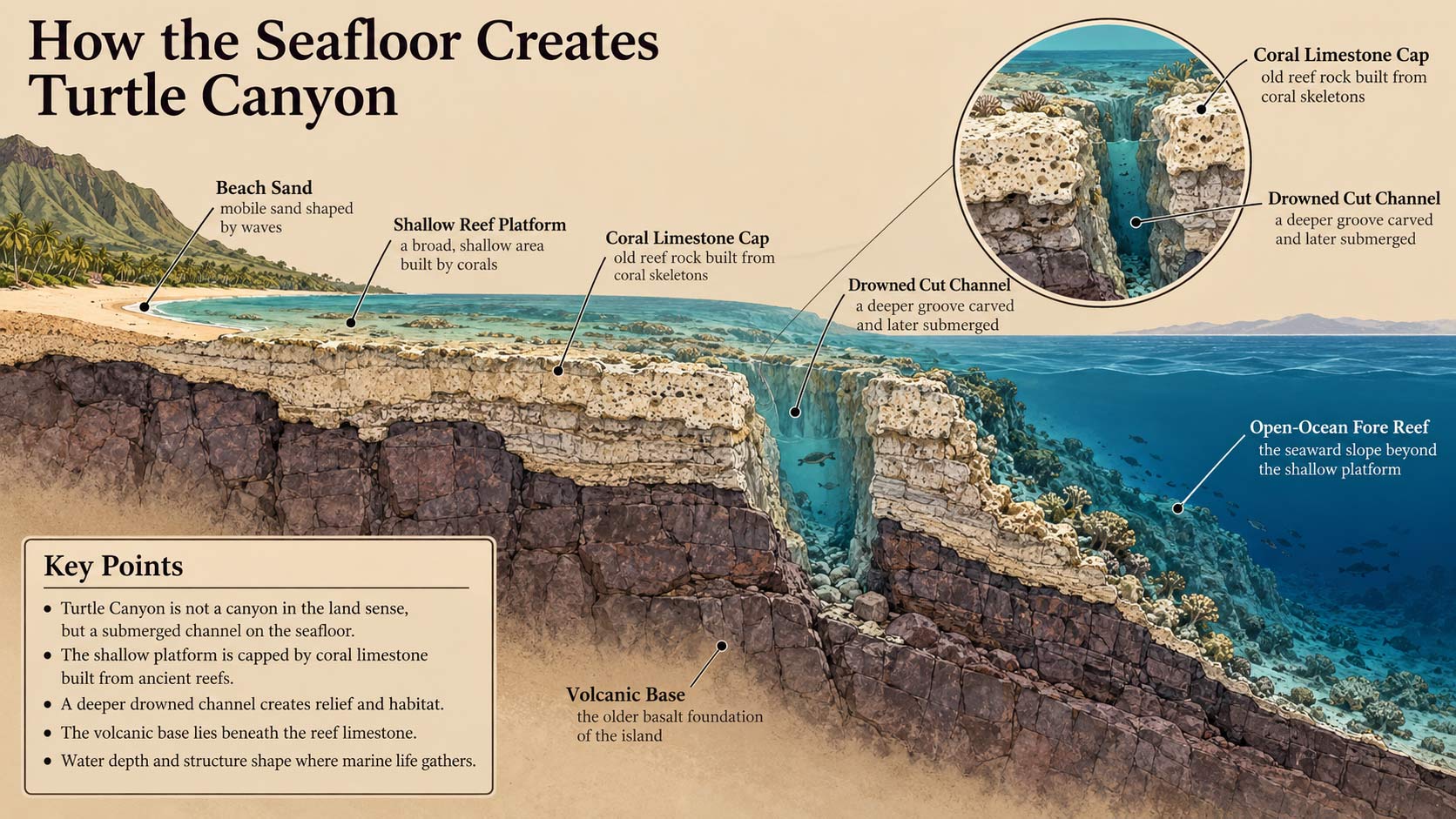
Lava made the island. Coral built a thick limestone cap on top of the volcanic rock over an enormous span of time. Then the ocean dropped during the ice ages, the reef became dry land, and running water cut channels into that exposed limestone the same way water cuts channels into any soft rock. When the ice melted and the sea came back up, those channels flooded.
What we call Turtle Canyon Oahu is one of those drowned channels. You are snorkeling over a landscape that was shaped in the open air.
Oahu Is Lava, the Reef Is Not
It is worth separating two kinds of rock that people tend to blend together.
The island itself is volcanic. Oahu was built by two large shield volcanoes, and the Koolau range behind Honolulu is the eroded remains of one of them. That rock is basalt, dark and hard, and it forms the actual foundation of everything here.
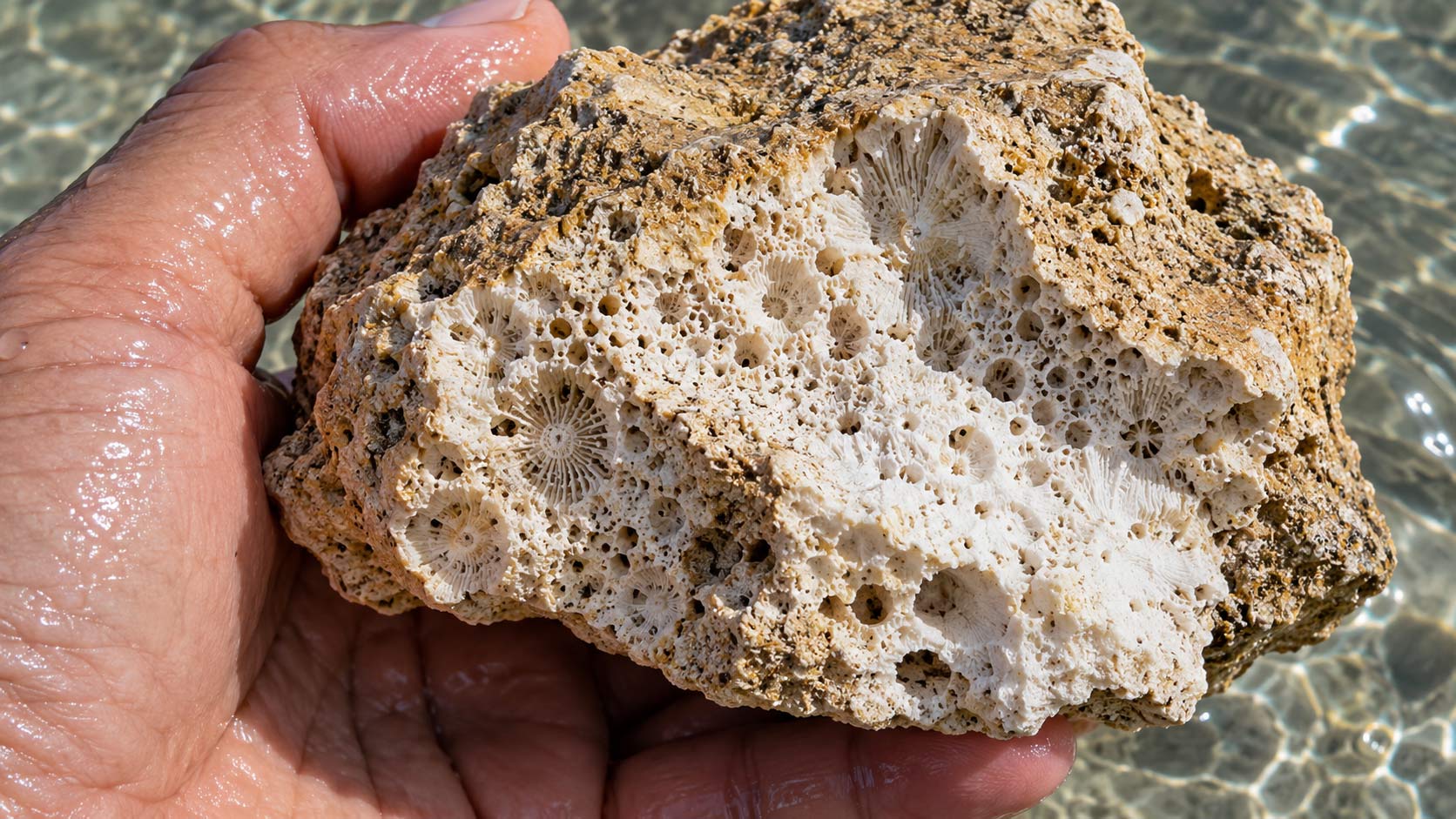
The reef is something completely different. Reef rock is limestone, made of calcium carbonate, and it was built by living things. Coral colonies grow, die, get cemented together, get broken up by surf, and the fragments pack down and harden. Do that for a long enough time and you get a thick layer of limestone sitting on top of the old basalt like frosting on a cake.
That distinction matters for this story, because basalt and limestone behave very differently when water gets at them. Limestone is far softer and far more soluble. It can be dissolved and carved. Basalt mostly just sits there.
The Ocean Used to Be Much Lower
Here is the part that surprises people. The sea level you are swimming in is a recent arrangement.
Through the ice ages, enormous volumes of water were locked up in continental glaciers, and the ocean sat far lower than it does now, by hundreds of feet at the coldest points. This happened repeatedly, in cycles, over a very long period.
When the ocean drops that far, the nearshore Oahu reef platform is not underwater anymore. It is a wide, pale, rocky plain extending well out past where Waikiki’s hotels now stand. Rain fell on it. Streams ran across it toward a shoreline that was much farther out. The reef that had spent ages underwater was suddenly a landscape, and it got treated like one.
Water Cut the Channels
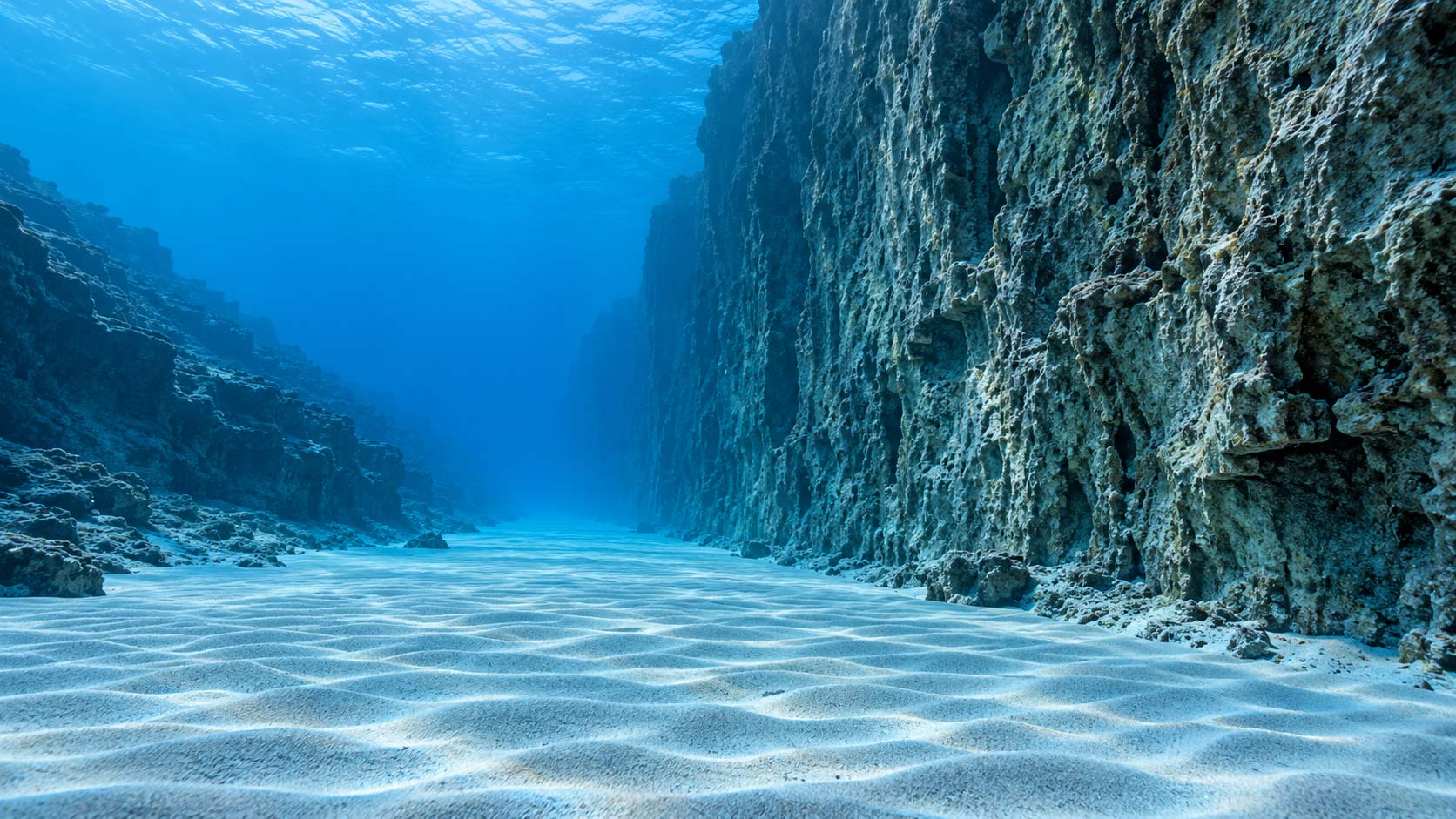
Running water on soft limestone does what running water always does. It finds the lowest line and starts cutting, and once a channel exists it collects more flow and cuts deeper. Rainwater is also mildly acidic, and limestone dissolves in mildly acidic water, so the rock gets attacked chemically as well as physically.
Over repeated glacial cycles, the exposed platform developed a drainage system. Channels, grooves and small valleys, all cut into reef rock, all sloping seaward.
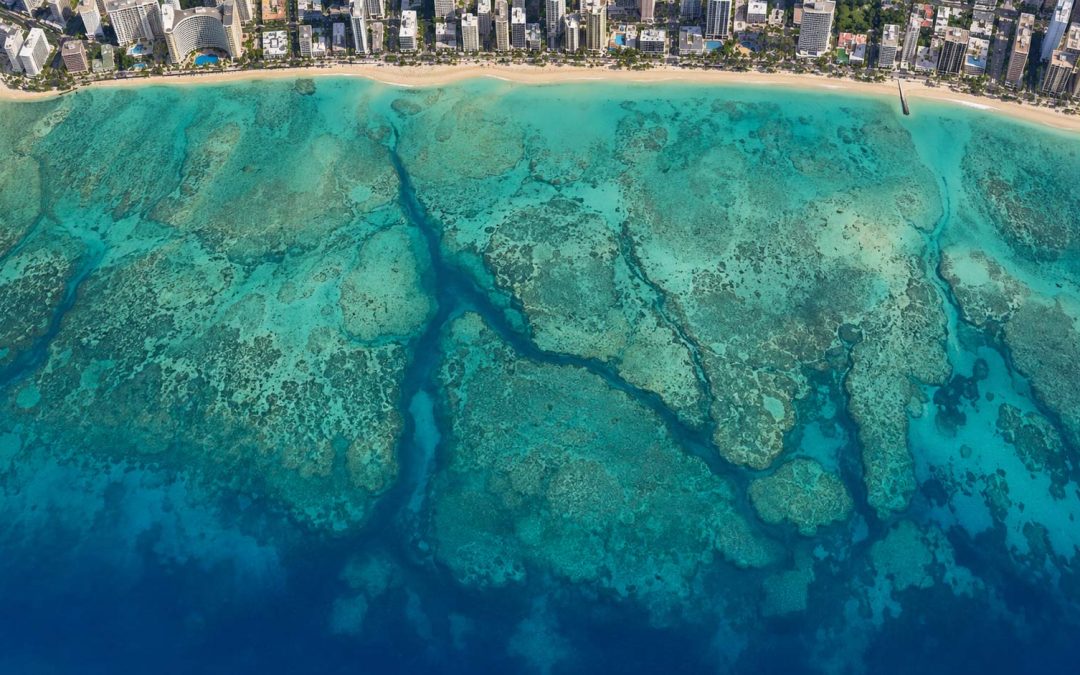
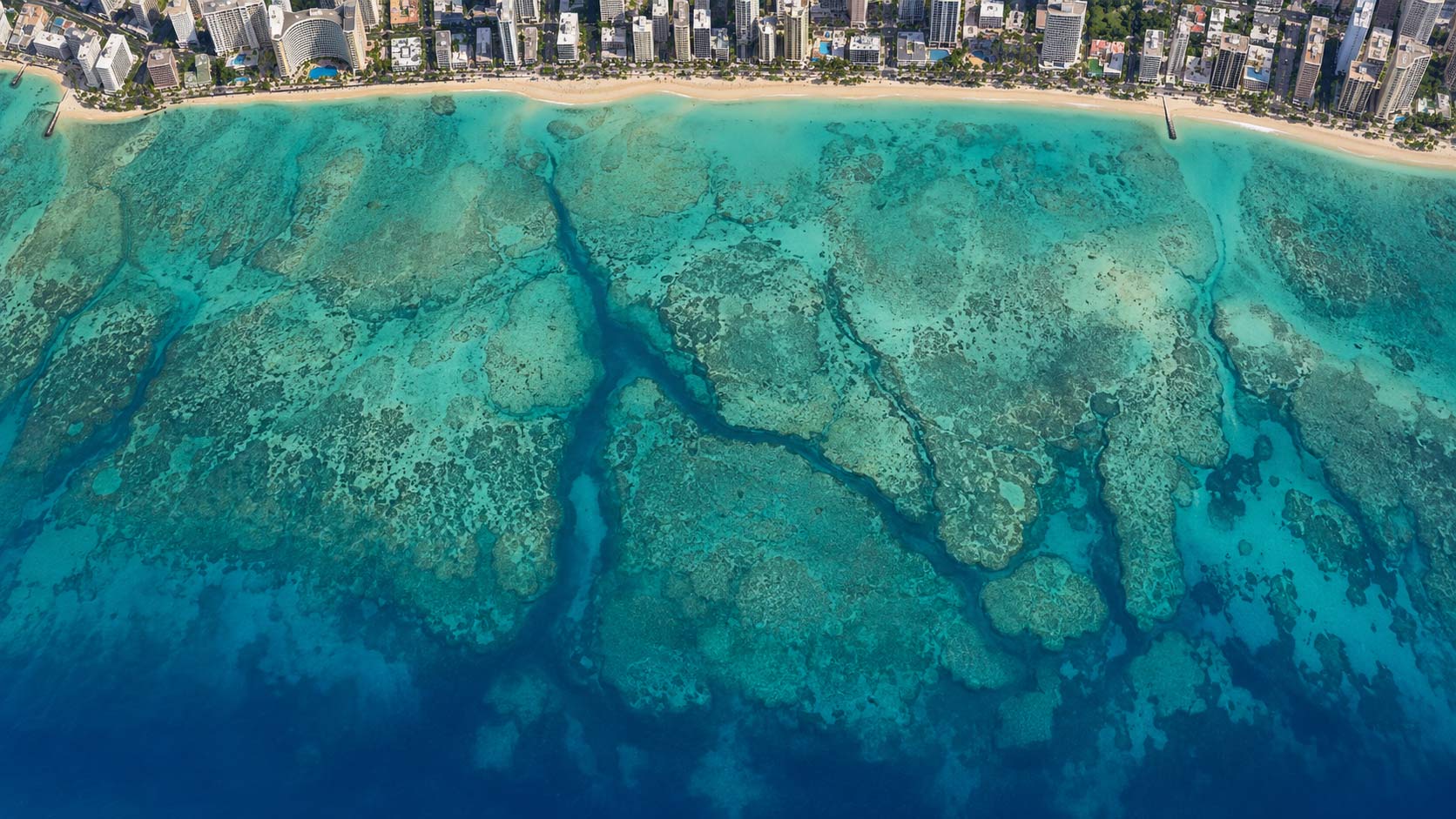
Then the ice melted. The ocean came back up, flooded the platform, and filled those channels. The high ground became the reef flats you see as pale patches from the air. The cut channels became the deeper blue lanes running through them, floored with sand because sand is what collects in the low spots.
Modern coral has been growing on all of it ever since, which rounds the edges and adds spur and groove structure, but the basic shape of the place is inherited. The ocean did not carve Turtle Canyon Oahu. The ocean moved back in and filled a canyon that was already there.
What You Are Actually Floating Over at Turtle Canyon
Put that together and the site makes a lot more sense once you are snorkeling over it.
- Hard limestone walls and reef structure on the sides, built from old coral and now colonized by new coral
- A sand floor in the low line of the channel, because sand settles where water slows
- Ledges and overhangs where softer layers eroded out faster than the layers above them
- Reef flats on either side, which are the parts that used to be high ground
The depths line up with that picture. The shallower sections sit around 15 feet below the surface and parts run deeper, which is exactly what you would expect from a drowned channel system rather than an even slope. Guests float at the surface in life jackets looking down, so you get the whole shape of it at once, which is honestly the best way to read a place like this.
Why Turtle Canyon Oahu Collects Honu
This is where geology turns into the reason you are out there.
A honu wants three things, and the structure of a drowned channel delivers all three in one place. It wants algae, which grows abundantly on hard limestone surfaces in good light. It wants somewhere to rest out of the current, which is what ledges and overhangs are for. And it wants to be able to reach the surface easily, which an open channel allows without obstacles.
That is why turtles cluster at specific sites rather than spreading evenly along the coast. The Oahu south shore is not uniform. It has a small number of places where food, shelter and easy access all overlap, and those places are concentrated where the old channels are. The honu are not responding to the view. They are responding to the shape of a landscape that was carved before there was anybody here to name it.
Why Turtle Canyon Is the Right Name
People sometimes assume the name is marketing. It is not, or at least not entirely.
A canyon is a channel cut into rock by water, with walls on the sides and a floor between them. That is a literal and accurate description of what is down there. The only unusual part is that the cutting happened in air rather than underwater, and the water that did the work was rain, not ocean.
So when you look down at walls on both sides and a sand floor running between them, you are not looking at a poetic nickname. Turtle Canyon Oahu is a canyon that happens to be submerged.
An Old Landscape You Can Float Over
Here is what I find worth sitting with. The reef off Waikiki is one of the few places where you can casually drift above a landscape built in three completely different worlds. Volcanic rock from an island being born. Limestone from millions of years of coral living and dying. And a drainage pattern carved in the open air during an ice age, by rain falling on ground that is now 20 feet under the Pacific.
The turtles grazing along the walls have no idea about any of that. They just know where the good algae is, and the good algae is where it is because of all of it.
Next time somebody asks how deep Turtle Canyon Oahu is, you can tell them. Then tell them the better part. It is the kind of thing worth knowing before you go snorkeling with turtles on Oahu, because it turns a nice swim into a look at something very old.