Why Don’t Sea Turtles Get the Bends?
Overview
Ask a scuba diver about the bends and you will get a serious answer. It is the thing every dive course drills into you, the reason for slow ascents and safety stops, and the reason divers plan their time at depth carefully. Now look at a sea turtle. A honu dives, surfaces, and dives again, on repeat, sometimes to depths that would demand a careful staged ascent from a human. It does this thousands of times a year for a lifetime measured in decades, and it never surfaces with bubbles in its blood. The reason is not that turtles are tougher. It is that a breath-hold diver is playing an entirely different game than a scuba diver, and a sea turtle’s body is built to stack the deck even further. Then there is the exception, which is where this story turns.
First, What the Bends Actually Is
Decompression sickness, known to divers as the bends, is a pressure problem. The air we breathe is mostly nitrogen, and under pressure, gases dissolve into liquid more readily. A scuba diver at depth is breathing air that has been compressed to match the surrounding water pressure, so with every breath, nitrogen keeps dissolving into their blood and tissues. It sits there harmlessly as long as the pressure stays high.
The trouble comes on the way up. As pressure drops, that dissolved nitrogen wants to come back out of solution, and if the ascent is too fast, it does it the way a shaken soda bottle does. Bubbles form inside blood vessels and tissues. Depending on where they lodge, the result ranges from joint pain to paralysis to death. The bubbles are the injury.
The First Answer: A Turtle Never Breathes Underwater
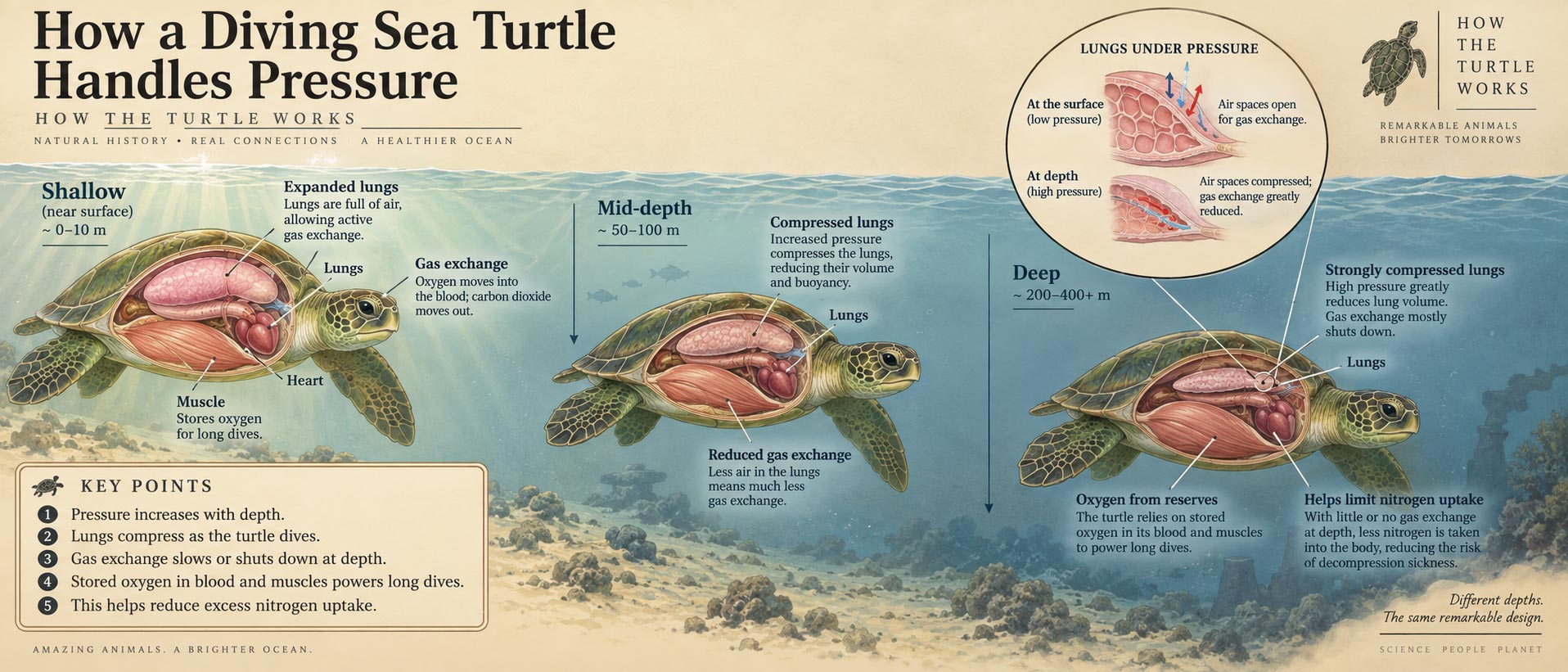
Here is the single biggest reason a sea turtle is safe, and it is almost too simple. A honu does not breathe at depth. It takes one lungful of air at the surface, at normal surface pressure, and then it goes down with exactly that much and no more.
That one detail changes everything. A scuba diver at 100 feet is continuously topping up their nitrogen supply with every breath from the tank. A turtle at 100 feet is working from a single fixed amount it brought from the surface. There is a ceiling on how much nitrogen can possibly load into its body, and that ceiling is low. This is why free divers, who also hold a single breath, face far less decompression risk than scuba divers going to the same depth.
Their Lungs Are Designed to Collapse
Now it gets genuinely clever. Even that single lungful represents some nitrogen, and under pressure it would still dissolve into the blood. So diving animals solve the problem structurally.
As a turtle descends, the increasing pressure squeezes its lungs. The tiny air sacs where gas actually crosses into the bloodstream, the alveoli, compress and collapse, and the air inside them gets pushed into the stiffer, more rigid airways, the windpipe and the larger passages. Those rigid airways are not built for gas exchange. Almost nothing crosses into the blood from there.
So the air is still inside the animal, it is simply parked somewhere it cannot do any harm. Gas exchange effectively shuts down for the deep portion of the dive, which means nitrogen loading largely stops too. It is a mechanical safety valve, and it happens automatically as a consequence of going deeper.
- One breath from the surface caps the total nitrogen available
- Collapsing air sacs shut down gas exchange at depth
- Air relocates to rigid airways where it cannot cross into the blood
- Circulation shifts away from the lungs during a normal dive
Slowing the Whole Body Down
Diving turtles also throttle their own circulation. Heart rate drops sharply during a dive, a response called bradycardia, and blood flow gets redirected away from tissues that can tolerate going without for a while, and toward the heart and brain. Less blood moving past the lungs means less opportunity for gas to transfer in either direction.
That same slowdown is why a resting honu can stay under for hours. It is running on a very low idle, and the same system that stretches its breath hold also keeps nitrogen from accumulating where it could cause trouble on the way up.
So Why Do Sea Turtles Ever Get the Bends?
Here is the part that surprised researchers, and it is the reason this is worth knowing rather than just interesting. Sea turtles can get decompression sickness. It has been documented, and the cause is us.
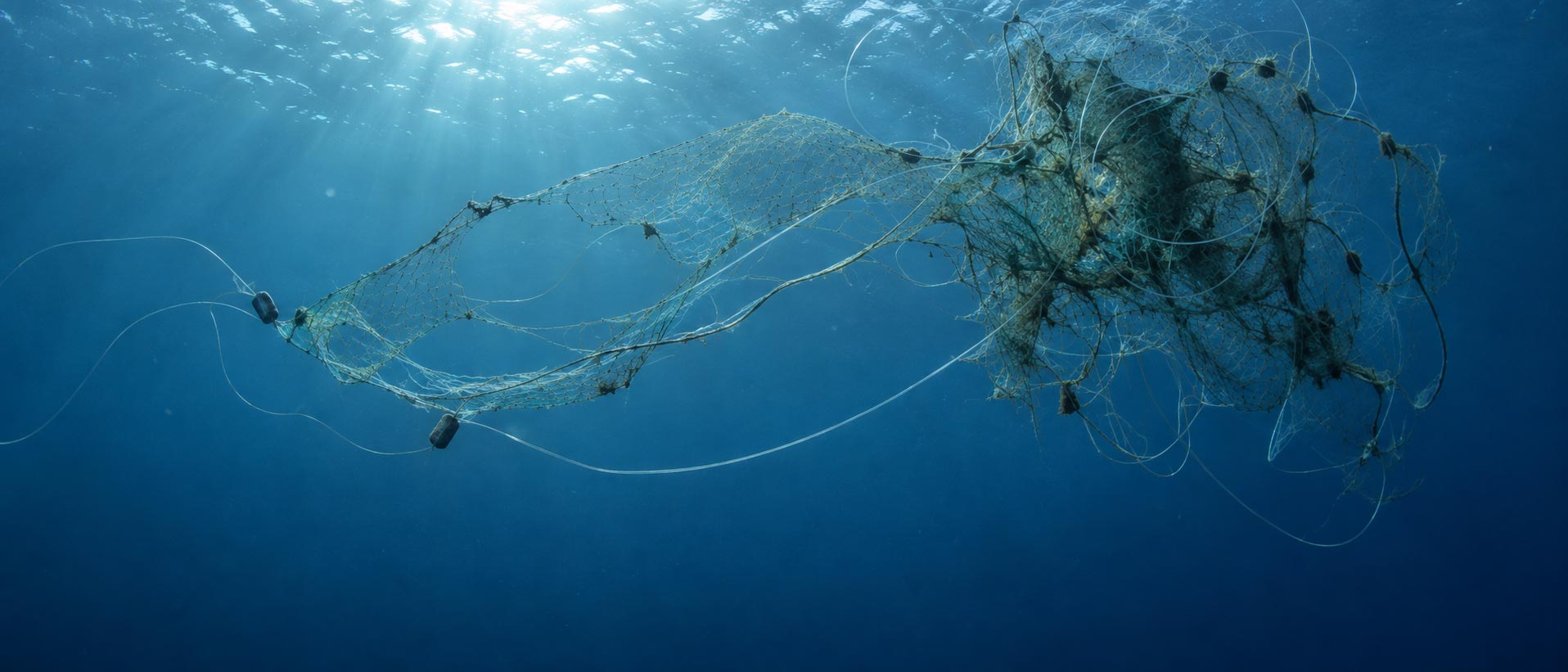
When a turtle is caught in a trawl net or a gillnet, it is held underwater against its will, often at depth, struggling and unable to surface. Studies on loggerhead sea turtles found that the normal diving response gets reversed under those conditions. Instead of circulation shifting away from the lungs, blood flow to the lungs increases. The protective system inverts, nitrogen loads into the blood and tissues at depth exactly the way it would in a scuba diver, and then the net is hauled up fast.
The result is gas embolism, bubbles in the blood and tissues, the same injury a human diver gets. Researchers found a direct relationship between the depth of the capture and both the likelihood and the severity of the bubbles, which had not been shown before in any breath-hold diving animal. The conclusion was blunt: this is likely a widespread and underestimated cause of sea turtle deaths in fisheries, and many turtles that appear to be released alive may not survive it.
The Treatment Is the Same Chamber a Human Diver Uses
There is a hopeful footnote. Affected turtles have been treated with hyperbaric oxygen therapy, the same pressurized chamber used on human divers with the bends. The turtle goes back under pressure so the bubbles redissolve, then gets brought back slowly and safely. Research on loggerheads found that lung function was significantly damaged in bycaught turtles with gas bubbles, and that the chamber treatment restored it.
It is a strange image, a sea turtle in a decompression chamber, but it works, and it means a turtle pulled up in a net is not automatically lost.
What This Means for the Honu Off Oahu
Most of the research on this has been done on loggerheads in commercial fisheries, not on Hawaii’s green sea turtles specifically, so it is worth being careful about how far the findings stretch. The underlying physiology, though, is shared across breath-hold diving animals, and the practical lesson carries over cleanly.
A honu doing its own thing on the reef is in no danger from pressure. It is built for this, and it has been doing it since long before anyone invented a tank. The danger arrives when something holds a turtle underwater and it cannot make its own choice about when to surface. That is one more reason discarded fishing gear and entanglement matter so much, and one more reason a tangled turtle is an emergency rather than an inconvenience.
Built for a Dive We Need Equipment to Survive
We put on tanks, run the numbers, and ascend in careful stages, and even then we get it wrong sometimes. A sea turtle takes one breath, drops into the blue, lets its lungs fold up, slows its heart to a crawl, and comes back whenever it feels like it. The whole system is elegant enough that it took researchers a long time to work out how it functions, and they only really proved it by studying what happens when human activity breaks it. The next time a honu glides past you and then heads for the surface, that unhurried rise is not carelessness. It is an animal that has never needed a safety stop in its life.