Why Sea Turtles Stay Calm Around Snorkelers but Vanish When Scuba Divers Show Up
Overview
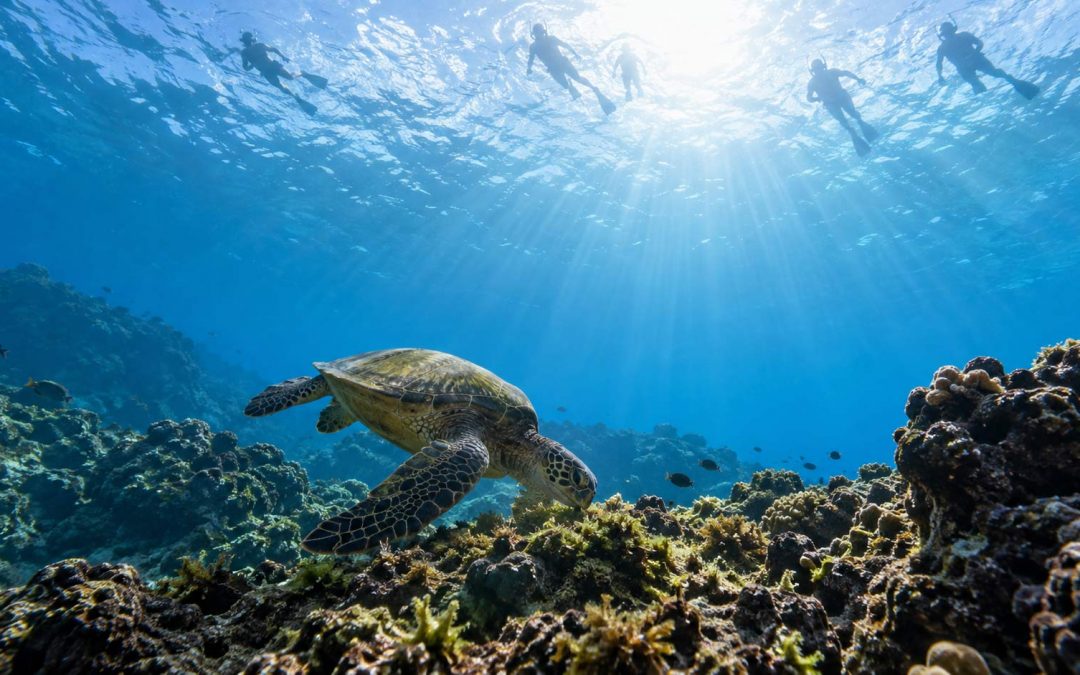
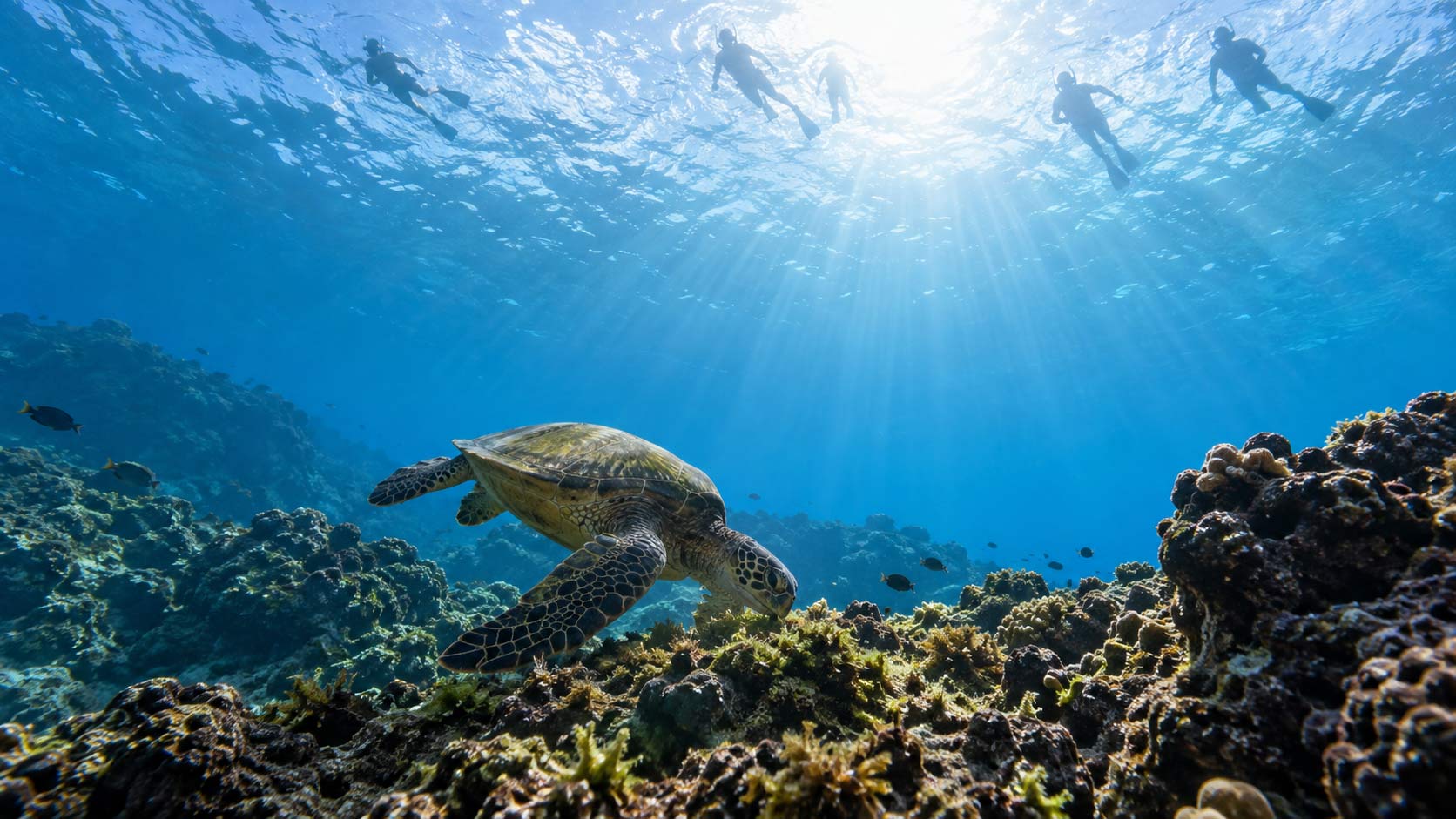
Spend enough mornings in Hawaiian water and you start to notice something odd. A green sea turtle will sit on the reef chewing limu while a whole group of snorkelers drifts along above it, completely unbothered. Then a scuba diver comes along, and that same turtle picks its head up, turns, and leaves. It looks personal. It is not. The turtle is reacting to specific things about how each person arrives, and once you understand what those things are, you can see why floating on the surface is often the better seat in the house. This is one of those cases where the less advanced approach genuinely works better.
The Short Answer
A sea turtle is not judging your skill level. It is responding to three things, and a scuba diver triggers all three while a snorkeler triggers almost none of them.
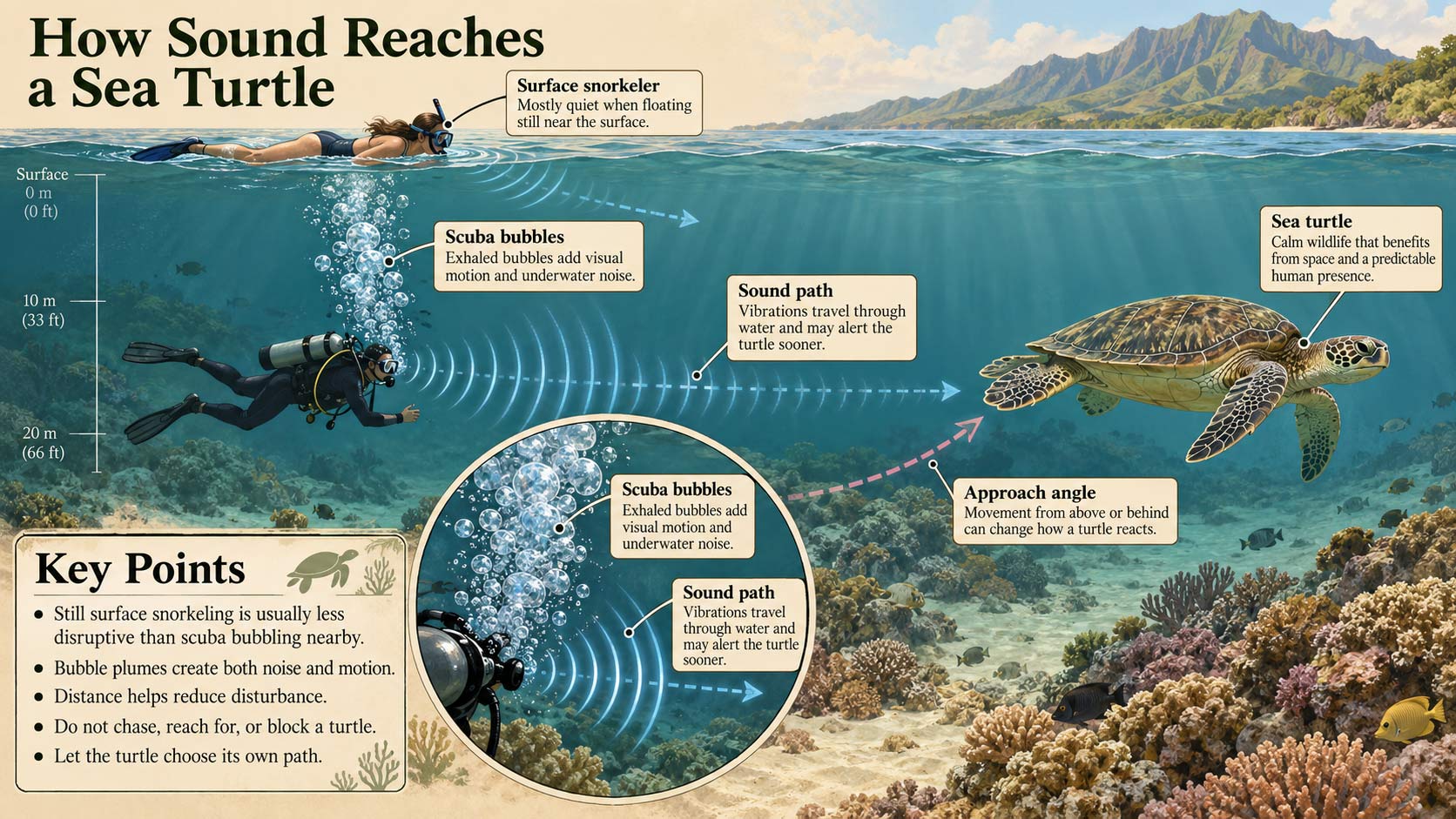
The first is noise, because open circuit scuba equipment is loud underwater in a way most divers never appreciate. The second is bubbles, which are visually enormous and arrive from an unusual direction. The third is position, because a diver shares the turtle’s own depth and often comes from below, while a snorkeler stays flat against the ceiling of the ocean where nothing dangerous has ever come from.
Put simply, a snorkeler reads as scenery. A diver reads as an event.
Bubbles Are Louder Than You Think
Here is the part that surprises people. Underwater, sound behaves nothing like it does in air. It travels roughly four times faster, it carries much further, and your ears lose most of their ability to tell you where it came from. A noise that would be a background detail on land becomes a large, directionless presence underwater.
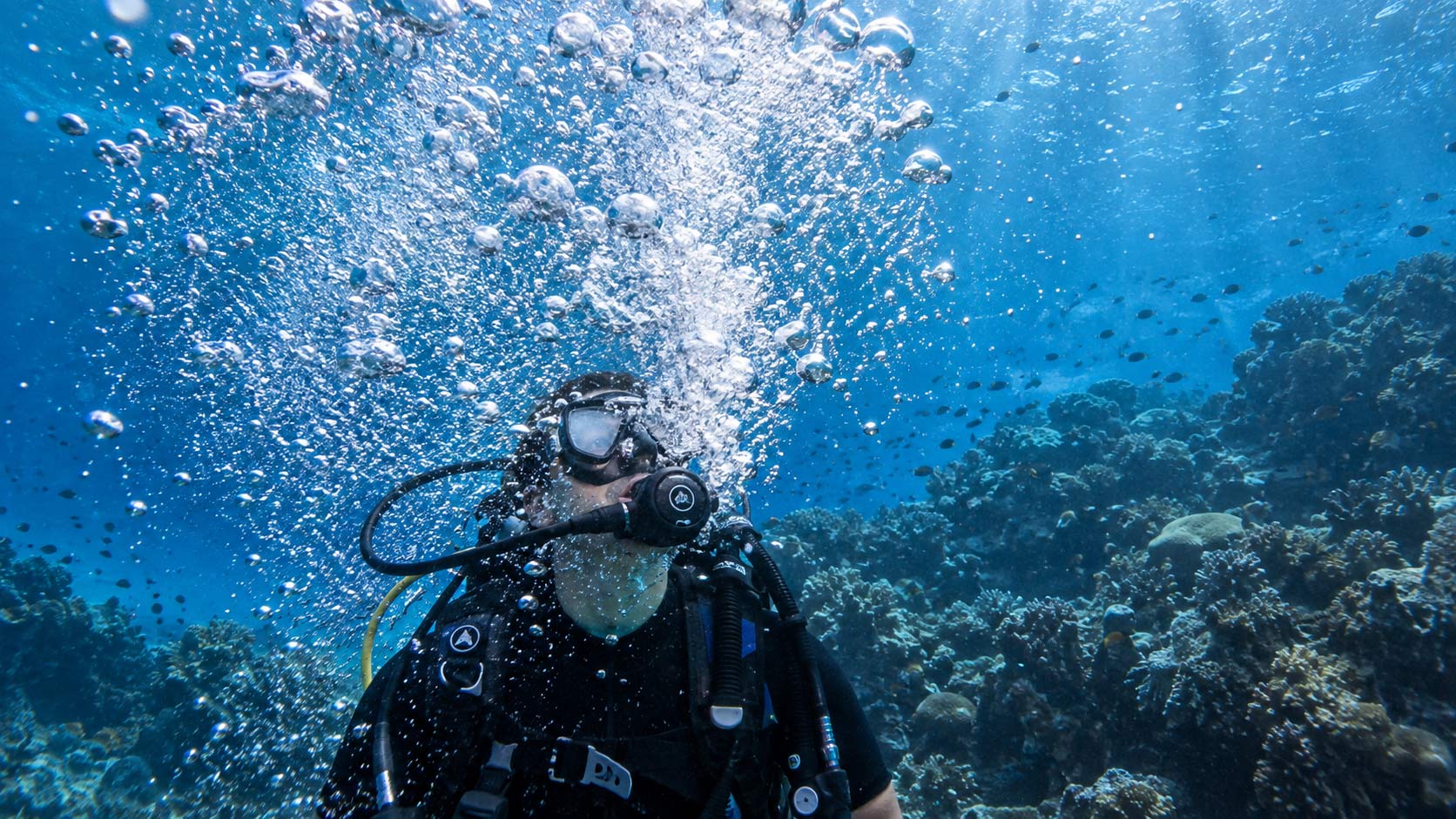
Now consider what open circuit scuba gear actually does. Every single breath out releases a burst of gas that expands, rattles, and rushes upward past the diver’s head. To the diver it is a familiar sound they tuned out on their second dive ever. To everything else on the reef it is a repeating, broadband, irregular noise with no natural equivalent. Nothing in the ocean sounds like that.
Sea turtles hear best at low frequencies, well below the range we think of as loud, and exhaust bubbles sit squarely in territory they notice. They are not in pain and they are not panicking. They simply know something large and unfamiliar is nearby, and a wild animal that has survived to adult size did it by leaving when that happens.
The Bubbles Look Wrong Too
Sound is only half of it. Picture the reef from the turtle’s point of view. Light comes from above. Small silver flashes happen when fish turn. Movement is generally horizontal and generally smooth.
A diver’s exhale breaks every one of those patterns at once. A silver cloud appears out of nowhere, expands fast, makes noise, and travels straight up. It is big, it is bright, it is loud, and it repeats every few seconds. If you were designing a signal specifically to make a cautious animal uncomfortable, you would have a hard time improving on it.
None of this means scuba divers are doing anything wrong. It is simply the equipment doing what it was built to do.
The Rebreather Clue
If you want the cleanest evidence that bubbles are the real problem, look at what wildlife filmmakers use. When a film crew needs to get genuinely close to skittish marine animals, they very often switch to a closed circuit rebreather. That gear recycles the diver’s exhaled gas instead of dumping it into the water, so it releases few bubbles or none at all.
The result is well known in the diving world. The same animals that keep their distance from a normal diver will tolerate a rebreather diver at much closer range, in the same spot, on the same day. Same human, same size, same movement. Take away the bubbles and the noise, and the behavior changes.
That is a pretty good natural experiment, and it points straight at the answer.
Why Coming From Below Feels Different
There is one more piece, and it is about geometry rather than gear. Sea turtles are air breathers. Every so often a honu has to go up, and the surface is the one place it absolutely must be able to reach.
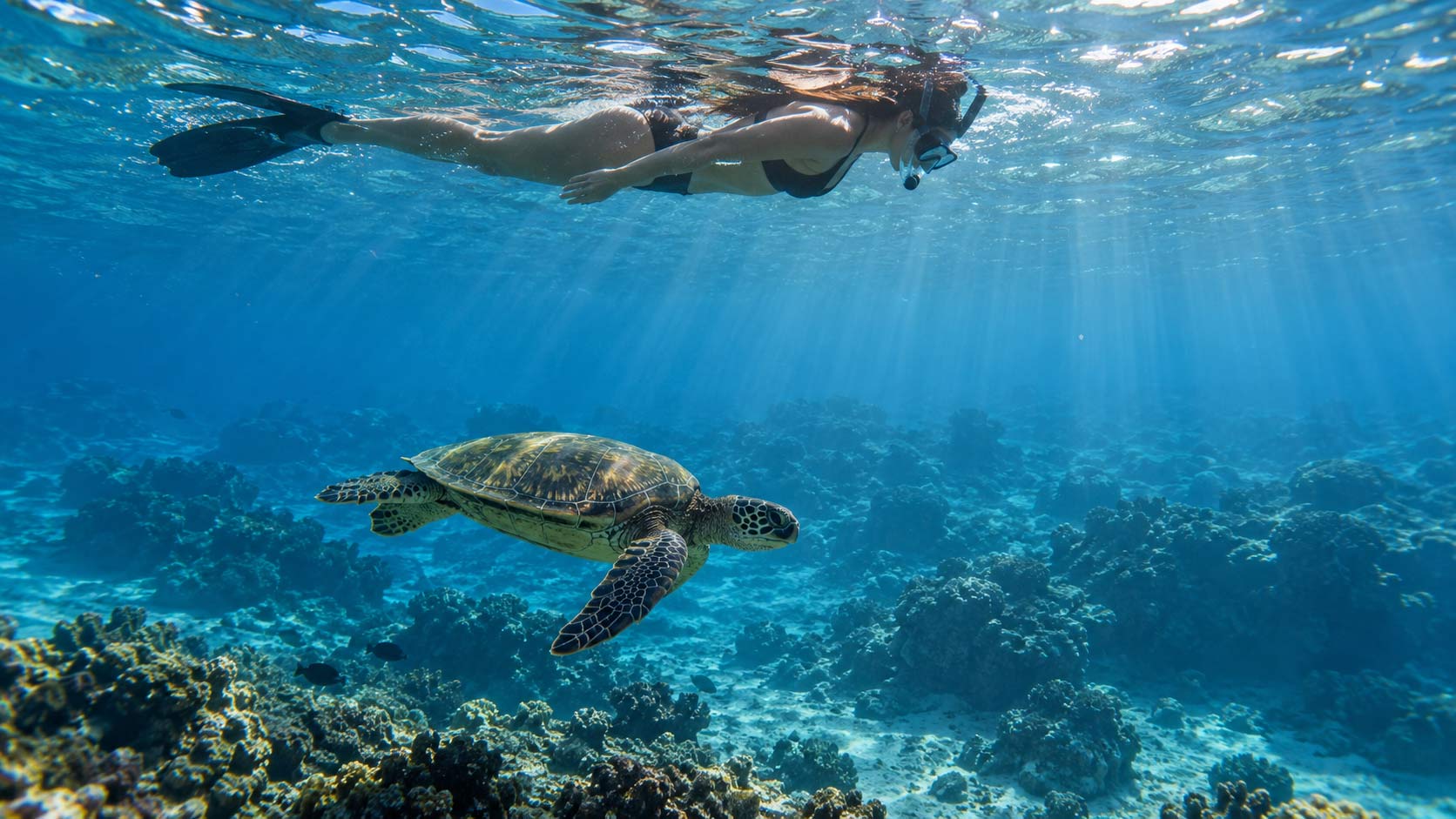
A snorkeler floating at the surface is above the turtle and out of the way. A diver at mid depth is in the same layer of water the turtle swims through, and sometimes directly under it, which sits between the animal and the air it needs. Even without any intent, that position reads as something to move away from.
There is also a plain silhouette effect. From below, a snorkeler is a dark shape against bright light, flat, slow and predictable, mostly just floating. A diver is a three dimensional object at the turtle’s own level, moving in every direction, trailing noise and a column of silver. One of those blends in with the ceiling. The other does not blend in with anything.
Why This Works in Your Favor at Turtle Canyon
This is the practical payoff. On our trips, guests are on the surface in life jackets, looking down at the reef from above. That is not a compromise version of diving. For watching turtles specifically, it is frequently the better arrangement.
You are quiet, because you are not carrying anything that exhales into the water. You are stationary, or close to it, because the life jacket does the work of holding you up. You are above the animal instead of beside it, so you never block a route to the surface. And you can stay in that position comfortably for a long stretch rather than managing depth and air.
A turtle that does not feel pressured stays and keeps doing what it was doing. That is the whole trick, and being on the surface at Turtle Canyon hands it to you for free.
How to Be the Snorkeler Turtles Ignore
The gear does most of the work, but a few habits make a real difference in how long an encounter lasts.
- Go still when a turtle appears instead of swimming toward it, because stillness is the single most effective thing you can do
- Keep your hands at your sides, since reaching changes your outline and reads as an approach
- Breathe slowly through your snorkel rather than gasping, which is quieter and also keeps you calmer
- Float flat and let the life jacket hold you, so you are not kicking and churning the water
- Stay above the animal and never move between a turtle and open water above it
- Let the turtle close the distance if it wants to, and it often will
The guests who get the best encounters are almost never the strongest swimmers. They are the ones who stopped moving first.
The Rules Have Not Changed
Being calm and quiet is about better viewing, not about getting closer than you should. Hawaiian green sea turtles are protected, touching or chasing one is illegal, and the published marine wildlife viewing guidelines ask people to keep a respectful distance and let the animal decide how the encounter goes.
Those two ideas fit together neatly. The behavior that is legal and respectful is also the behavior that gets you the longest look. You do not have to choose.
The Quietest Person in the Water Sees the Most
Here is the thing worth remembering. The reason a honu tolerates snorkelers is not that it likes us. It is that a still person floating at the surface does not set off anything in a turtle’s threat list. No bubbles, no engine noise, no shape moving in from below, nothing blocking the way up.
Divers work hard, spend a lot, and often end up watching turtles leave. Snorkelers float on their stomachs doing almost nothing and watch turtles stay. It is one of the few places in the ocean where the simplest approach is genuinely the better one.
So when you are out there and a honu drifts underneath you, do not chase the moment. Stop moving, breathe slowly, and let it happen. That is when the good stuff starts.