How Long Can a Honu Go Without Eating?
Overview
It is one of those questions that sounds simple until you look at the answer. How long can a sea turtle go without eating? For a person the honest answer is measured in days before things get serious. For a green sea turtle the answer is measured in months, and the most remarkable part is how little it seems to cost her. A nesting female can cross an ocean, build several nests, and go the entire time without a proper meal. She does not hibernate through it. She swims the whole way. The reason comes down to one biological difference that changes everything, and once you understand it, a lot of honu behavior starts making sense.
The Short Answer
A green sea turtle can fast for months at a time. A nesting female making a full round trip migration of well over two thousand miles, laying multiple clutches of eggs along the way, can complete the entire journey without feeding and lose under a fifth of her body weight doing it.
Sit with that for a second. She is swimming continuously, producing hundreds of eggs, hauling herself up a beach repeatedly, and digging nests in the sand, all while running on reserves she packed on months earlier. Day to day, the loss works out to roughly half a pound. That is an astonishingly low burn rate for an animal that size doing that much work.
Why Being Cold-Blooded Changes the Math
Here is the single biggest reason, and it is easy to miss because it sounds like a disadvantage. Sea turtles are ectotherms, which means they do not generate their own body heat. Their temperature follows the water around them.
For a warm-blooded animal, a huge share of every meal goes straight into keeping body temperature up. A person, a dolphin, or a seabird is running a furnace every hour of every day, and that furnace has to be fed whether anything else is happening or not. A sea turtle simply does not have that bill to pay. The energy that a mammal spends on staying warm is energy a honu never spends at all.
That one difference cascades through everything.
- No energy budget spent on internal heating
- A much lower baseline metabolic rate overall
- Fat reserves that stretch across months instead of days
- The ability to slow down further when conditions call for it
The Nesting Fast Is the Big One
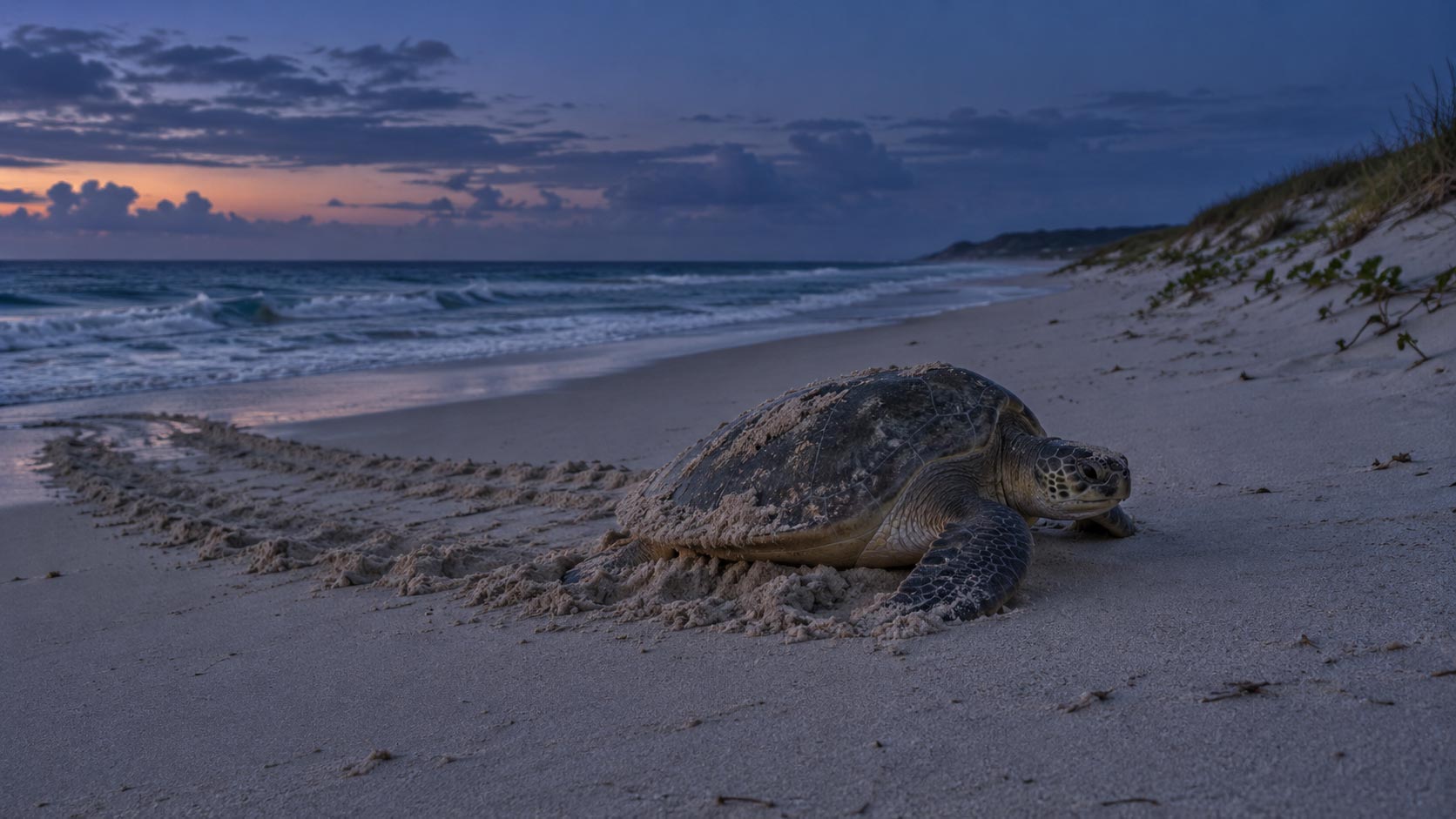
The longest fasts happen around reproduction, and the sequence is brutal by any normal standard. A female builds up fat reserves at her feeding grounds over a long stretch, sometimes years. Then she leaves. She migrates to the beach where she will nest, which can be an enormous distance away, and once she arrives she stays in the area for weeks, coming ashore multiple times to lay separate clutches.
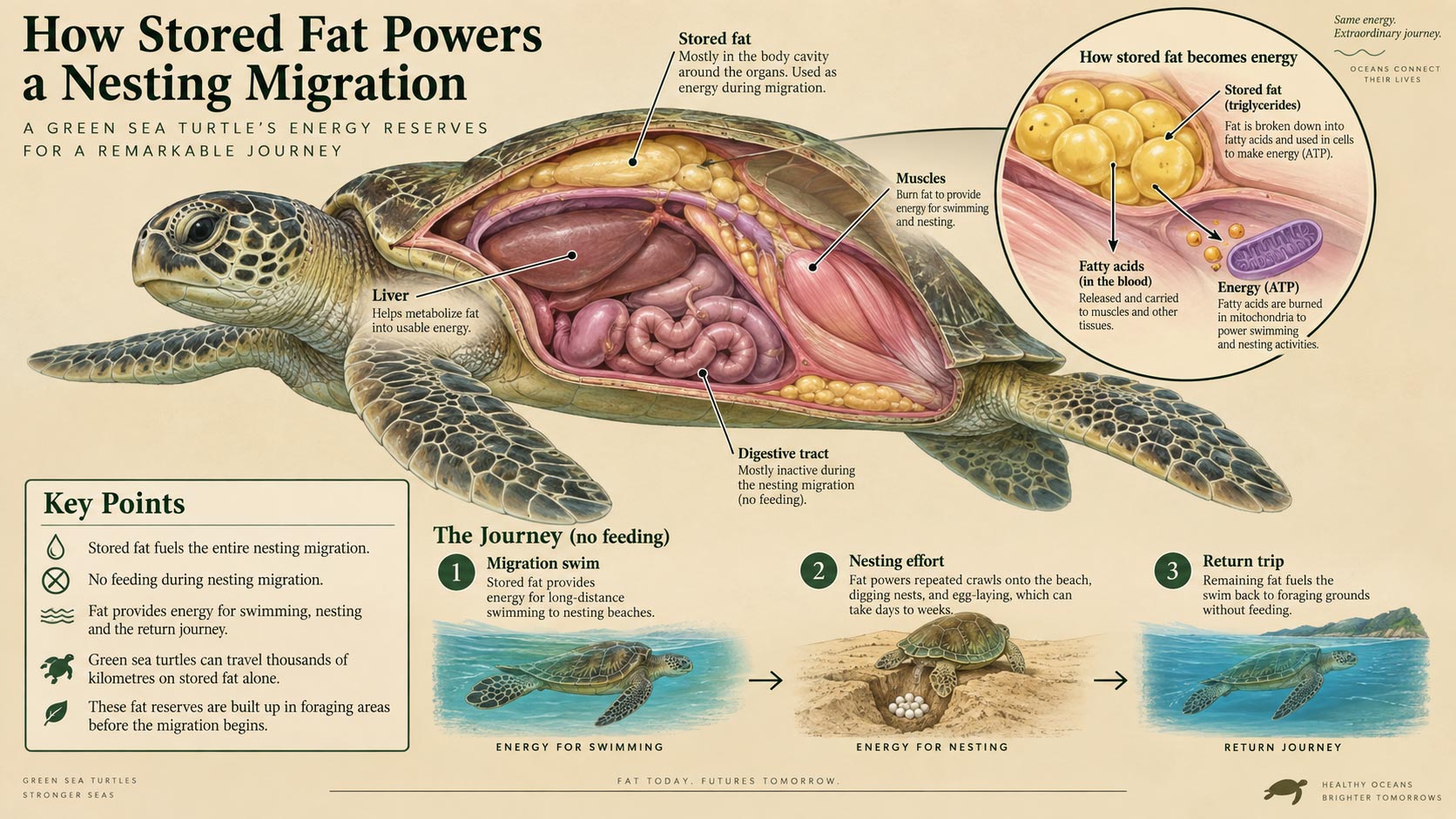
Through all of that, feeding largely stops. Her body shifts into a different mode, with hormonal changes that suppress appetite and switch her over to burning stored fat. She is not starving in any medical sense. She is running a plan her species has used for millions of years, and her body is doing exactly what it is built to do.
Hawaii’s Version of That Journey
Hawaiian green sea turtles do their own version of this. The large majority of them nest not on the main islands but at French Frigate Shoals, several hundred miles northwest in the remote Northwestern Hawaiian Islands. A honu that spends her life grazing reefs off Oahu leaves those feeding grounds, makes the crossing, nests, and eventually comes back.
That trip is the reason a turtle you see on the reef may simply vanish for a season. She is not gone, and she is not in trouble. She is doing the hardest and hungriest work of her life somewhere far away, and if all goes well she will be back on the same stretch of reef afterward, ready to eat again.
Hatchlings Start Life Fasting Too
The fasting begins at the very start. A hatchling breaks out of its egg having absorbed the remaining yolk sac, and that yolk is its entire fuel supply for what comes next. It digs its way up through the sand, crosses the beach, and then hits the water and begins the swim frenzy, a stretch of near-continuous swimming to get away from shore and into deeper water.
All of that runs on leftover egg yolk. Green sea turtle hatchlings generally do not begin feeding for the first couple of days, and real feeding does not start until they reach habitat where there is something to eat, which can be around a week after they leave the nest. The smallest, most vulnerable turtle in the ocean starts life by fasting through the most dangerous days it will ever have.
The First Week Barely Registers
For a healthy turtle, short fasts are close to a non-event. In younger turtles, the markers you would expect to shift when an animal goes without food hold steady for roughly the first week before they begin to move at all. There is that much slack built into the system.
Compare that to a small warm-blooded animal, where missing meals for a day or two is a genuine emergency, and the gap in design becomes obvious. The honu is built for a world where food comes and goes.
Cold Water Slows the Whole System Down
Because a turtle’s metabolism tracks the water temperature, cooler water means an even slower burn. A honu in cooler conditions is running at a lower idle, needs less, and moves less. This is part of why turtles in colder regions become sluggish and stop feeding when temperatures fall, and it is also why Hawaii’s consistently warm water keeps the honu here active and feeding year-round rather than shutting down seasonally.
When Not Eating Is Actually a Problem
All of this is about healthy turtles doing normal things. It is worth being clear that not eating can also be a symptom rather than a strategy. A turtle that is injured, sick, carrying heavy tumors, or recovering from an entanglement often stops eating, and in a rehabilitation setting appetite is one of the main things people watch. A turtle that will not eat is a turtle that is not ready to go home.
The difference matters. A nesting female fasting through her migration is following a plan. A turtle on a beach that has clearly been going downhill is not. If you ever come across a honu that looks thin, weak, or wrong, the right move is a call to the NOAA Marine Wildlife Hotline at 1-888-256-9840 rather than a guess.
Built for a World Where Food Comes and Goes
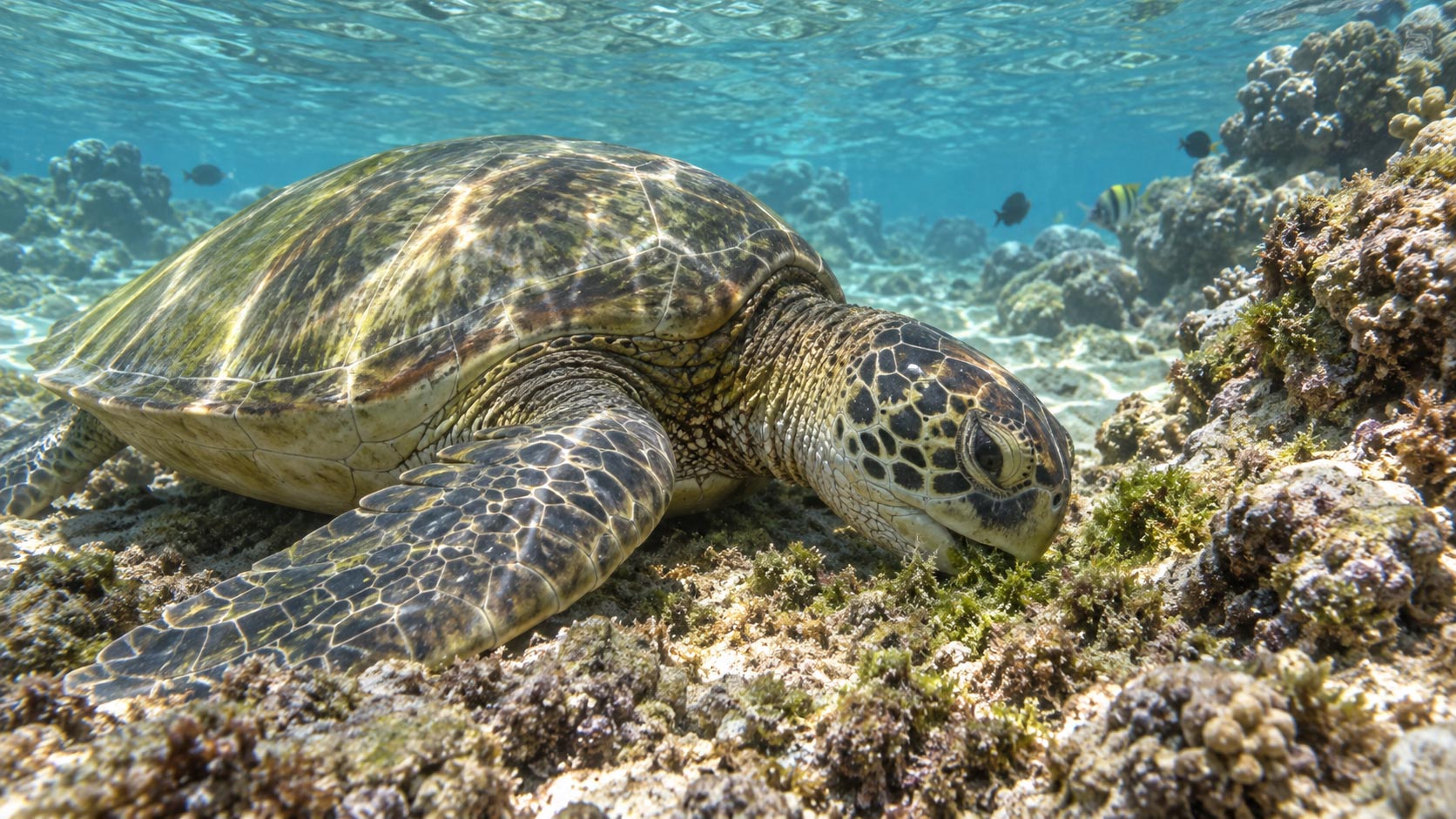
We tend to measure endurance by how hard an animal can push. A sea turtle measures it the other way, by how little it needs. No internal furnace to feed, a metabolism that drops with the water temperature, and fat reserves that stretch across an ocean crossing. The honu grazing quietly over the reef off Oahu is not just eating. It is banking, and some of what it stores today will carry it through months of open ocean where it will not eat at all. That unhurried animal is playing a much longer game than it looks like from the surface.