Baby Honu Eat Meat. Adults Go Vegetarian. Here Is Why.

Overview
Ask most people what a sea turtle eats and you will hear jellyfish. That is a fair answer for some species, and it is even correct for a green sea turtle, as long as the turtle in question is young enough. Somewhere along the way, Hawaii’s honu do something no other sea turtle does. They quit eating animals almost entirely and become full time plant eaters. This is not a small preference change. It happens at a specific stage of life, it lines up with a move across the ocean, and it requires the turtle to rebuild how its digestive system works. Here is what actually changes, and why the turtle you float above on the reef has a completely different menu than it started out with.
Two Completely Different Animals
Biologists have a term for this kind of change. An ontogenetic shift is when an animal’s diet, habitat, or behavior changes as it grows, and green sea turtles are one of the clearest examples in the ocean. The hatchling that scrambles down a beach and the adult that hauls out to bask on that same beach decades later are eating almost nothing in common.
The short version looks like this.
- Hatchlings and young juveniles live in the open ocean and eat mostly animals
- Somewhere around five to seven years old they move to shallow coastal habitat
- After that move, the diet turns steadily toward algae and seagrass
- Adults are largely herbivorous, which is unique among sea turtles
What a Baby Honu Actually Eats
The first years of a green sea turtle’s life happen far offshore, drifting with currents and taking shelter in floating mats of seaweed. Out there, plants are scarce and everything is small, so a young turtle eats whatever it can catch that fits in its mouth. That means jellyfish and other soft bodied drifters, tiny crustaceans, zooplankton, fish eggs, and small invertebrates riding the same seaweed the turtle is hiding in.

It is an opportunistic, protein heavy diet, and it makes sense for the job at hand. A young turtle is trying to grow as fast as possible, because size is the main thing standing between it and everything that wants to eat it. Animal protein builds body mass quicker than algae does.
The Move That Changes Everything
Then the turtle comes home. After several years in the open ocean, young green sea turtles recruit into shallow coastal waters, the reefs and bays where they will spend the rest of their lives. In Hawaii, this transition generally happens somewhere around age five to seven, and it flips the food situation completely. Suddenly the turtle is living in a place where plants are everywhere and easy to reach, and where it no longer has to chase anything at all.
Food that does not run away is a serious advantage. A grazing animal spends far less energy per meal than a hunting one, and on a healthy reef the supply never really runs out.
Building a New Gut
Here is the part that surprises people. A turtle cannot simply decide to eat plants. Plant cell walls are made of cellulose, and no vertebrate produces an enzyme that breaks cellulose down on its own. Cows cannot do it either. What cows have, and what a grazing turtle needs, is a population of gut microbes that ferment the stuff on the animal’s behalf.
Young green sea turtles acquire that fermenting gut microbiome after they settle into coastal habitat, and research tracking juvenile turtles through the move has documented the microbiome changing along with the diet. In other words, the turtle does not just change what it eats. It changes what lives inside it, and the new residents do the actual digestion. Until that community is established, a plant diet would be close to useless.
What Hawaiian Honu Eat Now
Most people picture green sea turtles grazing seagrass meadows, which is accurate in a lot of the world. Hawaii is a little different. Seagrass is limited here, so Hawaii’s honu feed heavily on limu, the Hawaiian word for algae and seaweed. They work through a range of species, including red algae such as Gracilaria, green algae such as Ulva, and various brown algae growing on the reef.
This is why a honu on an Oahu reef often looks busy rather than idle. It is grazing, moving along the bottom, cropping growth off rock and coral rubble, and working its way through a surprising volume of vegetation over the course of a day.
Grazing Lawns Are a Real Thing
Green sea turtles in some parts of the world do not graze randomly. They return to the same patches over and over, cropping them short and letting them regrow, which produces something researchers describe as grazing plots or lawns. The turtle gets tender new growth instead of tough old leaves, and the patch keeps producing.
That behavior is one reason green sea turtles matter to the health of the places they live. A large grazer working the same ground repeatedly shapes what grows there, keeps algae in check, and moves nutrients around the system. Remove the turtles and the whole community underneath them changes.
The Jaw Gives It Away
A green sea turtle’s mouth is built for this work. Instead of the crushing beak you find on species that eat hard shelled prey, a green sea turtle has a finely serrated edge that works like a set of cropping shears for slicing through vegetation. Look closely at a honu’s beak and you are looking at a tool for gardening, not hunting. Nothing about that mouth would help much with a crab.

Yes, This Is Why They Are Called Green
Their shells are not especially green. The name comes from the color of the fat inside them, and that color comes straight out of the diet. Years of eating algae and seagrass deposit plant pigments into the turtle’s body fat, tinting it green. It is a small, strange detail that ties the whole story together. The name we use for the species is a direct result of the food it switched to.
What This Means When You Are in the Water With One
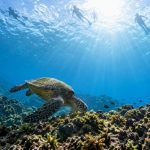
It changes what you are actually watching. A honu moving slowly along a reef and pausing at the bottom is almost certainly feeding, not resting, and it is doing a job the reef depends on. Understanding that makes the encounter better and it also makes the etiquette obvious. A feeding animal that keeps getting crowded stops feeding. Giving a grazing turtle room is not just politeness, it lets the animal do the thing it came there to do.

From Hunter to Gardener
The green sea turtle spends its early years as a small predator in a very large ocean, then comes ashore to the reefs, rebuilds its digestive system, and spends the next several decades as a gardener. No other sea turtle makes that trip. The next time you watch a honu grazing over the reef off Oahu, it is worth remembering that the same animal once drifted in open water eating jellyfish, and that everything about it, including the name we gave it, changed with the menu.