Overview
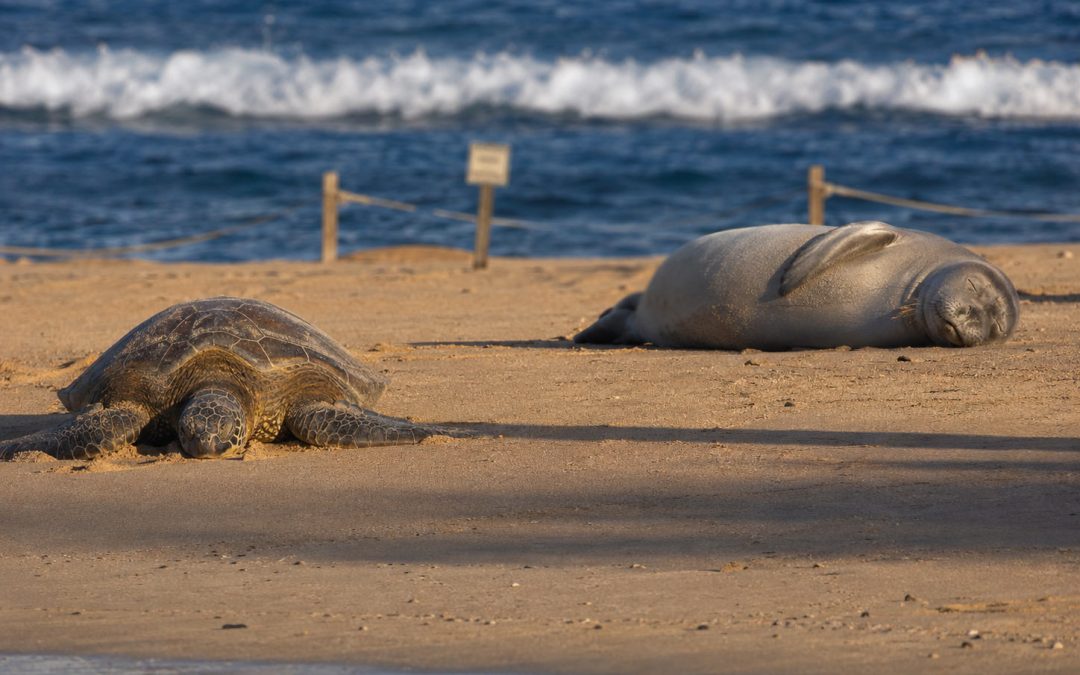
You come down the path to the sand and there is something large lying up above the waterline, gray brown, completely still. Almost everybody’s first guess is sea turtle, because the honu is the animal people come to Hawaii hoping to meet. Often that guess is right. But sometimes what is lying there is a Hawaiian monk seal, an animal that exists nowhere else on Earth and numbers only around 1,600 in total, and the rules for being near one are not the same rules you learned for turtles. Ten feet for a honu. Fifty feet for a seal. A hundred and fifty feet if that seal has a pup beside it. Knowing which animal you are looking at, from far enough away that it does not matter, is a genuinely useful skill on an Oahu beach.
The Short Answer
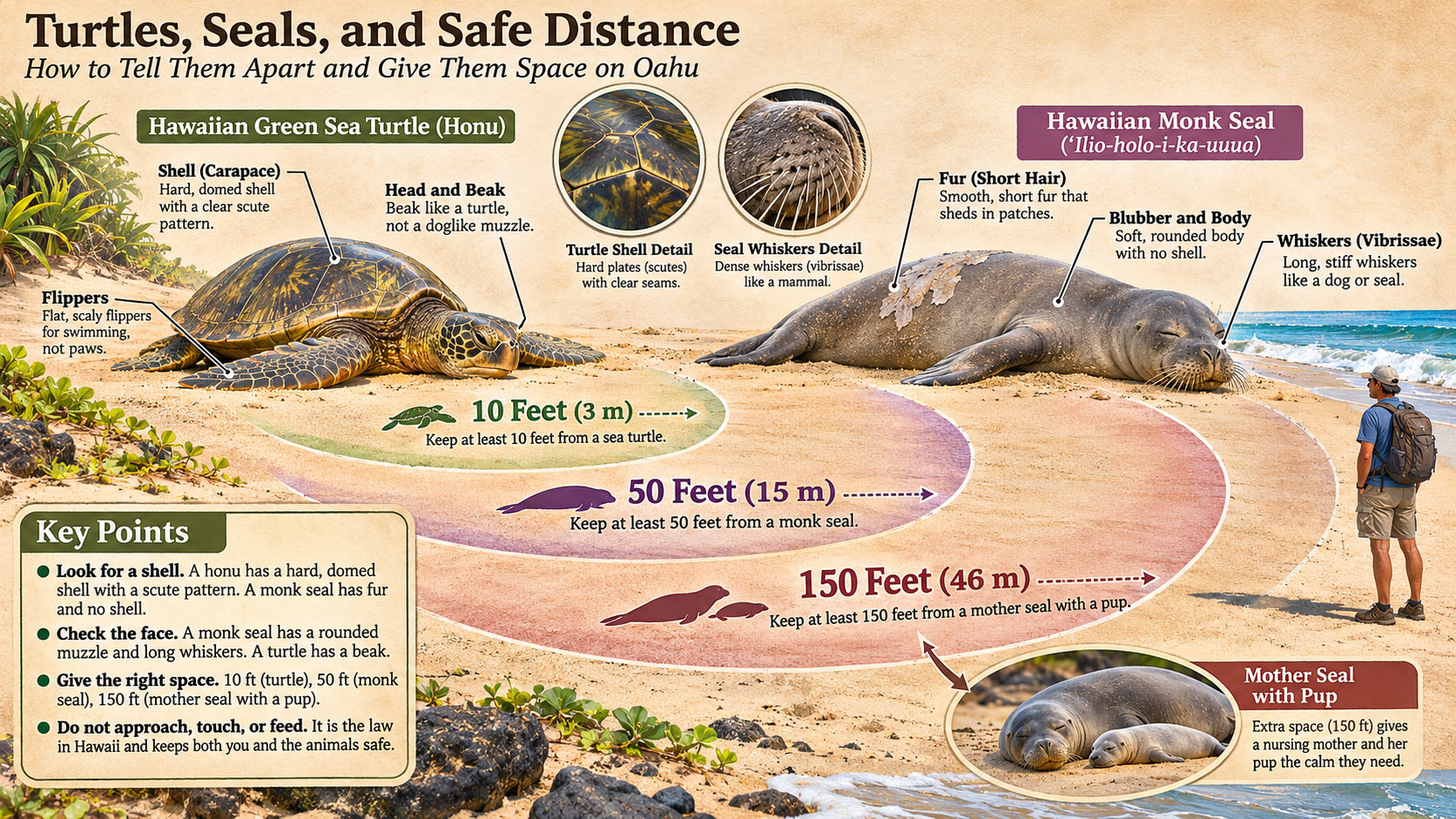
If it has a hard domed shell, it is a sea turtle, and you stay at least 10 feet back.
If it has fur, whiskers and no shell, it is a Hawaiian monk seal, and you stay at least 50 feet back. Make that 150 feet if there is a pup.
You never need to get closer to tell. Every difference that matters is visible from well outside both distances, and that is the whole point of the next section.
Telling Them Apart Without Getting Closer
From fifty feet or more, both animals can read as the same thing: a big smooth lump on sand that is not moving. Here is what separates them, in roughly the order you will notice it.
- The shell. A honu has a hard, domed carapace with a visible pattern of plates. A monk seal has no shell at all, just a smooth continuous body
- The shape. A seal is a torpedo that sags. It lies in loose curves, rolls onto its side, and changes position. A resting turtle is flat, low and architectural, and can hold one position for a very long time
- The flippers. A turtle’s front flippers stick out to the sides like paddles laid on the sand. A seal’s fore flippers are short and tuck in against its body
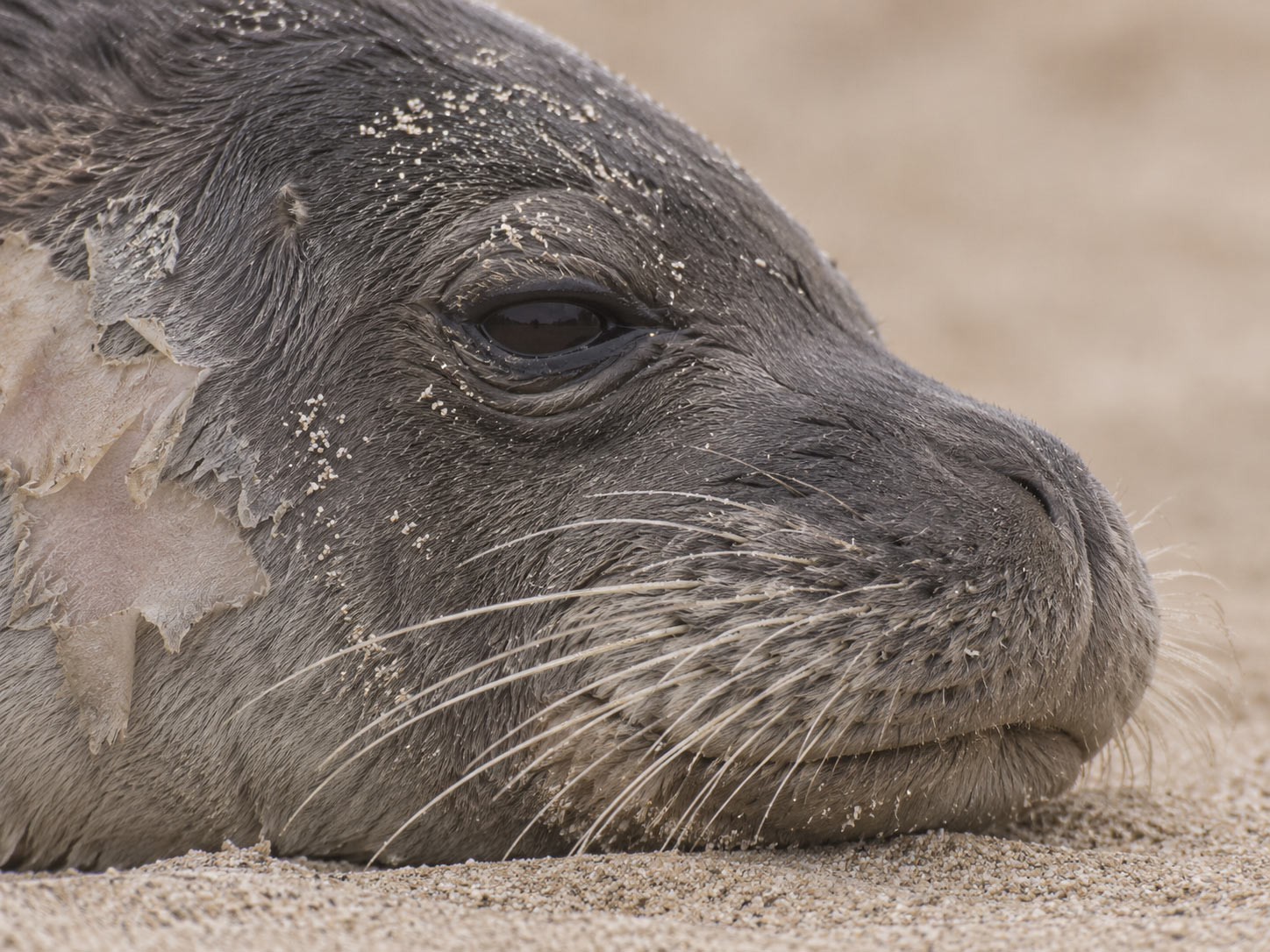
- The face. A monk seal has a blunt, dog like muzzle covered in stiff whiskers, which is where its Hawaiian name comes from. A honu has a beak and no whiskers anywhere
- Movement and sound. Seals snort, sigh, scratch themselves and shift around in their sleep. Turtles mostly do not
One honest warning. Both animals can look wrong. A basking honu often has algae growing on its shell, and a monk seal partway through shedding its skin can look patchy and even slightly green. Odd coloring does not tell you which animal you are looking at, and it is not a reason to walk over for a better look.
What a Monk Seal Actually Is
This is the part most visitors have never been told, and it changes how people behave once they know it.
The Hawaiian monk seal is endemic to this archipelago. It lives nowhere else on the planet, across a range of roughly 1,500 miles from Kure Atoll in the far northwest down to Hawaii Island. Its Hawaiian name is usually written ilioholoikauaua, which is most often translated as the dog that runs in rough water. The Pukui and Elbert dictionary renders it as a quadruped running in the rough seas, and at least one Hawaiian language writer argues the literal sense is different again, so the name is better treated as evocative than as settled.
The numbers are small. There are roughly 1,600 monk seals in total, with about 1,200 of them in the remote Northwestern Hawaiian Islands inside Papahanaumokuakea and only about 400 across the main Hawaiian Islands, the ones people actually live on and visit. That is around a third of the species’ historic size. The population did pass 1,500 in 2021 and has been growing slowly since 2013, which is genuinely good news, but there is no version of 1,600 animals that counts as a lot.
A few other things worth knowing when one is in front of you.
- They are big. Adults run 400 to 600 pounds and 6 to 7 feet long, and males and females are about the same size
- They are built for the water, not the sand. A monk seal spends roughly two thirds of its life at sea and can dive beyond 1,800 feet and hold its breath up to 20 minutes, though a normal working dive is about 6 minutes in under 200 feet
- They are not after anybody’s catch. Monk seals are generalist feeders that hunt fish, octopus, squid, eels and crustaceans along the seafloor, and they generally do not go for prized gamefish like ulua, papio or oio
- They can live past 30, though most do not
Why a Seal Is Lying There in the First Place
A monk seal on a beach is not stranded, not sick, and not in trouble. It is doing something necessary.
Seals haul out to rest, to shed their skin, to give birth and to nurse. Resting is most of it, and they are serious about it. A monk seal will sleep on a beach for hours and sometimes for days at a stretch, which looks alarming to anybody who assumes a wild animal should be busy. That rest is paid for by long foraging trips offshore, and interrupting it costs the animal energy it cannot easily replace.
Once a year they go through what biologists actually call a catastrophic molt, shedding the entire top layer of skin and fur. It takes time on land and it looks rough while it is happening. A seal that appears green simply has not molted recently.
And NOAA has been clear about one trend in particular: popular recreational beaches are increasingly where seals are hauling out and molting. They are not confined to empty wilderness coastline. Which is exactly why a visitor who only knows the turtle rule can end up far too close to a seal without ever intending to.
Mothers and Pups, the Part to Take Seriously
If there is a small black furred animal next to a larger one, stop where you are and go no closer.
A monk seal mother nurses her pup on the beach for up to seven weeks, and that pair is the most vulnerable thing on the sand. Peak pupping season in Hawaii runs roughly March through August. During those weeks a mother is protective and can be aggressive, a 500 pound animal that moves faster than it looks like it can. The required distance jumps from 50 feet to 150 feet for a reason, and it protects you as much as the pup.
Dogs are a specific, documented danger here, not a theoretical one. Dog attacks are a known cause of monk seal pup injury and death. If you have a dog with you, leave the beach.
Why the Distances Are Not the Same
People reasonably ask why a honu gets 10 feet and a seal gets 50. Four real reasons.
- Biology. A turtle is a reptile that does not parent. A seal is a mammal raising a pup it can be separated from, and that separation can be fatal
- Rest. A sleeping seal disturbed off a beach loses energy it needs to go hunt. A honu basking is thermoregulating and is less easily pushed off
- Risk to you. A monk seal is a large predator with teeth that will defend itself and its pup. A resting turtle will not come after anybody
- Numbers. Around 1,600 monk seals exist in the world. Every single one matters more than the arithmetic of a single beach visit suggests
There is also a legal difference worth stating precisely, because people repeat it wrong. The 10 foot sea turtle distance is listed by NOAA as a required viewing distance on land and in the water. The 50 foot monk seal distance is worded as a recommendation rather than a legal minimum. That does not make it optional in practice, because harassing a monk seal is separately illegal under the Marine Mammal Protection Act and the Endangered Species Act, and getting close enough to change the animal’s behavior is how harassment is judged.
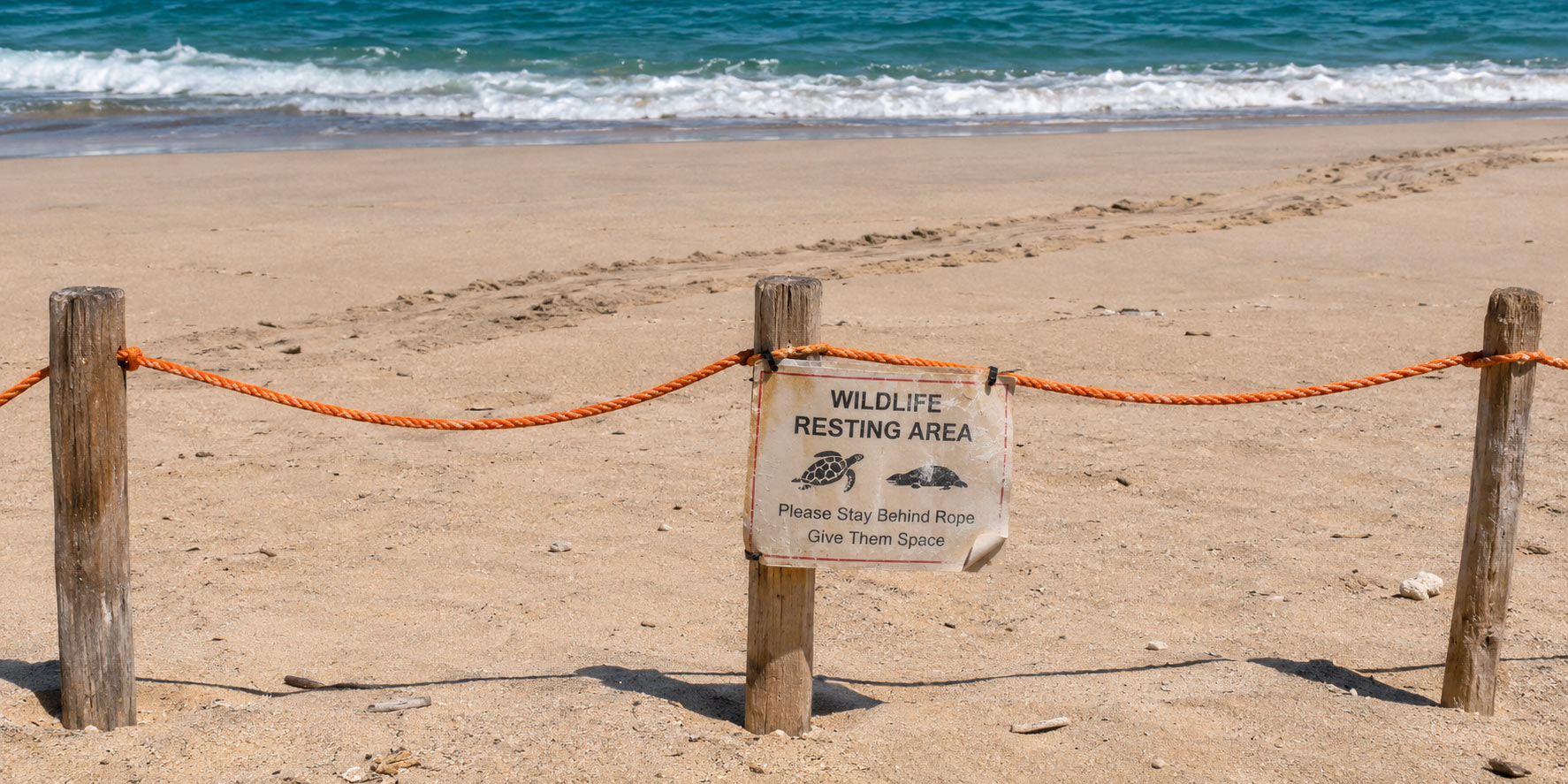
NOAA has a field trick for the seal distance that works without a tape measure. Hold your thumb up at arm’s length. If your thumb covers the entire seal, you are roughly 50 feet away. If any part of the animal sticks out past your thumb, back up. And if there are signs or rope barriers, those override the thumb every time.
What To Do When You Find One
The honest answer is almost nothing, which people find unsatisfying.
- Stop as soon as you see it, then back up rather than edging closer for a photo
- Go around, well behind it, using the top of the beach. Never walk between an animal and the water, and never between a mother and her pup
- Keep dogs off the beach entirely
- Do not pour water on it, shade it, push it toward the sea or try to help in any way. Both species are supposed to be out of the water
- Use your zoom. A long lens from 60 feet is a better photo than a phone from 10 feet, and it is legal
- Leave the rope lines and signs alone, and if volunteers are working the beach, do what they ask
If the animal is clearly injured, entangled in fishing gear, or has been hit, call the statewide Marine Wildlife Hotline at 1-888-256-9840. That one number covers sea turtles, monk seals and other protected marine animals. Reporting is the useful thing a bystander can actually do.
What Still Threatens Monk Seals
Worth knowing, because it explains why the rules feel strict for an animal that is simply asleep.
In the main Hawaiian Islands, toxoplasmosis is a leading cause of monk seal death, with at least 15 known cases. Entanglement in marine debris and fishing gear is among the worst documented for any pinniped, with 437 entanglements recorded in Papahanaumokuakea between 1974 and 2022. Erosion and rising seas are shrinking the low lying beaches the species depends on for pupping. And then there is the human column, which is the hardest to read: as of 2024, at least six monk seals had been shot and twelve had died from blunt force trauma.
Set against that, standing 50 feet back instead of 20 is a very small ask.
Where This Fits If You Are Here for the Turtles
Most people reading this came to Hawaii for honu, and that is a good reason to come. The turtles are reliable in a way the seals are not. On the North Shore, Laniakea is the beach where honu regularly haul out to bask, with volunteers and a rope line most days. And if you want to see turtles in the water rather than asleep on sand, a turtle snorkeling Oahu trip out to the canyon off Waikiki puts you above them while they are actually going about their day, which is a different and better experience than looking at a sleeping animal from behind a rope.
What you should not do is go looking for a monk seal. There is no monk seal beach to visit and no tour that finds them, because 400 animals spread across the main islands do not keep a schedule. If you see one, it is luck, and the correct response to that luck is distance.
Two Rare Animals, One Stretch of Sand
Here is the thing that makes an Oahu beach quietly remarkable. A reptile whose family outlived the dinosaurs can be resting on the same twenty yards of sand as a mammal that exists nowhere else on Earth and is down to its last couple of thousand. Neither one is there for anybody’s benefit. Both are doing the unglamorous work of resting, warming up and shedding skin, which is most of what wild animals actually do.
You get to walk past that. The only thing asked of you is to know which is which, and to give each the space it is owed. Ten feet, fifty feet, a hundred and fifty. Learn the three numbers and you are a good neighbor on any beach in Hawaii. If you would rather meet a honu in its own element, the Turtle Canyon tour page lays out how the trip works.