Where to See Sea Turtles on Maui in 2026
Maui has a reputation for a lot of things. Watching the sunrise from Haleakala. The winding road to Hana. Some of the best whale watching in the Pacific. But ask any snorkeler who has spent time in Maui’s waters, and they will tell you that swimming alongside Hawaiian green sea turtles belongs right at the top of that list. The island is home to some of the most turtle-rich reefs in the entire state, and several of the best spots are accessible straight from the beach. Whether you are planning your first trip or heading back for another look, this guide covers the top places on Maui where you are most likely to cross paths with honu.
The Hawaiian Green Sea Turtle on Maui
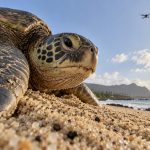
The sea turtle you will almost certainly encounter in Maui’s waters is the Hawaiian green sea turtle. In the Hawaiian language, this animal is called honu, and it has been part of the islands’ ecosystem for millions of years. Today it is listed as threatened under the Endangered Species Act, which means federal law requires you to keep at least ten feet of distance at all times. You cannot touch them, feed them, or position yourself between a turtle and open water. These rules are enforced, and they exist for good reason. Honu populations spent decades in serious decline, and the recovery that has happened since protections went into place is real and fragile.
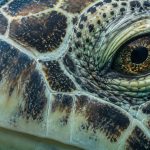
One fact that surprises a lot of first-time visitors is that the green sea turtle is not actually green on the outside. Their shells run from brown to olive to nearly black, depending on the individual. The name comes from the color of their body fat, which turns green from a lifetime of eating Hawaiian seagrass and red algae. These animals are strict vegetarians, and their diet is a big part of why Hawaii’s reef ecosystems are so well suited to them. The algae they graze on grows in the same shallow reefs and rocky ledges where you will find them day after day.
Turtle Town at Makena
The most well-known turtle destination on Maui is a stretch of South Maui coastline that locals and guides refer to simply as Turtle Town. It is not an official place name on any map. It is a general area near Makena and the resort community of Wailea where Hawaiian green sea turtles gather in numbers that are rare even by Hawaii standards. The heart of the area is Maluaka Beach, and the reef that runs off the southern tip of the beach offers some of the best snorkeling on the island.
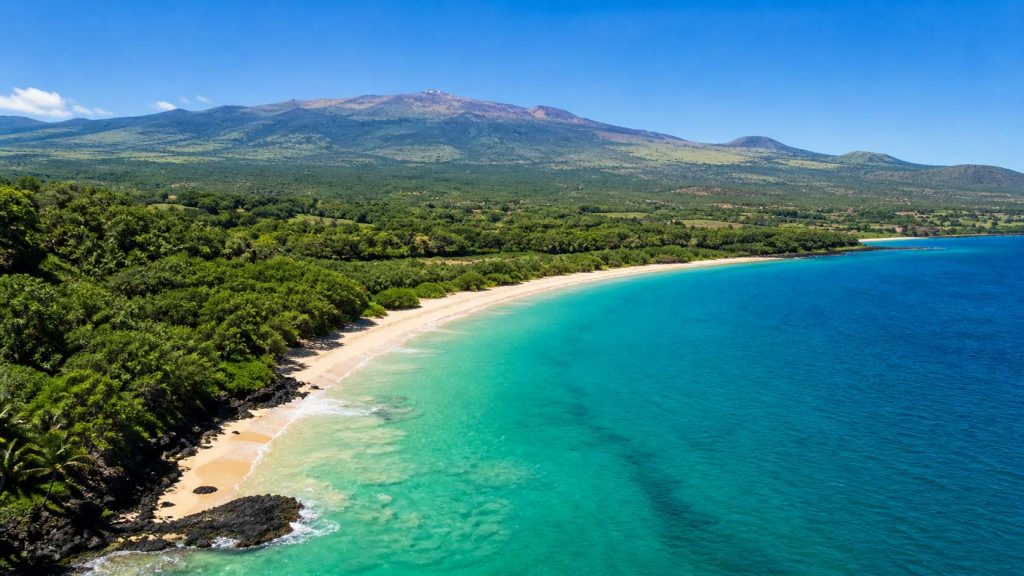
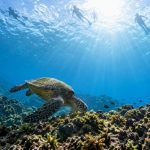
The underwater landscape here was shaped by ancient lava flows. Those hardened lava shelves are now blanketed in the algae that green sea turtles feed on, and that reliable food source is a big reason so many turtles show up here so consistently. The reef is calm, the water is generally clear, and the area offers shelter from stronger currents. On a typical morning, it is not unusual to spot multiple turtles grazing on the reef within a short swim from shore.
Maluaka Beach has parking and basic facilities, which makes it a practical starting point for independent snorkelers. The water entry is easy from the sand, and the reef is reachable without a boat. If you plan to swim out to the deeper sections, a snorkel buoy is a smart addition since boat traffic increases as the day goes on.
Olowalu Reef on West Maui
On the western side of Maui, tucked between the mountains and the channel, sits one of the most impressive reef systems in the Hawaiian Islands. Olowalu Reef covers roughly 900 acres, making it the largest intact reef in Hawaii. Because it faces the leeward side of the island and is sheltered from the trade winds, it stays calm and clear on days when other spots have turned choppy. Water visibility at Olowalu regularly reaches 120 feet, which is exceptional by any measure.
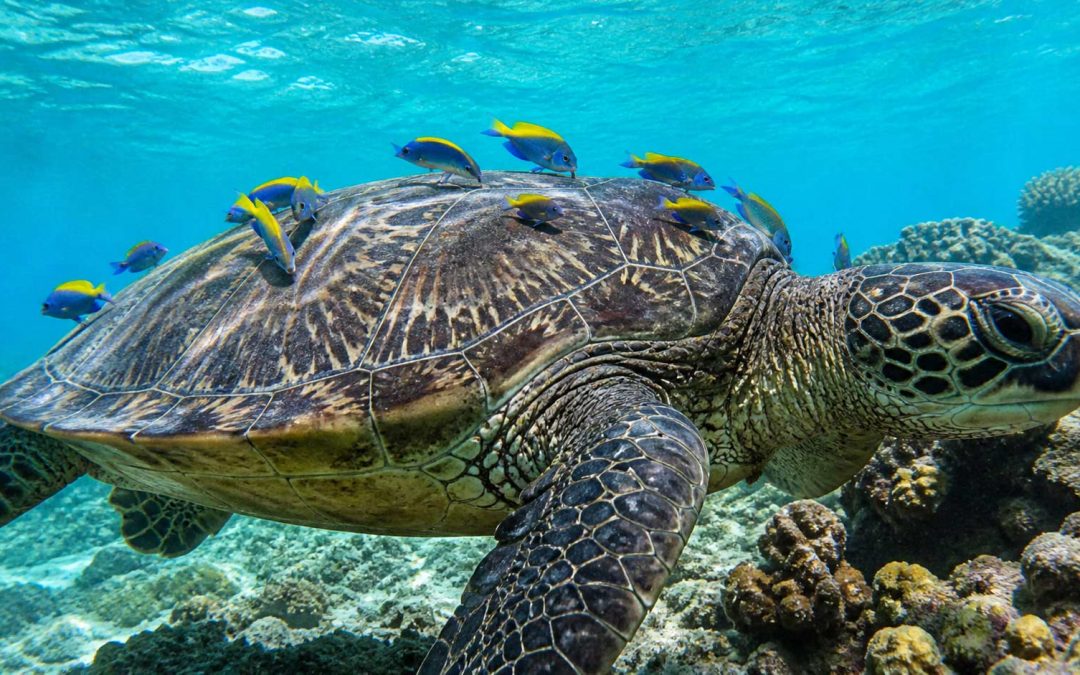
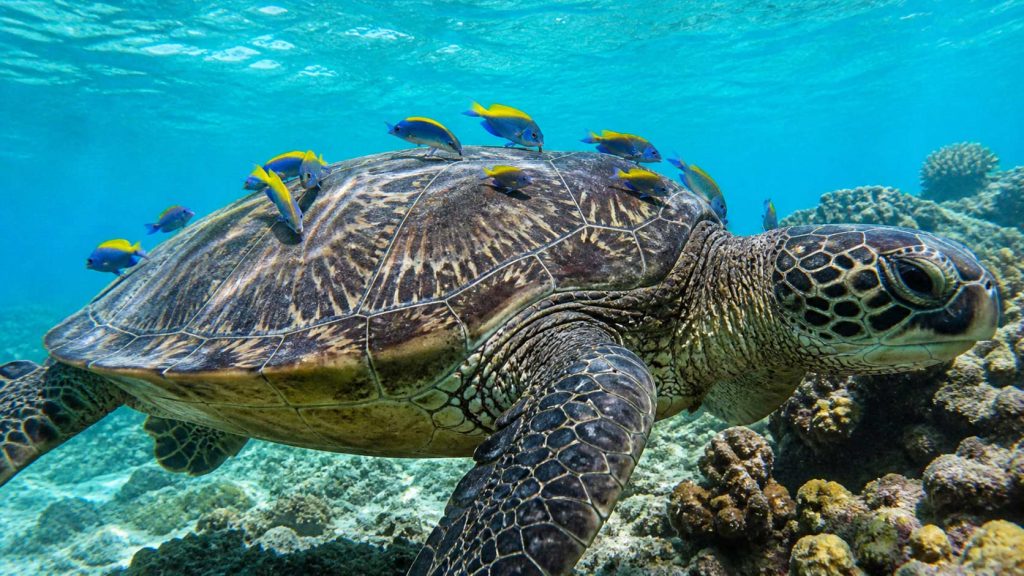
Olowalu is also home to something that draws serious turtle-watchers specifically: a turtle cleaning station. This is a section of reef where Hawaiian green sea turtles gather to let small reef fish do maintenance work on their shells and flippers. Fish like tangs and wrasse pick algae and parasites off the turtles’ shells while the turtles float nearly motionless in the water. It is a behavior sea turtles engage in regularly, and when you come across a cleaning station with half a dozen turtles lined up while fish work on their shells, it is one of the more extraordinary things you can witness underwater. Sometimes there are more than a dozen turtles at once.
Olowalu is accessed from the Honoapiilani Highway on the western side of the island. The entry is close to shore and straightforward even for less experienced snorkelers. The calm, protected water and long sightlines make it one of the most rewarding snorkel sites on Maui, particularly for anyone who wants more than a quick glimpse of a turtle.
Ka’anapali and Pu’u Keka’a
In North West Maui, the popular resort beach at Ka’anapali is also a reliable spot for sea turtle sightings. The volcanic outcrop at the northern end of the beach, known in Hawaiian as Pu’u Keka’a and commonly called Black Rock, creates an underwater structure where turtles are regularly spotted resting on coral ledges. Because Ka’anapali is a wide, gently sloping beach with a calm surf zone, conditions here are manageable for snorkelers of most skill levels.
The turtles at Ka’anapali are accustomed to human presence, which often makes for relaxed and extended sightings. A turtle that does not feel threatened will continue foraging or resting naturally, and you get to watch it on its own terms rather than watching it swim away. That said, the ten-foot rule still applies here exactly as it does everywhere else in Hawaiian waters. Crowding a turtle at Ka’anapali carries the same legal consequences as anywhere else in the state.
Honolua Bay
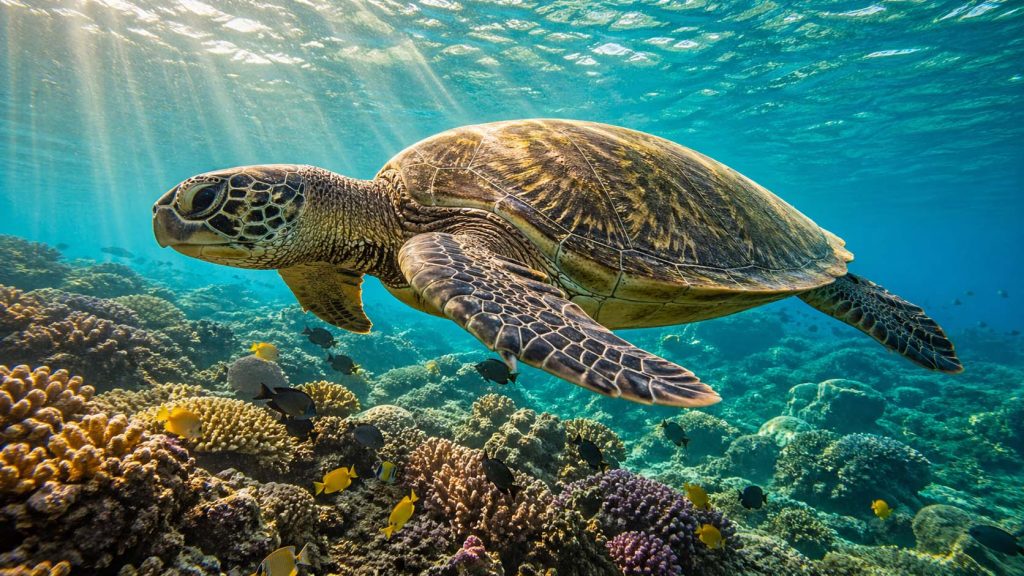
At the northern tip of West Maui, Honolua Bay is a protected marine reserve that sees fewer visitors than Turtle Town or Ka’anapali, partly because reaching the water requires a walk down to a rocky shoreline rather than a sandy beach entry. The effort is worth making. The bay holds some of the clearest water on the island, the coral is healthy, and turtles move through the open water here on a regular basis.
The turtles at Honolua tend to appear in open water rather than grazing on a shallow reef. You might be watching a school of fish and suddenly realize there is a large, calm shape gliding through the water below you. The bay is also one of Maui’s well-known surf breaks, so snorkeling there is best suited to the calmer summer months when large north swells are not rolling through.
When to Go and What to Expect
Hawaiian green sea turtles are present in Maui’s waters year-round. Unlike some sea turtle populations on the mainland, honu do not leave the Hawaiian Islands seasonally. They live, feed, and rest on the same reefs across every month of the year, which means your odds of a sighting are high regardless of when you visit.
That said, morning hours tend to offer the best conditions. Before ten in the morning, the water is usually calmer, boat traffic is lower, and turtles are often actively feeding rather than resting on the bottom. A turtle on the move is easier to spot than one motionless on a dark reef ledge. High-visibility days with light winds are always better than choppy afternoons. Checking the surf report before you head out is a simple habit that pays off.
The Rules That Protect Hawaii’s Sea Turtles
Hawaii’s sea turtle protection laws are federal, not optional guidelines. They apply to every snorkeler, swimmer, and kayaker in Hawaiian waters without exception. The animals have been recovering from near-extinction for decades, and the behavior of individual people in the water affects that recovery more than most visitors realize. Staying back and giving turtles space is not just the polite thing to do. It is what allows these animals to keep using the reefs they have relied on for generations.
The basics come down to a short list, and every one of these points is worth taking seriously before you enter the water:
- Stay at least ten feet away from any sea turtle at all times
- Never reach out to touch, even gently or briefly
- Do not position yourself between a turtle and the surface, as they must come up to breathe
- Do not chase a turtle that is swimming away
- Never feed turtles, which disrupts their natural foraging patterns
Watch: Honu in Their World
The video below from the Hawaiian Islands Humpback Whale National Marine Sanctuary gives you a close look at the Hawaiian green sea turtle in its natural habitat. It is a good introduction to the behavior and biology of honu before you get in the water for the first time.
Maui vs. Oahu: Two Islands, Two Kinds of Turtle Encounter
Both islands are exceptional places to see Hawaiian green sea turtles, but they offer different kinds of experiences. On Maui, many of the best spots are accessible directly from the shore. You park, walk in, and explore at your own pace. That independence is a real draw for snorkelers who like to go at their own speed and stay as long as they want.
On Oahu, Turtle Canyon just off the coast of Waikiki offers one of the most consistent and reliable turtle encounters in the state. A guided snorkel tour takes you offshore by boat to where large numbers of honu congregate on the reef. The boat gets you to calmer, deeper water than most shore entries, and experienced crew members know exactly where the turtles feed and rest. If you are visiting Oahu and want a guided experience paired with a traditional Hawaiian cultural program, a snorkel tour at Turtle Canyon is a natural fit.
Whichever island you visit, the honu will be there waiting.
Still Waters and Old Souls: The Valley Isle’s Greatest Gift
Hawaiian green sea turtles have been gliding through Maui’s reefs for longer than any map has named these waters. They are part of the reef, part of the culture, and part of what makes Hawaii feel unlike anywhere else on earth. Maui gives you a front-row seat to that history from a sandy beach, a snorkel buoy, or a pair of fins.
Wherever the water takes you on the Valley Isle, slow down when a turtle appears. Let it set the pace. You are a guest in its living room, and it has been there far longer than any of us.