From Stranded to Set Free: What Happens After a Honu Is Rescued
Overview
There is a good chance you already know the rule. If you find a Hawaiian green sea turtle on the beach that looks hooked, tangled, badly injured, or simply wrong, you keep your distance and you report it. That part gets repeated often, and for good reason. What gets talked about far less is the other side of that phone call. Somebody answers. Somebody drives out. And if the turtle needs more than a quick fix on the sand, it enters a system most visitors never see, one built around veterinary care, permits, patience, and a release date nobody can predict. This is the story of what happens between the call and the day a honu swims away.
It Starts With a Phone Call
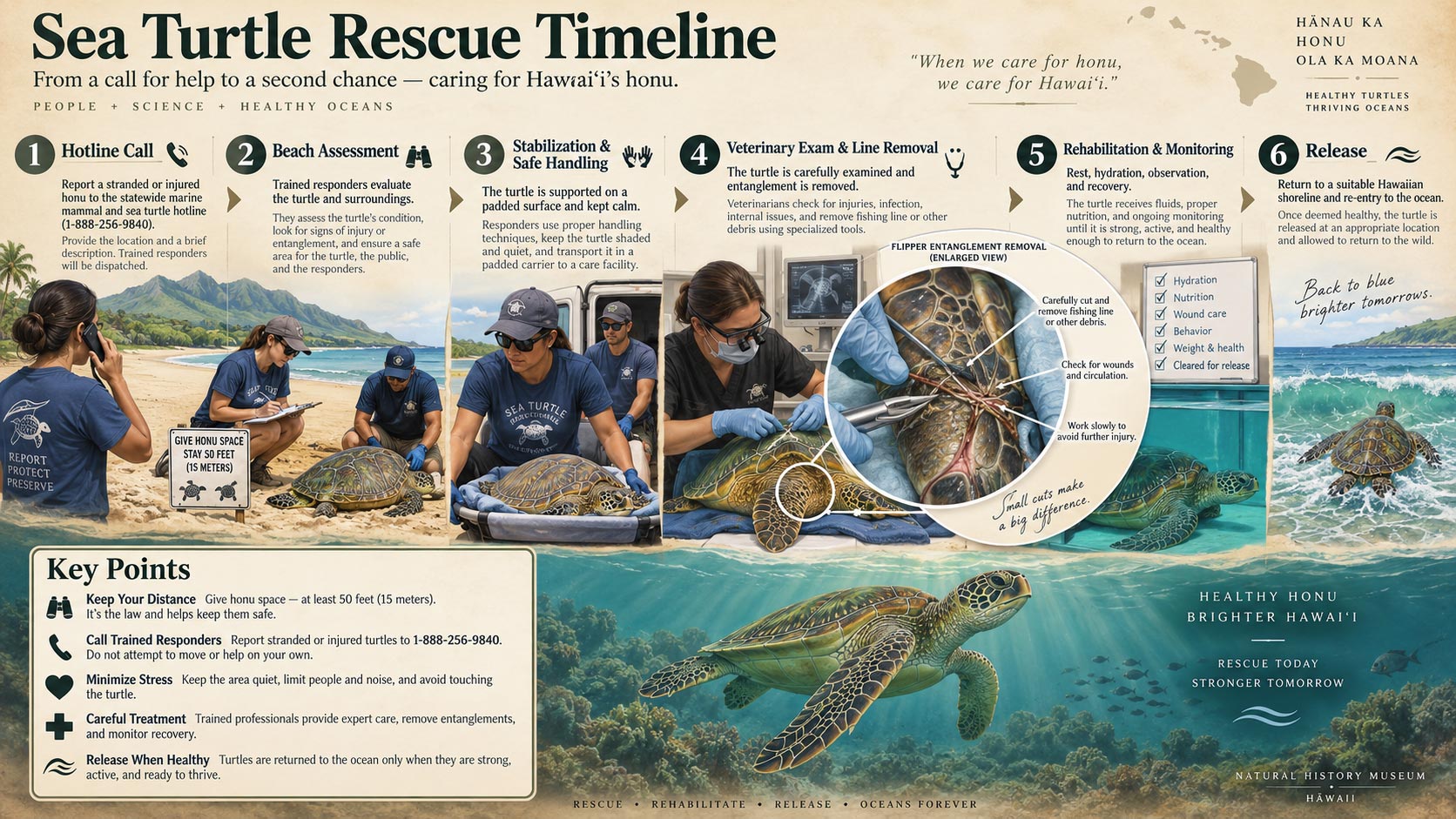
Hawaii runs a statewide 24 hour hotline for marine animals in distress, and it is the single most useful phone number a beachgoer can have. The NOAA Marine Wildlife Hotline is 1-888-256-9840, and it covers sea turtles along with the other protected species around the islands. On Oahu, that call routes into a response network that includes NOAA Fisheries partners and trained local responders from Hawaii Marine Animal Response.
- Note the exact location, including landmarks or a beach access name
- Describe what you actually see rather than what you assume is wrong
- Mention fishing line, hooks, netting, wounds, or tumors if any are visible
- Take a photo from a distance if you can do it without approaching
- Stay nearby if possible so a responder can find the animal
The reason detail matters is that responders make triage decisions before they arrive. A turtle resting normally on the sand and a turtle wrapped in monofilament are two very different calls, and the more accurate your description, the better prepared the person driving out will be.
Why You Should Never Move the Turtle Yourself
This is the hardest instruction for kind people to follow. Every instinct says to help, and helping usually looks like carrying the animal back to the water. Please do not. Hawaiian green sea turtles are protected under the Endangered Species Act, and only responders operating under federal permits are allowed to handle them. That is not bureaucracy for its own sake. An injured or exhausted turtle pushed into the surf can drown, and a turtle that swims off with a hook still in it is a turtle nobody can help later.
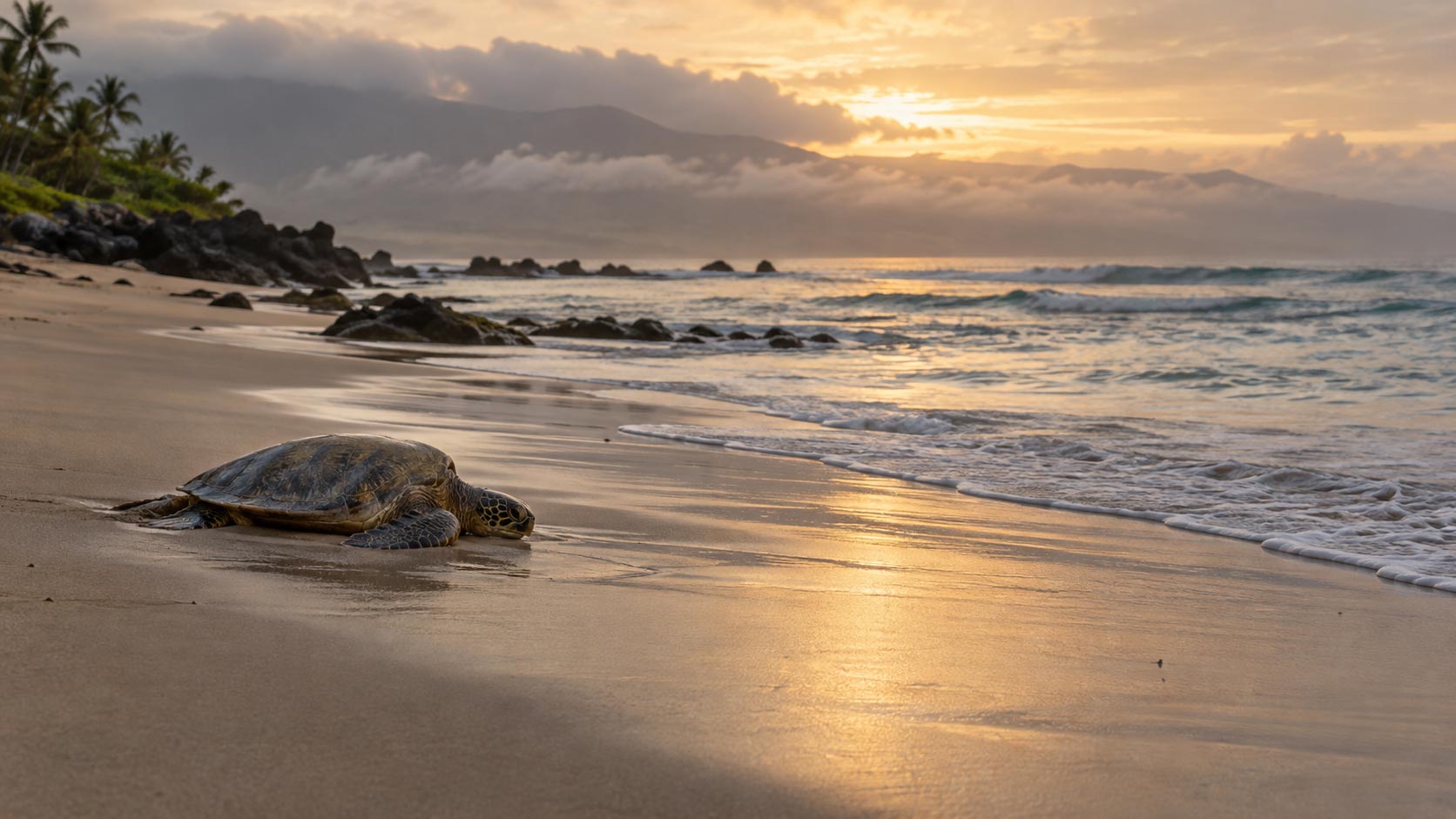
There is also a second trap. Hawaiian green sea turtles bask on land as normal, healthy behavior, which means a turtle lying still on the sand is often perfectly fine. Well meaning people have dragged healthy basking turtles into the water believing they were saving them. When you are unsure, the right move is a phone call, not a rescue attempt.
What Responders Do at the Scene
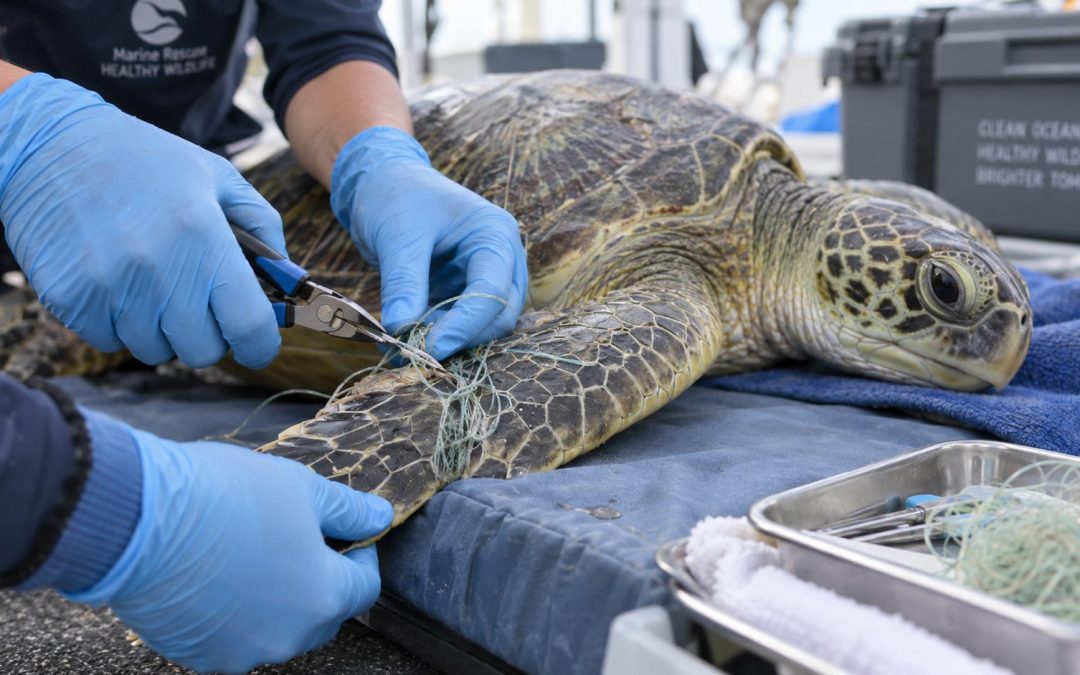
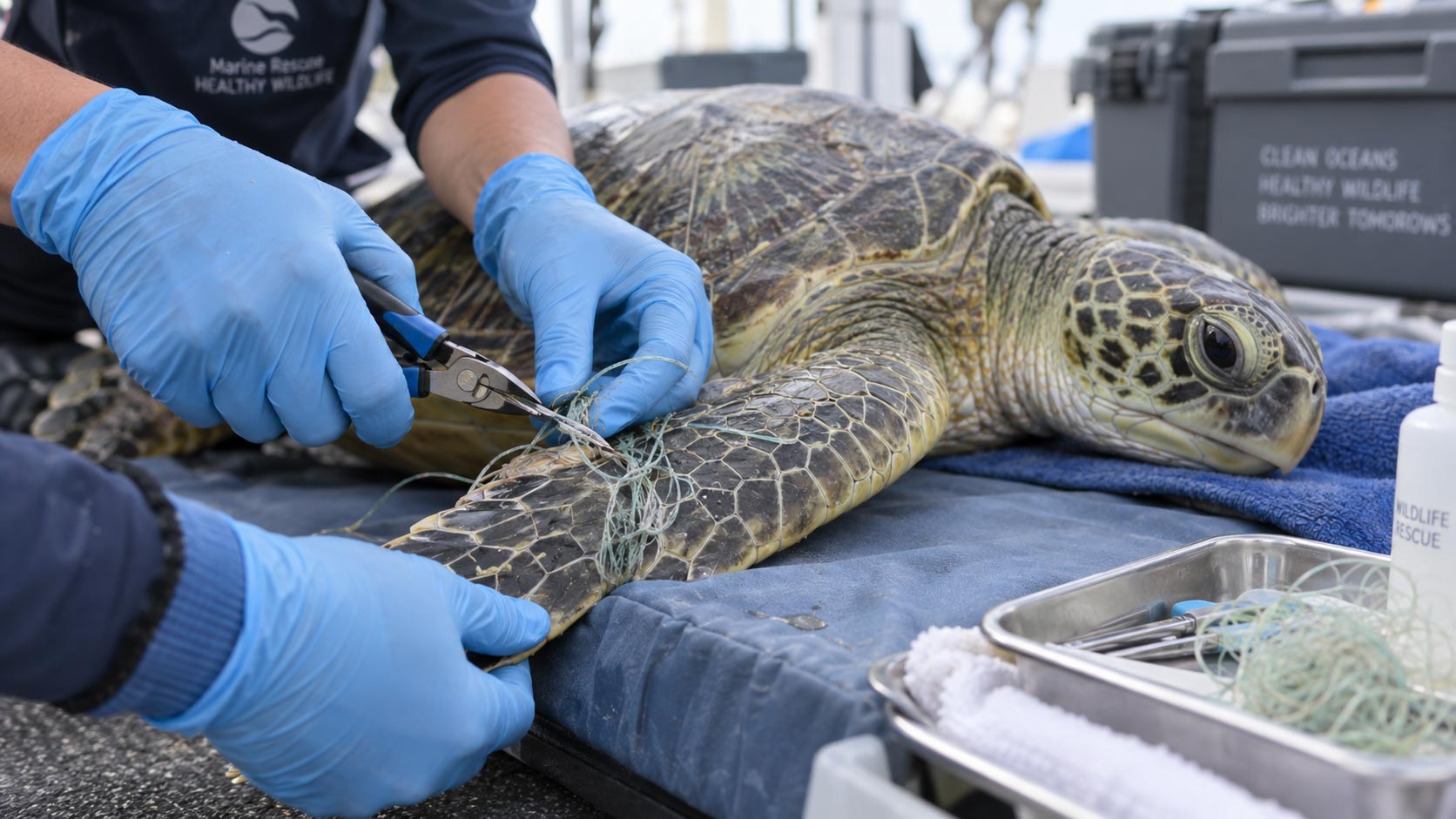
Once a trained responder reaches the animal, the first job is assessment. They look at body condition, alertness, wounds, whether the turtle can move normally, and whether anything is wrapped around a flipper or the neck. A surprising number of cases get resolved right there on the beach. Fishing line and gear can often be cut away in the field, and a turtle that is otherwise strong can be released on the spot with far less stress than a trip in a truck would cause.
When it cannot be handled in the field, the turtle is secured for transport. That means keeping it stable, shaded, and calm, because a stress response is one of the real dangers to an animal already in trouble. From there it heads to care.
Who Actually Treats a Sick Honu
Hawaii’s response system is a partnership rather than a single facility. NOAA Fisheries holds jurisdiction over sea turtles, and the Pacific Islands Fisheries Science Center runs the Marine Turtle Biology and Assessment Program, which rehabilitates and studies stranded turtles from across the Hawaiian Islands. The Marine Institute at Maui Ocean Center coordinates the statewide stranding response network and takes on rehabilitation for critically injured turtles, working in partnership with NOAA.
What that means in practice is that a turtle picked up on an Oahu beach becomes part of a statewide effort. Every case also becomes data. Where it stranded, what was wrong with it, how it responded to treatment, and what happened next all feed into a long running record that shapes how Hawaii protects the species.
What Actually Puts a Honu in Rehab
Stranding is a broad word. It covers any turtle that comes ashore or is found in distress, and the causes fall into a few recurring categories.
- Fishing gear, including hooks, monofilament line, and netting that cuts into flippers
- Boat and propeller strikes, which can crack the shell or cause serious internal injury
- Predator wounds, most often shark bites
- Fibropapillomatosis, a tumor disease that affects Hawaiian green sea turtles heavily
- Debris ingestion, especially plastic mistaken for food
- Exhaustion and general poor body condition, sometimes after storms
Fibropapillomatosis Is the Big One
Among Hawaii’s honu, no single problem shows up as often as fibropapillomatosis, usually shortened to FP. It causes external tumors that commonly grow around the eyes, mouth, neck, and flippers. A heavy tumor load can blind a turtle, make it unable to eat properly, or interfere with swimming, and any of those is eventually fatal on its own.
The encouraging part is that FP tumors can sometimes be surgically removed, and turtles do recover. It is slow work. A turtle may need multiple procedures, weeks of monitoring, and a long stretch of simply eating well and regaining strength before anyone considers releasing it. Cases like these are the reason rehab stays measured in months.
Rehab Takes Patience
There is no standard recovery timeline, because there is no standard injury. A turtle with a hook removed and a clean wound may be back in the water quickly. A turtle recovering from tumor surgery or a shell fracture might spend a long stretch in care. Through all of it, the daily work is unglamorous, which is exactly why the public rarely sees it. Wounds get cleaned. Weight gets tracked. Appetite gets watched, because a turtle that will not eat is a turtle that is not ready. Water quality gets managed. Progress is measured in small, boring improvements rather than dramatic moments.
Not every animal makes it. Some arrive too far gone, and part of responsible care is recognizing when an animal is suffering without a realistic path back to the ocean.
Release Day
When a turtle is eating well, moving normally, and cleared by the people responsible for it, it gets to go home. Release usually happens at or near suitable habitat, and often the turtle is tagged first so researchers can recognize it if it turns up again. That last part matters more than it sounds. A tagged turtle spotted years later, healthy and going about its business, is one of the few ways anyone gets to confirm that all those months of care actually worked.
For the people involved, release is the entire point, and it is over fast. The turtle hits the water, orients itself, and disappears. No ceremony from the animal’s side. That is exactly the outcome everyone wanted.
Even the Ones That Do Not Survive Teach Something
It is worth saying plainly that some rescued turtles die, and some are found already dead. Those cases are not wasted. Examinations reveal what killed the animal, whether that was ingested plastic, an infection, a boat strike, or disease. Over years, that record is how Hawaii learned how widespread FP had become, how often fishing gear is involved, and where the trouble spots are. A dead turtle reported is still a turtle contributing to the survival of the rest.
How to Be the Person Who Makes the Call
Every rescue in Hawaii starts with somebody who noticed and did the small, unglamorous thing. Not a dramatic wade into the surf, just a phone call and a willingness to wait around and point.
- Save the hotline in your phone now, 1-888-256-9840
- Keep your distance, and keep dogs and kids back too
- Do not push, drag, carry, or pour water on the animal
- Do not feed it
- Report a turtle that is clearly dead as well, because those cases still matter
- If in doubt, call anyway and let a trained responder decide
The Quiet Work Behind Every Healthy Turtle
The honu gliding under your board or drifting past you over the reef looks like it has never needed anybody. Some of them have. A share of Hawaii’s turtles are swimming today because a stranger on a beach made a phone call, a responder drove out, a veterinary team did slow and careful work for months, and somebody finally carried a much healthier animal down to the water and let it go. It is one of the least visible conservation stories in the islands, and one of the most hopeful. The next time you see a turtle in trouble, remember that you are the first step in that entire chain.