Ancient and Aware: The Surprising Intelligence of Hawaii’s Sea Turtles
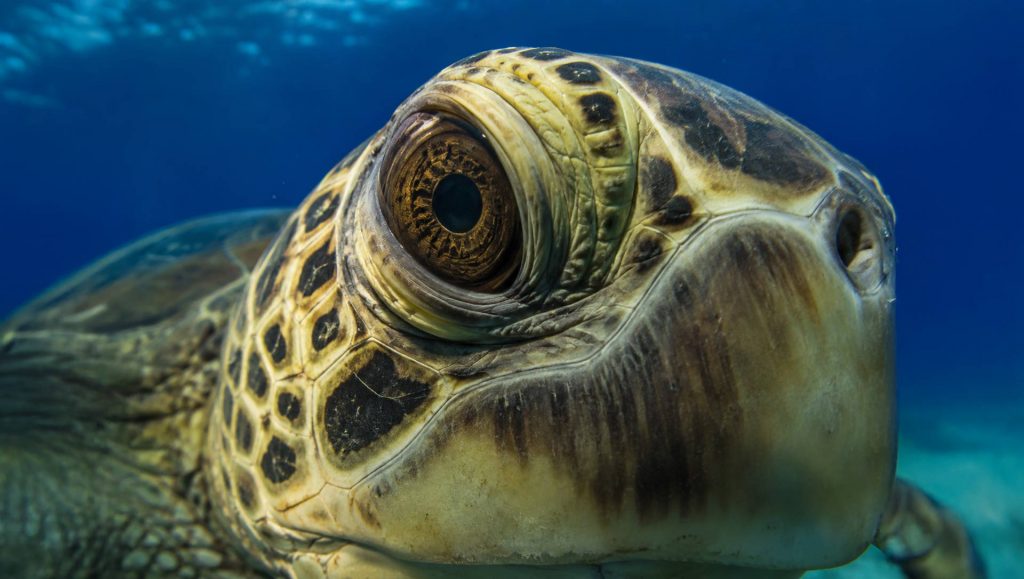
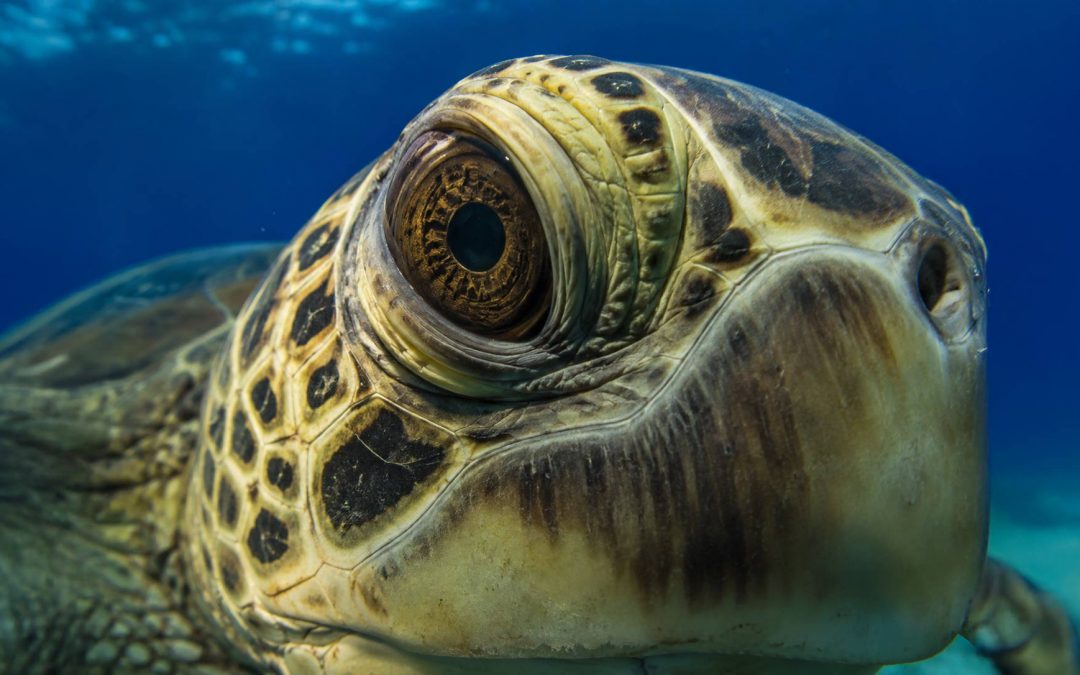
When people think about sea turtles, they usually picture something slow, ancient, and mostly instinct-driven. But spend any time in the water with Hawaii’s green sea turtles and something shifts. A honu will swim over, pause, and look directly at you. Not in the way a fish darts past without registering you are there. More like it is actually taking you in. That is because sea turtles are far more aware than most people give them credit for. The science behind sea turtle intelligence is still developing, but what researchers have found already is genuinely surprising.
A Brain Built for What Matters
Sea turtles have a relatively small brain compared to their large body size. That much is true. But brain-to-body ratio is not the whole story, and scientists have known this for a while. A sea turtle’s brain is not primitive. The sensory regions tied to vision, smell, and spatial awareness are well developed, meaning the parts of the brain that matter most for survival are doing exactly what they need to do.
Turtles belong to the reptile class, and reptiles have long had a reputation for being simple creatures running mostly on instinct. Recent research has pushed back hard on that idea. Studies comparing reptile cognition to birds and mammals have found that turtles can learn, remember, and even observe others to figure out tasks. That is not instinct. That is learning.
Long-Term Memory Across Decades
One of the most striking things about sea turtle intelligence is their long-term memory. Female Chelonia mydas, the Hawaiian green sea turtle, return to the exact beach where they were born to lay their own eggs, sometimes decades later. A turtle hatched in the 1990s can navigate back to that same stretch of Hawaiian shoreline in the 2020s. The precision involved is remarkable and has fascinated researchers for years.
What makes this possible is partly a sensory ability called magnetoreception. Sea turtles have magnetite crystals in their brains that allow them to detect Earth’s magnetic field. Scientists believe turtles essentially memorize the unique magnetic signature of their birth beach as hatchlings and carry that location information like an internal GPS beacon for the rest of their lives. This is not passive instinct at work. It requires storing specific data and retrieving it years, sometimes decades, later.
Learning From Experience, Not Just Instinct
Laboratory research has shown that sea turtles can learn through both classical conditioning and by watching other turtles. In one series of experiments, green sea turtle hatchlings were trained using standard conditioning techniques, and they picked up the associations faster than researchers expected. In a separate study, turtles that observed a trained turtle completing a task were able to replicate it themselves. This kind of social learning, where an animal watches and imitates, is considered a meaningful marker of cognitive ability across the animal kingdom.
The learning is slower than you would see in a crow or a dolphin, but it sticks. Once a turtle learns something, it tends to remember it for a long time. This durable memory is part of what makes sea turtles such effective survivors across very long lifespans in a constantly changing ocean.
The Cognitive Map Theory
One of the more interesting ideas in sea turtle research is the concept of a cognitive map. A cognitive map is an internal mental picture of the environment, not just a set of fixed instinctual responses. Researchers have proposed that sea turtles maintain something like a mental map that allows them to adapt when their surroundings change, rather than simply getting confused or lost.
This would explain how turtles manage to keep finding productive feeding grounds, navigate around obstacles in the open ocean, and reorient when currents shift unexpectedly. An animal running on pure instinct struggles when the environment changes rapidly. A turtle with something resembling a working mental map can make adjustments. Given that sea turtles have survived on Earth for more than 100 million years through multiple mass extinctions and major climate shifts, there is clearly something very effective about the way they process the world around them.
How Nesting Temperatures Affect Hatchling Cognition
One of the more recent areas of sea turtle research involves climate change and how warming beaches might affect the cognitive ability of future hatchlings. Researchers studied loggerhead sea turtles incubated at different temperatures to simulate what rising sand temperatures could produce in coming decades. Their findings were reassuring. Hatchlings from warmer nests performed just as well on maze and problem-solving tasks as those incubated at lower temperatures. Cognitive flexibility did not appear to be significantly impaired by the heat.
This matters because warming nests are already shifting the sex ratios of sea turtle populations worldwide, with hotter incubation tending to produce more females. Understanding whether heat also affects how well hatchlings function and learn gives conservationists a fuller picture of what climate change means for sea turtles over generations. The brain, at least in these early studies, appears more resilient than some researchers feared.
Curiosity and Social Behavior in the Water
Hawaii’s green sea turtles are not exactly solitary animals. Research on green sea turtles in coastal environments has documented surprisingly active social behavior, with individuals interacting with each other at rates that suggest social dynamics play a genuine role in their daily lives. This is a relatively new area of study, and researchers are still working out what sea turtle sociality actually involves, but it challenges the long-held idea of the turtle as a lone drifter with no connection to others.
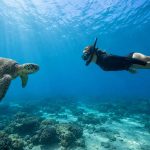
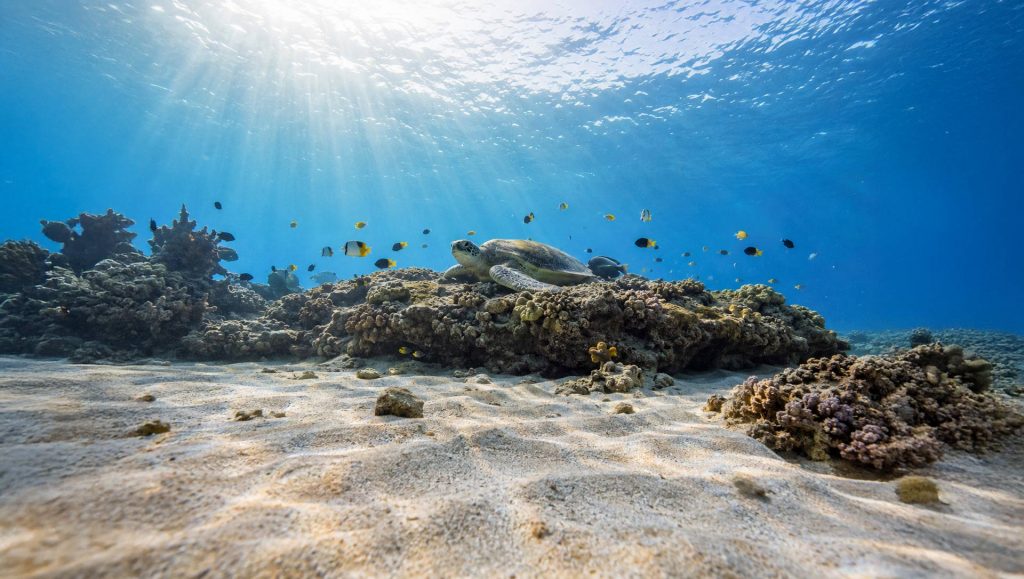
What visitors to Turtle Canyon regularly notice is something related to this. Turtles at this site frequently approach snorkelers on their own. They do not appear startled or cornered. They linger near people for stretches of time before calmly moving on. Whether that represents something like genuine curiosity or is a learned comfort built up from years of peaceful human presence is still an open question. But the behavior is consistent enough that guides and researchers who spend time at Turtle Canyon mention it regularly.
What This Means When You Are in the Water
Understanding that sea turtles are more cognitively sophisticated than they look changes the experience of being near one. When a honu glides over and slows down beside you, it is responding to something. It is taking in information in real time and making a choice about whether to stay or go. That is worth pausing to appreciate, especially when you are floating above a reef that this particular turtle may have been visiting for longer than most people can remember.
The Turtles and You tour at Turtle Canyon puts you directly in the water with these animals at one of the most consistent green sea turtle gathering spots on Oahu. The guides are trained in Hawaii’s sea turtle interaction guidelines, keeping safe distances while still getting guests close enough to have a genuine, unhurried encounter with the honu in their natural environment.
Conservation Starts With Understanding
Protecting sea turtles has always depended on public support, and public support grows when people feel a real connection to the animals they are being asked to care about. Knowing that the green sea turtle you encountered at Turtle Canyon has been navigating this reef for decades, that it carries a magnetic memory of beaches it visited as a hatchling, that it can learn by watching others and remember lessons for years, makes conservation feel much less abstract.
Hawaii’s green sea turtles are listed as a threatened species under the federal Endangered Species Act. Their population has grown meaningfully since federal protections were established in the 1970s, but they still face ongoing pressure from ocean warming, plastic debris, coastal development, and boat traffic. The more people understand about how these animals actually think and function, the better the odds that future generations will still be able to share the water with them off Waikiki.
Not Just Old, But Aware
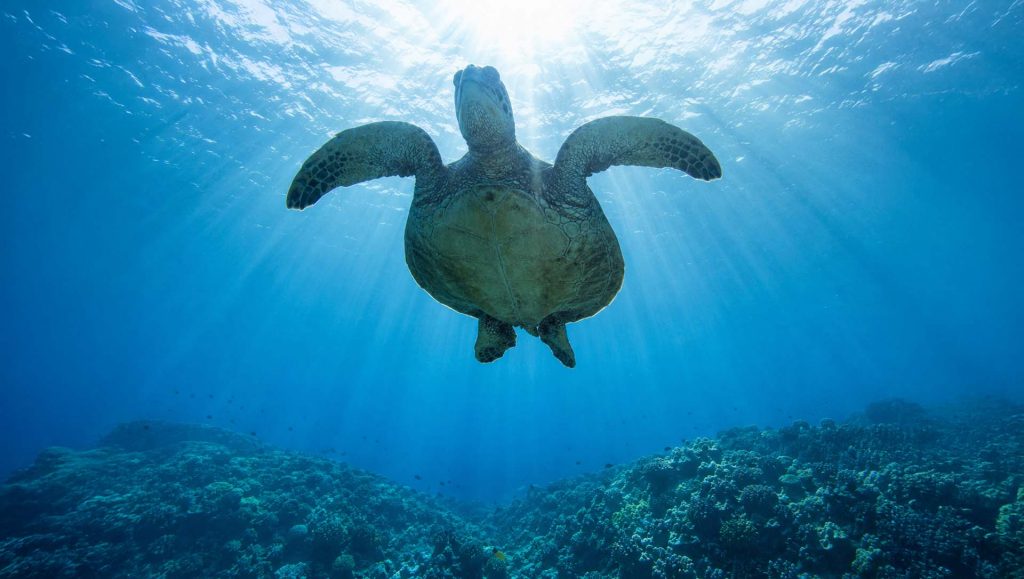
Sea turtles have been on Earth for more than 100 million years. They survived whatever ended the non-avian dinosaurs. They outlasted species with larger brains, faster reflexes, and more complex social structures. That kind of staying power does not come from being a mindless machine. It comes from an animal that can learn, remember, adapt, and navigate some of the most dynamic and unpredictable environments on the planet.
The next time you are snorkeling at Turtle Canyon and one of Hawaii’s green sea turtles turns and looks at you, there is something real looking back. Ancient, yes. But aware in ways we are only beginning to understand.
Ancient Eyes, Living Memory: Meet Hawaii’s Most Intelligent Ocean Resident
The sea turtles at Turtle Canyon have been navigating these waters long before most of us were born. They carry magnetic maps in their brains, learn from watching others, form long-term memories of places that matter to them, and return to the same shores across decades. Their intelligence does not look like ours, but it is built precisely for the life they lead. Book a tour with Turtles and You and see for yourself what it feels like to share the water with an animal like that.