Millions of Sea Turtles, One Beach, One Night: The Olive Ridley Story
Most people who visit Oahu leave a piece of their heart with the honu, Hawaii’s beloved green sea turtle. There is nothing quite like drifting alongside one at Turtle Canyon, watching it move through crystal-clear water with slow, confident grace. But the ocean is home to seven species of sea turtles, and each one has its own remarkable story. The story of the Olive Ridley sea turtle is one of the most astonishing in all of nature, because once a year, hundreds of thousands of them do something that no other animal on Earth does quite the same way.
What Is the Olive Ridley Sea Turtle?
The Olive Ridley sea turtle, known scientifically as Lepidochelys olivacea, gets its name from the soft olive-green color of its shell. It holds the title of most abundant sea turtle on the planet. At the same time, it is listed as Vulnerable on the IUCN Red List and protected under the Endangered Species Act. Both things are true: numerous enough to be the most common sea turtle in the world, and still facing serious threats that could change that picture.
The Olive Ridley belongs to a genus called Lepidochelys, which it shares with only one other living species, the Kemp’s Ridley sea turtle found in the Gulf of Mexico and the Atlantic. Together, they are the smallest sea turtles alive. An adult Olive Ridley is typically about two feet long and weighs somewhere between 80 and 110 pounds. Compare that to the Leatherback, the largest sea turtle in the ocean, which can tip the scale at up to 1,500 pounds. The Olive Ridley is small, but it punches far above its weight in both numbers and one completely extraordinary behavior.
Small but Built for the Open Ocean
The Olive Ridley’s heart-shaped shell, called a carapace, is one of the features that make it easy to identify. While most sea turtle shells are wider and more rounded, the Olive Ridley’s tapers noticeably toward the rear, giving it that distinct shape. The shell has between six and nine pairs of lateral scutes, the individual bony plates along the sides of the carapace, which is more than most other sea turtle species. Scientists in the field often count these scutes as part of their identification process.
The rest of the body is built for distance. Long, powerful front flippers are designed for open-ocean travel across thousands of miles. The head is small and roughly triangular, with eyes that have a faint reddish tint. Adult females and males look nearly identical from a distance, though males have a slightly longer, thicker tail, a detail that becomes important during mating season.
Where in the World Does the Olive Ridley Live?
The Olive Ridley is one of the most wide-ranging sea turtle species on the planet. They live in the tropical and subtropical waters of the Pacific Ocean, the Indian Ocean, and parts of the Atlantic Ocean. Their core range runs along the coasts of India, Sri Lanka, Mexico, Costa Rica, and West Africa, but individual turtles can travel far outside these zones.
Unlike Hawaii’s green sea turtles, which are closely tied to specific reef habitats and return to the same feeding grounds year after year, Olive Ridleys are pelagic travelers. That means they are animals of the open ocean, spending most of their lives in deep water far from any coastline. Satellite tagging studies have shown that individual Olive Ridleys can travel thousands of miles in a single year, crossing entire ocean basins as they move between feeding grounds and nesting beaches.
The Arribada: When Hundreds of Thousands Nest Together
This is the part of the Olive Ridley story that stops people in their tracks.
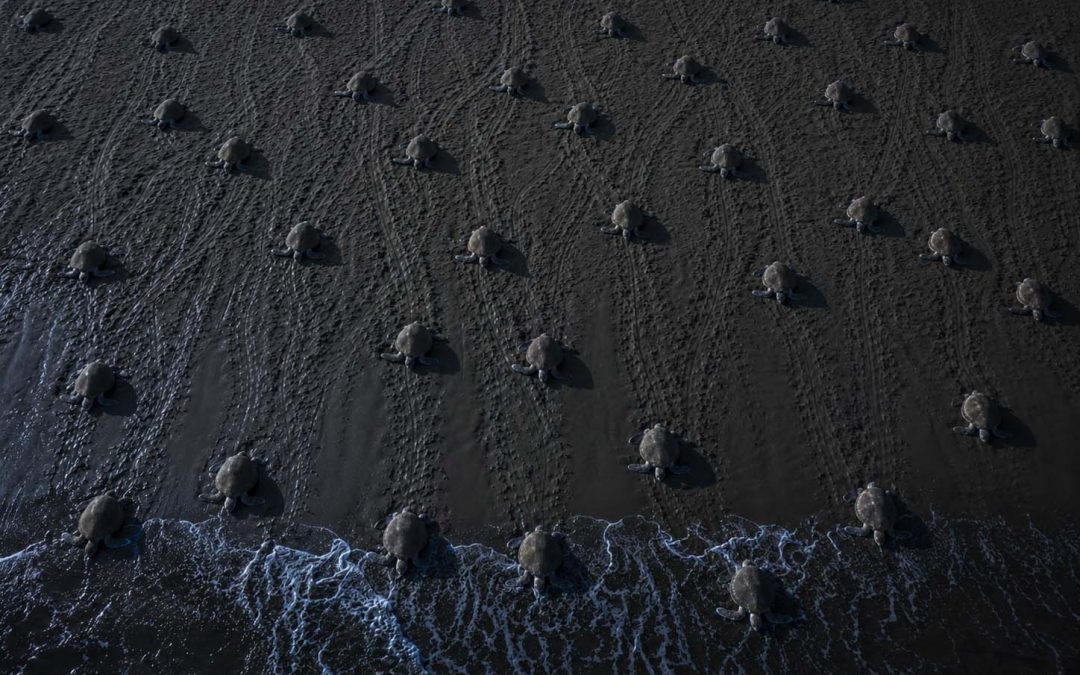
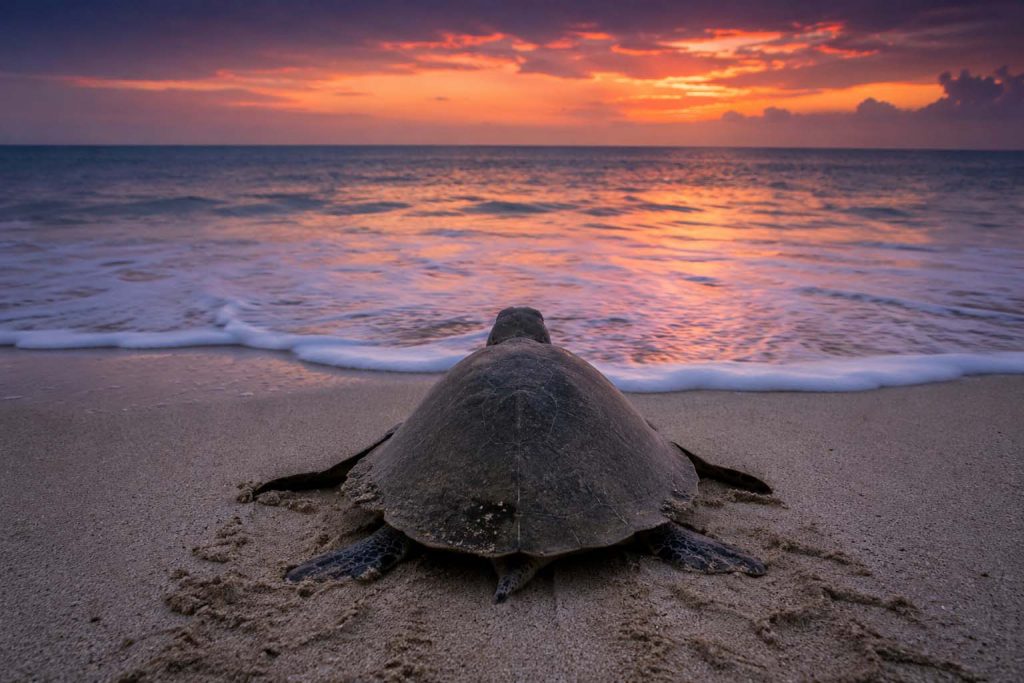
All sea turtles nest, and most do it alone. A female hauls herself onto the beach in the dark, digs a nest above the tide line, lays her eggs, covers them, and returns to the ocean. It is a quiet, solitary act carried out in the middle of the night. The Olive Ridley does this too, sometimes. But it also does something no other sea turtle species does: it nests in massive synchronized events called an arribada, which is Spanish for arrival.
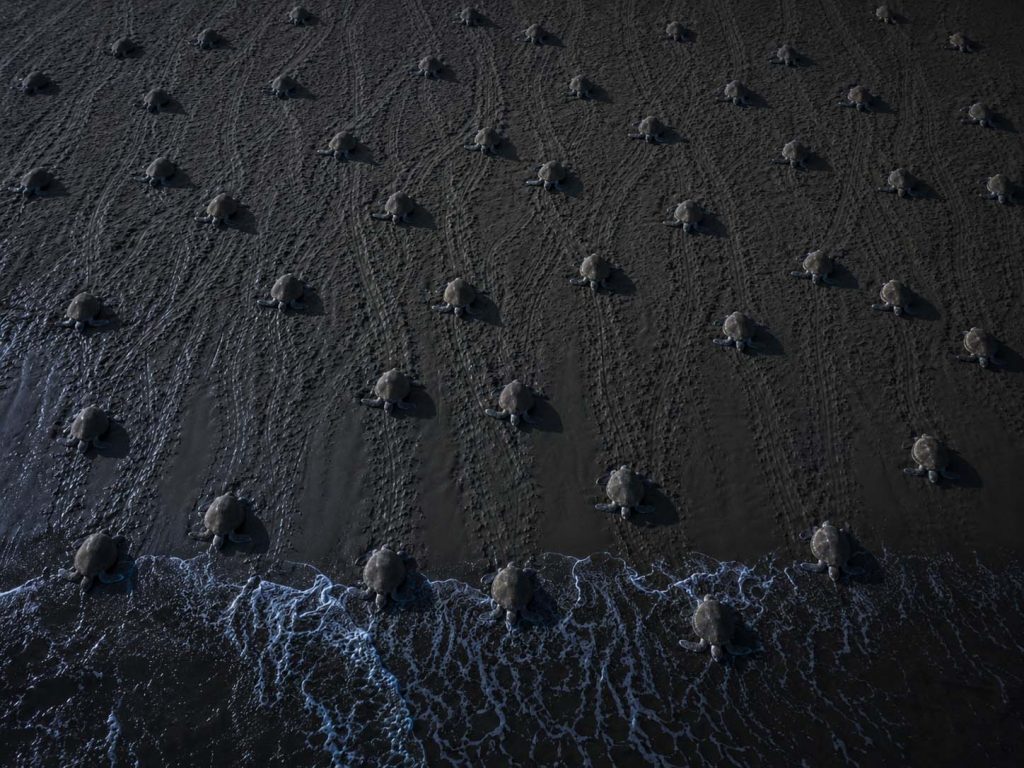
During an arribada, tens of thousands to hundreds of thousands of female Olive Ridley sea turtles emerge from the ocean and flood the same beach over the course of two to seven nights, all at roughly the same time. The beach becomes completely transformed. Turtles cover every inch of sand. Some females accidentally dig up nests that others laid just hours earlier. Tracks going in every direction turn the whole beach into a map of crossings and returns. The sound of flippers dragging across sand fills the night air.
Researchers have studied what triggers an arribada for decades without arriving at a single answer. Lunar cycles, offshore wind patterns, water temperature, and chemical signals released by females already nesting on the beach all appear to play a role. What is clear is that this behavior has been passed down through millions of years of evolution, and when the conditions align, it unfolds on a scale that is hard to put into words. At Gahirmatha Beach in the state of Odisha on the east coast of India, estimates of a single arribada have reached 800,000 turtles.
The World’s Most Famous Olive Ridley Nesting Beaches
Three major regions account for the vast majority of Olive Ridley mass nesting worldwide. India’s Odisha coast, particularly Gahirmatha Beach and the nearby Rushikulya River mouth, hosts events each year between January and March. The scale of what happens on those beaches is unlike anything else on the planet.
Costa Rica is the second major hub. The Ostional National Wildlife Refuge on the Nicoya Peninsula hosts regular arrivals from July through December, with peak activity in late summer and early fall. In Mexico, La Escobilla Beach in the state of Oaxaca sees several large mass nesting events per year as well.
Outside these core areas, Olive Ridleys also nest in smaller numbers along the coasts of Nicaragua, Panama, Sri Lanka, and West Africa. Each female returns to the same general beach region to nest year after year, guided back by the Earth’s magnetic field in a behavior called natal beach fidelity.
What Does an Olive Ridley Sea Turtle Eat?
The Olive Ridley is an omnivore, meaning it eats both animals and plant material. In the open ocean, the main items on the menu are jellyfish, crabs, shrimp, lobster, and small fish. Near coastlines, Olive Ridleys also forage on invertebrates and algae. This dietary flexibility is part of what allows them to thrive across such a wide range of ocean environments.
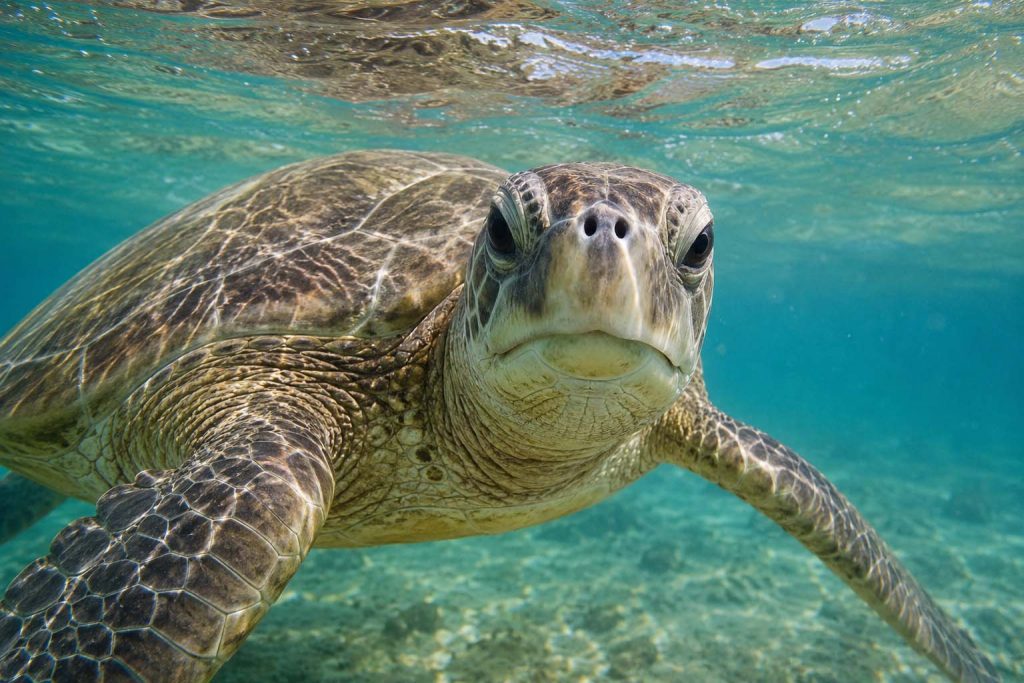
This stands in clear contrast to Hawaii’s green sea turtles, which are primarily herbivores as adults, grazing on marine algae and limu in reef habitats like Turtle Canyon. The Olive Ridley’s ability to eat nearly anything the ocean provides helps explain why it is found so far from any single reef system.
From Sand to Sea: The Hatchling Journey
After a female lays her eggs, she covers the nest and returns to the ocean. The eggs incubate for about 45 to 60 days, buried in warm sand while the mother is long gone. The temperature inside the nest is critical to what happens next. Warmer nests tend to produce more females, cooler nests more males, a process called temperature-dependent sex determination. As beach temperatures rise due to climate change, the balance of male to female hatchlings in many populations is beginning to shift, which is one reason scientists are watching this closely.
When the eggs are ready, the tiny hatchlings work together to push through the sand and emerge as a group. They then race toward the ocean, navigating by the light reflected off the water’s surface. Ghost crabs, birds, fish, and other predators wait at every step. The odds facing any individual hatchling are steep, and only a small fraction will survive to adulthood. The full story of that remarkable sprint from nest to ocean is one worth reading on its own.
Threats Facing the Olive Ridley Today
The Olive Ridley’s abundance can create a false sense of security. It faces serious, sustained pressure from multiple directions. Bycatch, the accidental capture of sea turtles in commercial fishing gear, is the single biggest threat. Trawl nets, gill nets, and longlines kill large numbers of sea turtles every year, and Olive Ridleys make up a significant portion of that toll.
Coastal development shrinks the amount of available nesting beach. Light pollution from hotels, roads, and buildings disorients both hatchlings trying to reach the ocean and nesting females trying to reach the sand. Egg poaching continues in some parts of the world despite legal protections. Plastic pollution is an especially dangerous problem for a species that relies on jellyfish as a major food source. A floating plastic bag looks like a jellyfish to a sea turtle, and swallowing one can be fatal.
Olive Ridleys are protected internationally under the Convention on International Trade in Endangered Species, known as CITES, which prohibits the commercial sale of sea turtle products across borders.
The Olive Ridley and Hawaii’s Sea Turtles
Hawaii is home to several sea turtle species. The honu, the Hawaiian green sea turtle, is the most common and the one most visitors encounter at spots like Turtle Canyon off Waikiki. The hawksbill sea turtle, called honu’ea in Hawaiian, is also found here in smaller numbers. Leatherbacks occasionally pass through Hawaiian waters on long Pacific migrations. Olive Ridleys, while a Pacific species, are not resident to Hawaiian waters and do not nest on Hawaiian beaches. But they are part of the same ocean, the same global picture of sea turtle conservation, and the pressures on Olive Ridley populations in the Pacific affect the health of the broader ocean ecosystem that Hawaiian sea turtles call home.
If seeing sea turtles up close is on your list for your Oahu trip, the Turtles and You Turtle Canyon tour departs twice daily from Waikiki. The tour includes about 45 minutes of in-water time at Turtle Canyon, a reef system where Hawaiian green sea turtles are regularly encountered year-round. Snorkel gear, complimentary snacks, and hotel trolley service from Waikiki are all part of the experience.
How You Can Help
Protecting sea turtles, whether the Olive Ridley on a beach in India or the honu at a reef in Oahu, comes down to choices made consistently over time. Reducing single-use plastic keeps bags and packaging out of the ocean. Supporting fisheries that use turtle-friendly gear reduces bycatch. Choosing eco-certified tour operators when you travel sends a clear signal that responsible wildlife tourism matters.
In Hawaii, federal law requires that people stay at least six feet away from sea turtles at all times. That distance protects the animals, and it also tends to produce the best experience. A turtle that feels safe stays put, behaves naturally, and gives you something genuinely worth remembering.
Simple ways to support Olive Ridley sea turtle conservation:
- Reduce your use of single-use plastics, especially plastic bags
- Support sustainable seafood programs and certified fisheries
- Donate to organizations like the Sea Turtle Conservancy or NOAA’s sea turtle programs
- Follow all wildlife distance rules whenever you are near sea turtles
- Share what you learn about sea turtles with people who have never heard the story
One Ocean, Seven Species, One Shared Future
The Olive Ridley spends most of its life unseen, somewhere out in the deep Pacific or Indian Ocean, traveling routes it knows by the invisible pull of the Earth’s magnetic field. Then one night, for reasons we are still working to understand, it joins hundreds of thousands of its kind on a single beach and takes part in one of the most overwhelming spectacles in all of nature. The honu at Turtle Canyon moves quietly through a very different kind of ocean. But these animals are connected by the same water, the same threats, and the same long, unbroken chain of survival. Getting to know one of them changes the way you see all of them.