

The Story of Hawaii’s Traditional Honu Harvest: Culture, Balance, and Renewal

For generations, Native Hawaiians lived in close connection with the land and sea. One powerful example of this relationship is the traditional harvest of the honu, or green sea turtle. This practice was never just about food. It was guided by strict rules, cultural beliefs, and deep respect.
Over time, outside influence changed everything. Honu populations dropped sharply. Today, the turtles are federally protected. Yet as their numbers recover, many are asking an important question: Can limited cultural harvest return in a careful, responsible way?
Here’s a closer look at Hawaii’s traditional honu harvest, how it changed, and why the conversation continues today.
Honu: More Than Just a Sea Turtle
In Hawaiian culture, honu hold a special place. They were not simply animals in the ocean.
Honu were seen as:
- Sacred beings
- Family guardians known as ʻaumākua
- Symbols of wisdom and endurance
- Signs of good luck and protection
- Important figures in stories and mythology
For many families, the honu represented ancestral connection. Seeing one in the ocean was meaningful. This spiritual role shaped how they were treated and managed.
How the Kapu System Protected the Honu
Traditional Hawaiian society followed a system of laws called the kapu system. Chiefs controlled access to important resources, including honu. These rules were not random. They were designed to protect balance.
Under this system:
- Chiefs decided when turtles could be taken
- Harvesting was limited and controlled
- Access was restricted to prevent overuse
- Cultural protocol guided every step
This structure helped ensure that harvesting did not harm the long-term health of the turtle population. It was about stewardship, not exploitation.
Every Part Had Purpose
When honu were harvested, nothing went to waste. The turtle provided more than food.
Here’s how different parts were used:
- Meat served as a valuable food source
- Shells became containers, tools, and jewelry
- Bones were crafted into fishhooks and ornaments
- Certain parts were used in traditional medicine
The harvest supported both daily life and cultural practice. It was a system built on respect and careful use.
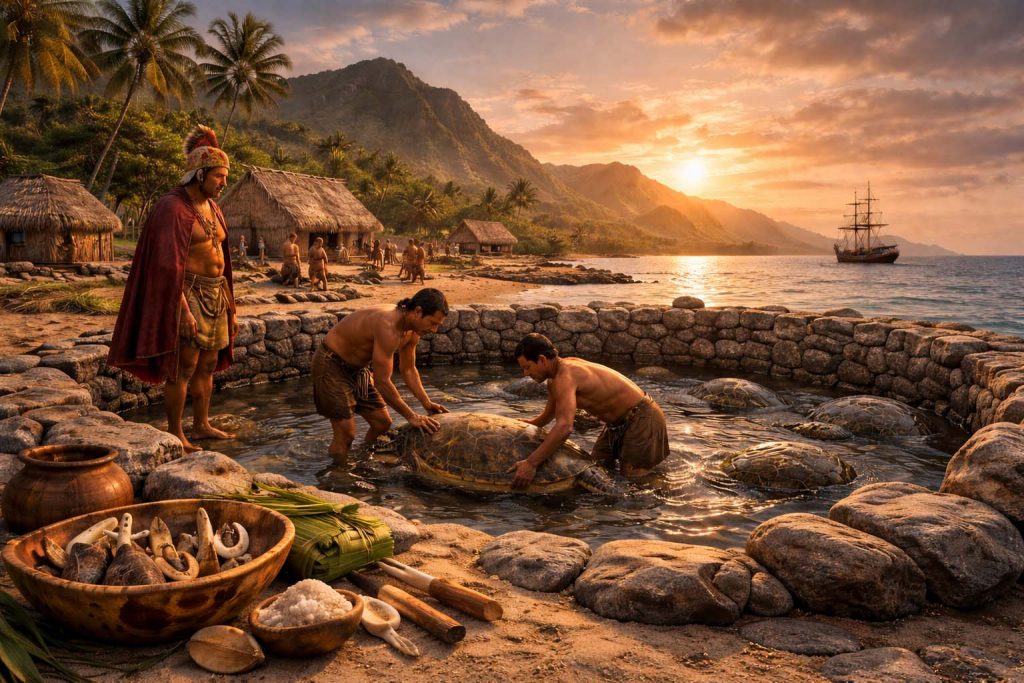
Sustainable Practices Like Pāhonu
Ancient Hawaiians even developed special methods to manage turtle resources.
One example was pāhonu, turtle enclosures used to raise turtles, often for chiefs. These enclosures allowed turtles to be kept and managed rather than taken freely from the wild.
This practice shows how resource management was already part of traditional knowledge. Sustainability was not a new concept. It was built into the culture.
Western Contact and Rapid Decline
Everything shifted after Western contact.
Demand for honu increased, especially for commercial purposes. Turtle meat and turtle soup became popular products for sale. Harvesting expanded far beyond traditional limits.
As a result:
- Commercial hunting increased
- Regulations tied to the kapu system disappeared
- Turtle populations dropped sharply
What had once been a carefully managed resource became heavily exploited. The balance was broken.
Federal Protection and Endangered Status
As numbers declined, action became necessary.
The green sea turtle was eventually listed under the Endangered Species Act, making it illegal to harvest them. These federal protections aimed to prevent extinction and allow the population to recover.
Over time, the protections worked. Honu populations began to rebound in Hawaiian waters.
A New Conversation: Cultural Harvest Today
With populations improving, discussion has returned to whether limited cultural harvest could be reinstated.
Supporters of cultural revival argue that:
- Traditional practices are part of Native Hawaiian identity
- Carefully regulated harvest could be sustainable
- Cultural knowledge should continue to be passed down
However, any proposal emphasizes strict limits.
Modern cultural harvest discussions include:
- Subsistence-only use, not commercial sale
- No egg collection
- Specific methods and locations
- Education and training requirements
- Clear population monitoring
The focus is on sustainability and cultural continuity, not profit.
Balancing Tradition and Conservation
The story of Hawaii’s traditional honu harvest is not simple. It includes reverence, loss, recovery, and debate.
In the past, the harvest was guided by strong cultural rules that maintained balance. Outside demand disrupted that system and nearly wiped out the species. Federal protection helped the turtles recover.
Now the challenge is finding a path that honors both cultural tradition and environmental responsibility.
Respecting the Past While Protecting the Future
The honu has always symbolized endurance. Its journey mirrors Hawaii’s own story. Careful stewardship once kept populations stable. Mismanagement led to steep decline. Protection brought hope.
As conversations continue, one idea remains clear: any future harvest must reflect the same respect and discipline that defined traditional Hawaiian practice.
The goal is not to return to the past exactly as it was. It is to move forward with wisdom, balance, and care.