The Leatherback Sea Turtle: The Gentle Giant You Will Never See in Hawaii
No Shell, No Limits: The Incredible Life of the Leatherback Sea Turtle
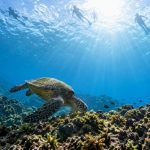
Most people picture a sea turtle as the kind you might encounter while snorkeling off Waikiki: smooth greenish shell, long graceful flippers, floating slowly over a bright coral reef in warm blue water. That is the Hawaiian green sea turtle, the honu, and it is one of the most beloved animals in the Pacific. But far from any reef, in the deep cold open ocean, there is another turtle entirely. The leatherback sea turtle shares the same ancient family tree as the honu, but in nearly every other way, it is a completely different animal. It is bigger, deeper diving, and stranger than most people ever imagine a sea turtle could be.
A Turtle With No Hard Shell
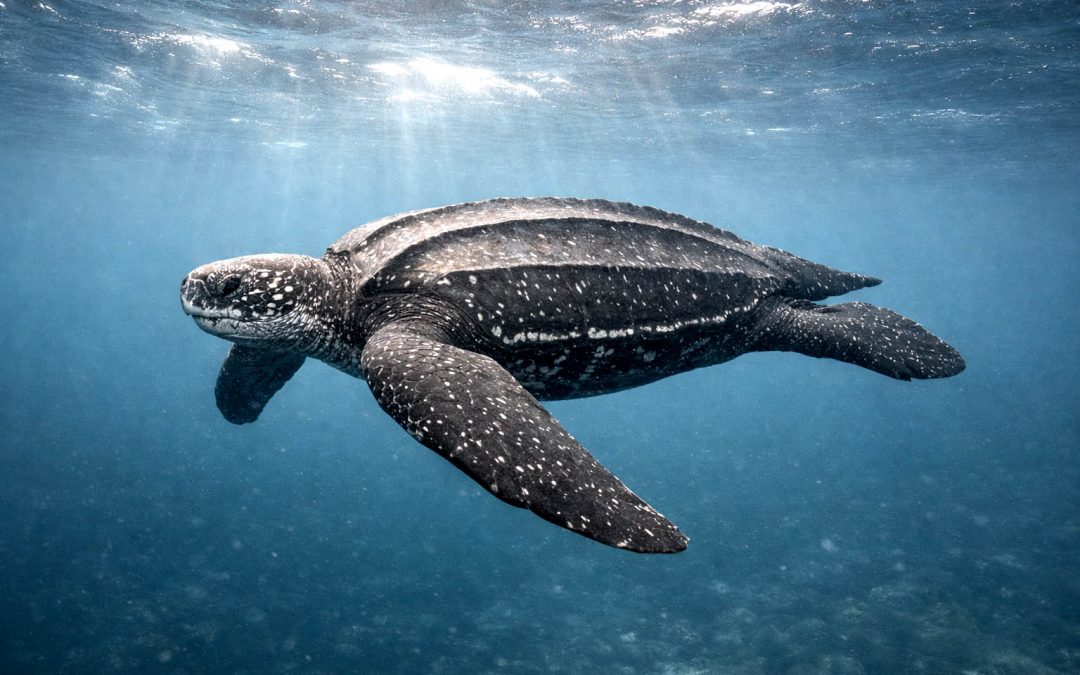
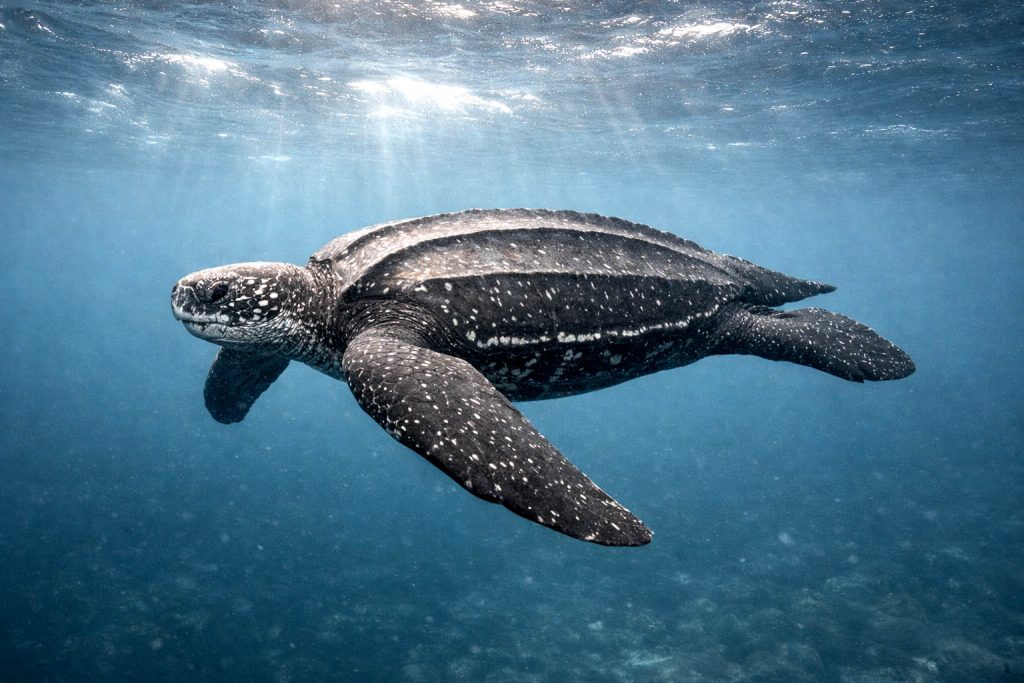
The first thing that sets the leatherback apart is right there in its name. Every other living sea turtle species has a hard bony shell called a carapace, a rigid structure fused to the spine and ribs. The leatherback has none of that. Instead of hard scutes, its back is covered with thick, flexible, rubbery skin that feels almost like a firm wetsuit material. Beneath that skin is a matrix of tiny bones embedded in cartilage, giving the shell structure without making it rigid. The surface has seven distinct raised ridges running from the neck down to the tail, which is where most of the leatherback’s distinctive silhouette comes from. That flexible body is not a weakness. It is actually one of the leatherback’s greatest advantages, allowing it to withstand the crushing pressure of deep dives in ways a rigid shell never could. The scientific name, Dermochelys coriacea, translates to leathery-skinned turtle, and the moment you see one, the name makes perfect sense.
The Numbers That Will Surprise You
Even people who have spent years around sea turtles are often caught off guard by how large a leatherback actually gets. A typical adult measures between five and six feet from head to tail and weighs somewhere between 550 and 1,500 pounds. The largest leatherback ever officially recorded came in at just over 2,000 pounds, roughly the weight of a small car. For comparison, a full-grown Hawaiian green sea turtle, which is by no means a small animal, usually tops out around 300 to 400 pounds. The leatherback’s front flippers are equally impressive. On a large adult, the span from one flipper tip to the other can reach nearly nine feet, which gives the animal an almost wing-like silhouette as it moves through open water. These are creatures that need to be seen in person to be fully believed.
Built for the Deep
No other sea turtle on Earth comes close to the leatherback when it comes to deep diving. Hawaiian green sea turtles graze on algae and seagrass in shallow reef environments and rarely need to dive more than a few dozen feet. Leatherbacks regularly descend to depths of 3,000 feet or more in pursuit of jellyfish, and the deepest recorded dive for a leatherback reached over 4,200 feet. That is deeper than the average dive of most research submarines on a routine mission. To reach those depths safely, the leatherback has evolved a set of physical adaptations that other turtles simply do not have. Its flexible body compresses under pressure rather than being crushed by it. Its lungs collapse safely during deep dives, and oxygen is stored in the blood and muscles rather than the airways, the same strategy used by deep-diving whales. Its heart rate drops dramatically to stretch every bit of available oxygen across a long dive. A leatherback can remain submerged for up to 85 minutes, though most dives are much shorter than that.
A Diet Built Around One Strange Food
If you had to describe the leatherback’s diet in one word, that word would be jellyfish. While green sea turtles graze on algae, seagrass, and occasional sponges across warm tropical reefs, leatherbacks spend their lives hunting jellyfish, salps, and other soft-bodied creatures drifting in open water. The challenge with surviving on jellyfish is that they are mostly water and deliver very little nutrition per mouthful. Leatherbacks compensate by eating enormous quantities, sometimes consuming close to their own body weight in jellyfish every single day. Their mouths and esophaguses are lined with hundreds of sharp, backward-facing spines called papillae that work perfectly for trapping and swallowing something as slippery as a jellyfish. Once something goes down a leatherback’s throat, it is not coming back out. This unusual diet also means leatherbacks have to go where the jellyfish are, which is why they spend so much time in cold, nutrient-rich ocean currents far from any tropical reef.
The Longest Ocean Crossings on Earth
Leatherbacks are extraordinary travelers, and their migrations put almost every other animal on Earth to shame. Some Pacific leatherback populations nest on beaches in Papua New Guinea and Indonesia and then migrate thousands of miles to cold feeding waters off the coasts of California, Oregon, Washington, and Canada. A leatherback fitted with a satellite tag was once tracked traveling from Papua New Guinea to the waters off Oregon, covering more than 12,000 miles in under two years. Atlantic leatherbacks nesting in the Caribbean and along the northeast coast of South America have been followed across the open Atlantic to feeding grounds off the coasts of Portugal, Spain, and West Africa. These are not random wandering routes. Leatherbacks navigate using Earth’s magnetic field with remarkable precision, finding the same productive feeding areas year after year. They are built for sustained open-ocean travel in a way that reef-dependent species simply are not.
Where Leatherbacks Nest Around the World
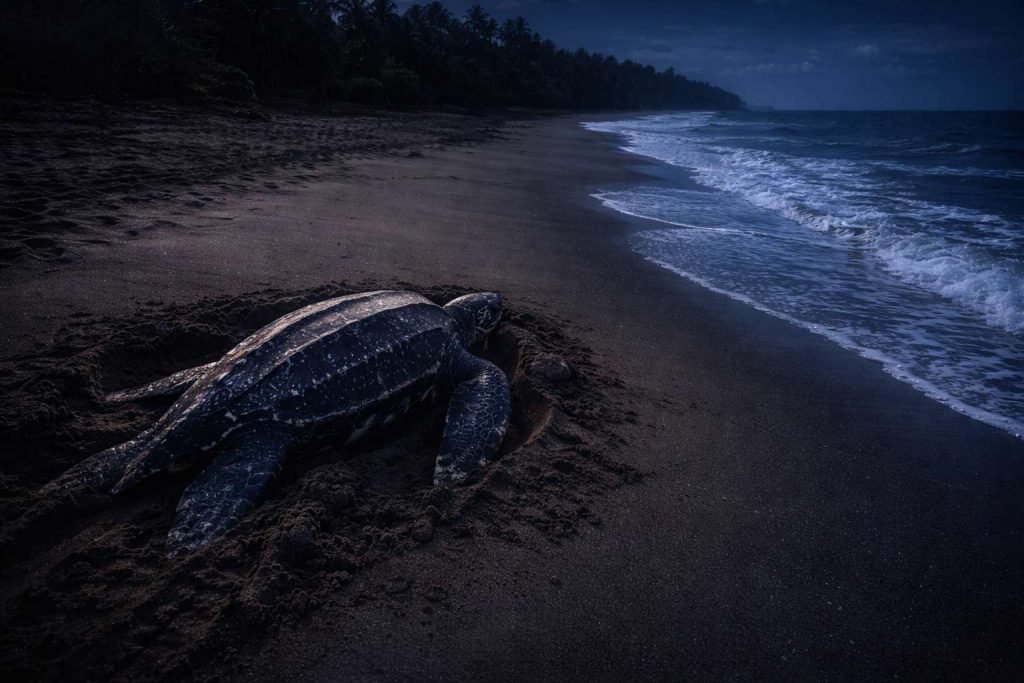
Leatherbacks do not have the wide distribution of nesting beaches that green sea turtles do. Their nesting is concentrated on a smaller number of locations, typically in or near the tropics, even though their feeding grounds are often in cold ocean waters far away. Some of the most important leatherback nesting beaches in the world include:
- Trinidad in the Caribbean, which hosts one of the largest Atlantic leatherback nesting populations
- Playa Grande in Costa Rica, protected within the Las Baulas National Marine Park on the Pacific coast
- The beaches of French Guiana and Suriname on South America’s northeast coast
- Gabon in West Africa, home to one of the largest leatherback nesting aggregations on Earth
- Remote beaches in Papua New Guinea, the Solomon Islands, and Indonesia in the Pacific
Female leatherbacks nest at night, digging nests significantly deeper than green sea turtles because of their enormous size. A single female typically lays multiple clutches of 60 to 100 eggs in a nesting season before returning to the open ocean, and females do not return to nest every single year.
The Pacific Leatherback Is in Serious Trouble
The Pacific leatherback population is one of the most urgent conservation stories in the ocean right now. Researchers estimated there were around 90,000 nesting females across Pacific beaches in the 1980s. By the early 2000s, surveys suggested that number had fallen to somewhere between 2,000 and 5,000. That kind of collapse within a single generation is almost without parallel among large marine animals. The primary driver is bycatch, the accidental capture of leatherbacks in commercial fishing gear like longline hooks and gillnets. Leatherbacks are air-breathing animals, and entanglement in fishing lines can be fatal within minutes if they cannot surface. Egg poaching on nesting beaches has also accelerated the decline in some regions. Plastic pollution adds another serious layer of danger, because a floating plastic bag looks almost identical to a jellyfish when viewed from below the surface, and ingesting plastic causes blockages that are often fatal. The Atlantic population of leatherbacks is in somewhat better condition but is still listed as vulnerable. International conservation programs have made real gains at some Caribbean and West African nesting beaches, but the Pacific leatherback remains critically endangered.
Why There Are No Leatherbacks at Turtle Canyon
If you have ever snorkeled at Turtle Canyon off Waikiki and wondered whether a leatherback might ever show up, the honest answer is almost certainly not. Leatherbacks occasionally pass through Hawaiian waters during long-distance migrations, but they do not live here, feed here, or nest here. Hawaii does not offer what leatherbacks need. There are no dense jellyfish blooms for them to hunt, and the warm, shallow reef environment is the opposite of the cold, deep open ocean they prefer. Leatherbacks are capable of regulating their body temperature better than most reptiles, but they are built for cold productive water and sustained deep dives, not for cruising a shallow tropical reef at 80 degrees. The Hawaiian honu has spent millions of years evolving to thrive in exactly the kind of environment Turtle Canyon provides. The leatherback has spent those same millions of years evolving for a completely different ocean, one that most people will never experience firsthand.
Green Sea Turtle vs. Leatherback: Two Different Worlds
Placing both animals side by side makes the contrast impossible to miss. They share an ancient lineage and both face serious pressure from human activity, but the similarities largely end there.
- Green sea turtle: hard bony shell, up to 400 pounds, eats algae and seagrass, lives on shallow tropical reefs, nests in Hawaii
- Leatherback: flexible rubbery skin, up to 2,000 pounds, eats almost exclusively jellyfish, lives in cold deep open ocean, does not nest in Hawaii
- Green sea turtle typical dive depth: under 100 feet
- Leatherback typical dive depth: regularly over 3,000 feet, record over 4,200 feet
- Green sea turtle migration: regional, following reef systems and nesting beaches in the Pacific
- Leatherback migration: transoceanic, up to 12,000 miles in a single round trip
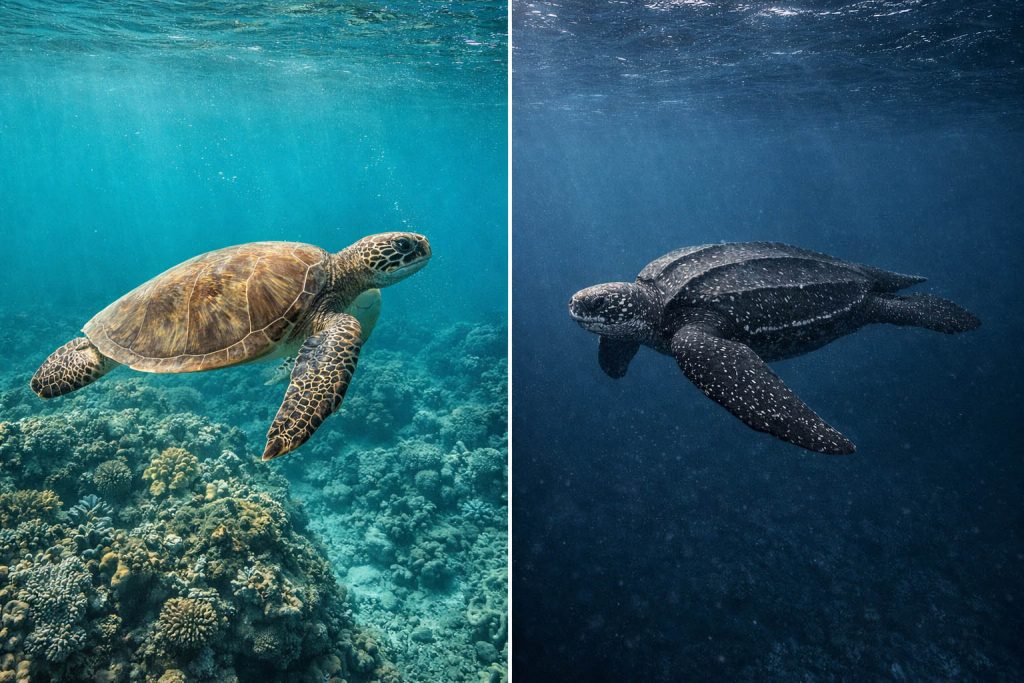
When you drift above the reef at Turtle Canyon and a honu glides past just a few feet below you, you are watching one version of what a sea turtle can be. The leatherback is the other version, somewhere out in the open ocean, deep and cold and entirely on its own terms.
The Ocean Is Big Enough for Both: A Closing Thought
The story of the leatherback sea turtle is a reminder that the ocean holds more variety than most of us ever get to see. Two animals can share the same ancient family tree and end up in completely different worlds, one grazing a sunlit reef, the other hunting jellyfish in the cold dark deep. Hawaii’s honu has made the warm, shallow reef its home for millions of years. The leatherback chose the open sea. Both are extraordinary. Both are worth protecting. And while a snorkel trip to Turtle Canyon is far more likely to bring you face to face with a green sea turtle than a leatherback, knowing that the ocean also holds something as improbable as a 2,000-pound jellyfish-eating giant diving 4,000 feet below the surface makes the whole ocean feel a little bigger and a little more worth caring about.